

Perforated roller shutters let people see into your shop after closing while still putting a metal curtain between your stock and the street. They are one of three common lath choices for shopfront shutters, alongside solid laths and punched laths, with open grilles as a fourth option. Each one balances visibility, privacy, weather protection and planning differently, and the right choice depends on what you sell, where you trade and what your insurer and council expect. This guide compares them honestly, including the drawbacks that sales brochures tend to skip.
We are Sunrise Shopfronts & Shutters. We make solid, punched and perforated shutters in our own West Midlands workshop, built to the surveyed size of each opening, and fit them for shops, takeaways, salons and showrooms across Birmingham, the West Midlands and the UK.

Key takeaways
- Perforated laths have many small holes; punched laths have larger slots and give a clearer view. Open grilles give the clearest view of all.
- You only see through them with light behind the curtain. Plan display lighting on a timer.
- Planning is the big variable. External shutters commonly need permission, and some councils treat small perforations much like solid laths.
- Security depends on the whole system (lath thickness, guides, locking, fixings), not just whether the lath has holes.
- Solid laths still win for privacy, weather protection, insulation and high-risk stock.
In this guide
- Solid, perforated, punched and grille: what is the difference?
- Why see-through shutters are popular
- The trade-offs
- What goes into a perforated shutter specification
- When solid laths are the right answer
- Punched laths, vision panels and mixed curtains
- Internal shutters and shopping centre units
- Planning permission and council design guides
- Security and insurance
- Which curtain suits your business?
- Getting the most from a see-through shutter
- Common mistakes to avoid
- Six checks before you order
- Upgrading an existing solid shutter
- What happens at the survey
- Cleaning and maintenance
- Frequently asked questions
Solid, perforated, punched and grille: what is the difference?
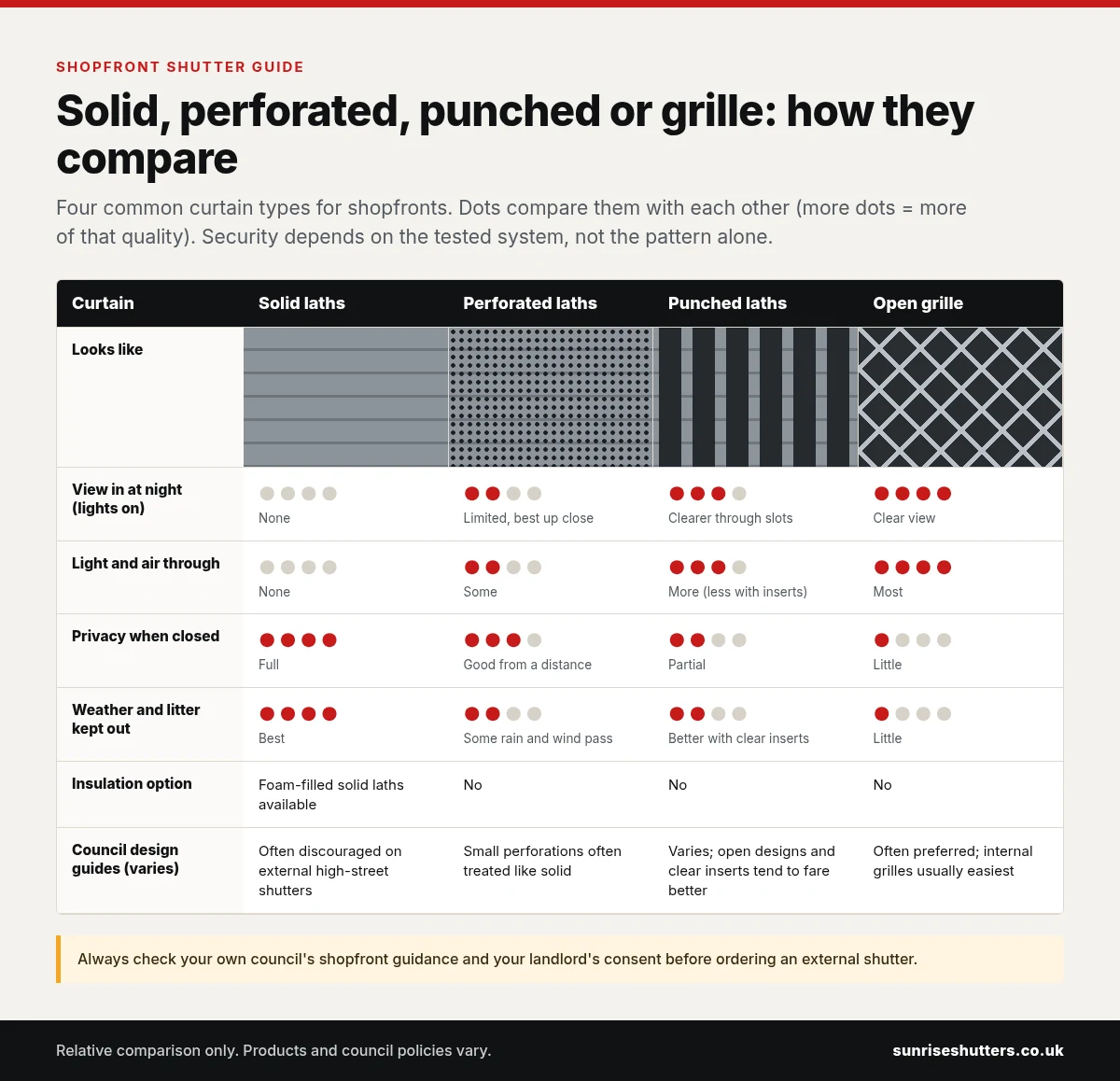
| Curtain | What it is | Best at | Main drawback |
|---|---|---|---|
| Solid laths | Interlocking laths with no openings | Privacy, weather protection, insulation (if foam filled), a strong visual deterrent | A blank frontage after closing; often discouraged on external high-street shutters |
| Perforated laths | Laths with many small holes punched through | Some view in at night, some light and air, keeps a fairly solid look | View is limited; some councils treat small perforations much like solid |
| Punched laths | Laths with larger slots, often in a regular pattern | A clearer view in, a more designed look; some take clear polycarbonate inserts | Less privacy; more rain and litter can pass without inserts |
| Open grille | A lattice or link grille rather than laths | The clearest view and the most open look; often preferred by councils | Little weather protection or privacy; security depends heavily on design |
If you are weighing up a grille rather than a shutter, our earlier guide to security grilles vs solid shop shutters goes into that choice in detail, and our security grilles page shows the collapsible grilles we make.
Why see-through shutters are popular on high streets
Your window display keeps working after closing
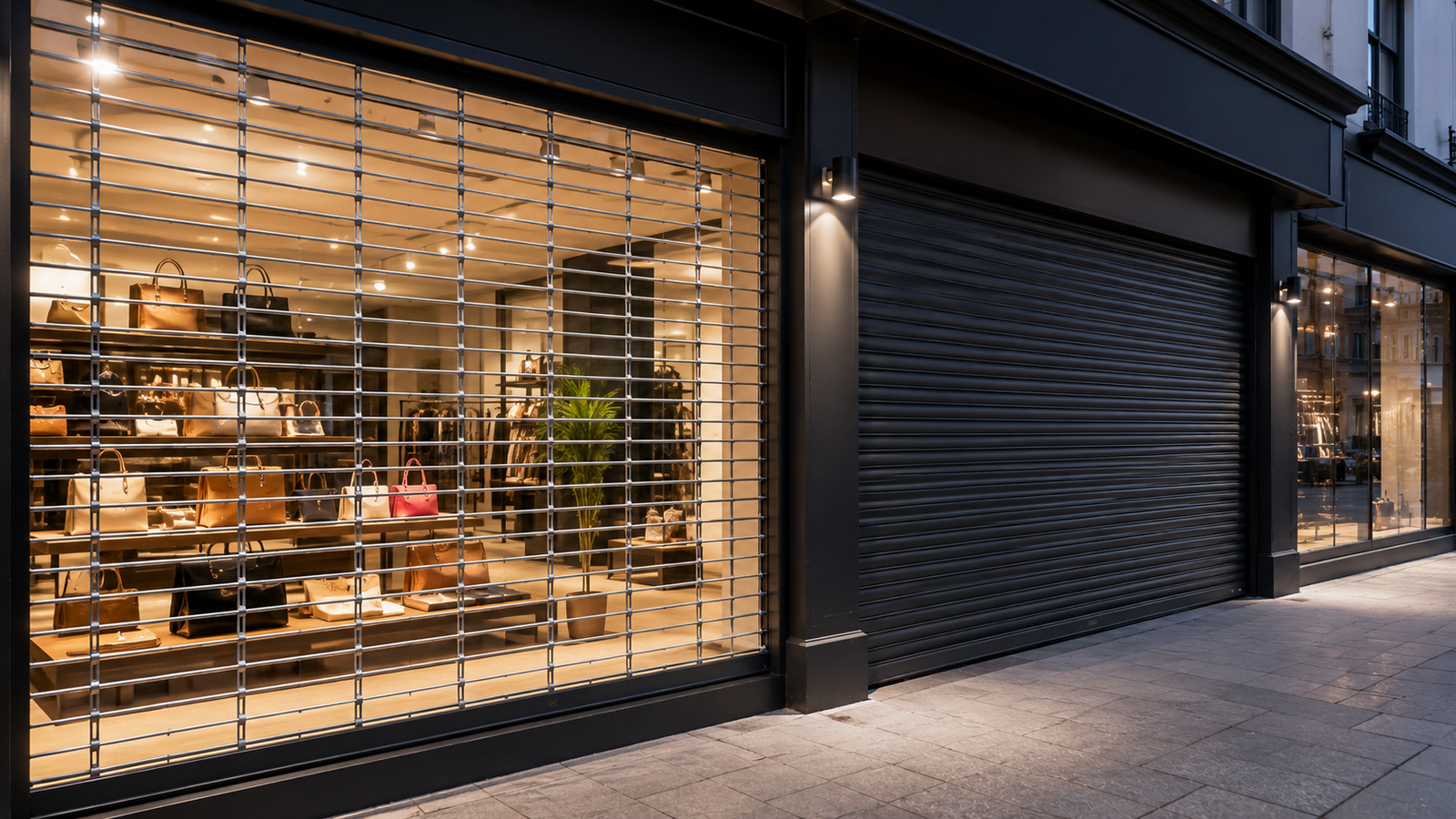
A shop window is advertising. With a solid shutter down, the street sees a blank sheet of metal from closing time until the next morning. With perforated or punched laths and some lighting left on inside, people walking past in the evening can still see what you sell. That matters for fashion, gifts, phone shops, showrooms, cafés and any business that relies on window shopping.
The street feels safer and more welcoming
Rows of closed solid shutters can make a high street feel dead at night. Councils are well aware of this. Dudley Council’s planning advice for businesses, for example, says external shutters that are solid or have small perforations allow no or limited views into the shop and create an uninviting “dead” frontage, and lists alternatives such as internal grilles and laminated glass.
Light and air can pass through
Perforations and slots let some air and daylight through when the shutter is down. That can help in premises that need some airflow when closed, but it is not a substitute for designed ventilation.
Passing patrols can see inside
Being able to see into the premises can help a police patrol, security guard or keyholder spot that something is wrong. Behind a solid shutter, a break-in through the back can go unnoticed from the street for longer.

The trade-offs of perforated and punched shutters
| Issue | What to expect | How to manage it |
|---|---|---|
| Security | Removing metal can reduce a lath’s strength slightly compared with a solid lath of the same profile | Choose lath thickness, guides and locking for the risk; ask for a tested product if your insurer requires it |
| Privacy | Perforated laths reveal more than many people expect once lights are on inside | Use solid laths, or a solid lower band, where privacy matters |
| Weather | Rain and wind pass through; the glass behind must still be weathertight | Punched laths with clear polycarbonate inserts keep out more rain and litter |
| Dirt | Holes and slots collect dust and grime on busy roads | A periodic clean keeps the view clear and the shutter looking smart |
| Insulation | Perforated and punched laths provide no meaningful insulation | Choose a solid foam-filled lath where insulation matters |
| Planning | Small perforations may be treated much like a solid shutter | Check your council’s shopfront guidance before choosing |
If insulation is a priority, for example on a workshop or a garage, read insulated roller shutters: are they worth it?.
What goes into a perforated shutter specification
“Perforated shutter” describes the curtain, not the whole product. When you compare quotes, these are the parts that decide how the shutter looks, performs and lasts:
The lath profile and metal
Perforated laths are usually roll-formed from steel or aluminium strip, with the holes punched before the lath is formed. The gauge (thickness) of the metal and the depth of the profile affect how stiff the curtain is across the opening and how well it resists being pushed in or levered out of the guides. Wider shopfronts need a stiffer curtain, and sometimes a removable centre post, to stay secure.
The hole pattern
Hole size and spacing set the balance between visibility and privacy. Small, close-set holes keep a more solid look from the street but limit the view in. A solid band at the top and bottom of each lath, where the laths interlock, keeps the joints strong. If visibility is the main reason for choosing the shutter, ask to see a sample or a photo of the same product installed at night.
The guides, bottom rail and locking
The guides hold the edges of the curtain. Deeper guides with good fixings make it much harder to pull the curtain out at the sides. The bottom rail takes most of the abuse at ground level, and how it locks, whether by manual locks or by the motor and the weight of the curtain, matters to security. These parts count as much as the lath itself.
The finish
Perforated shutters can be supplied plain galvanised or powder coated in a chosen colour. A coloured finish usually looks far better on a high street, can help a planning application, and a darker colour tends to make it easier to see through at night.
Operation and controls
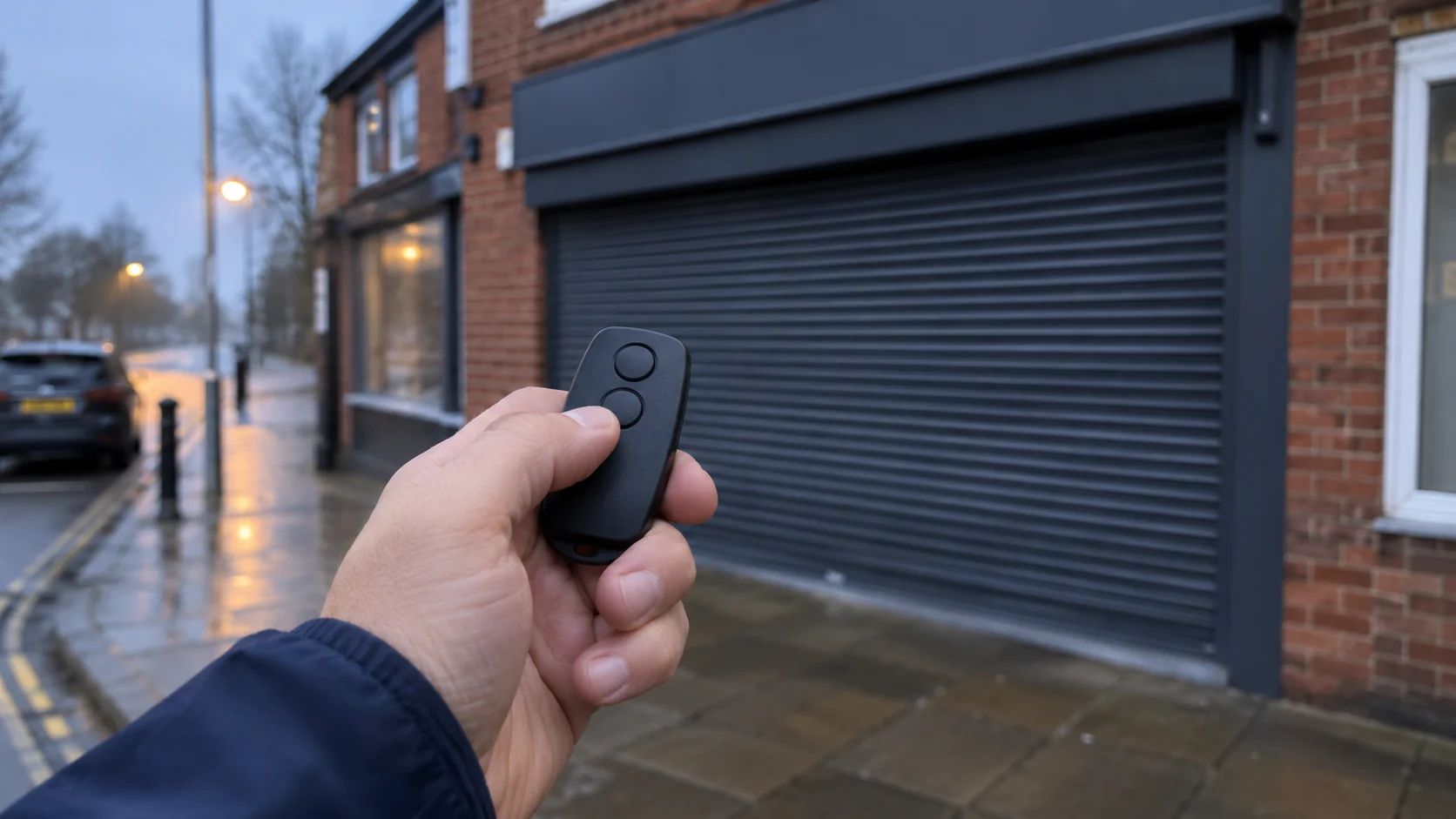
Smaller shutters can be manual or spring-assisted. Larger shopfront shutters are usually electric, with a tubular motor in the barrel or a motor mounted at the side, operated by a key switch, push button or remote. Electric shutters should have safety devices appropriate to how and where they are used.
When solid laths are the right answer
Solid shutters are not just for warehouses. They make good sense when:
- the shop holds high-value or easily resold stock, such as tobacco, alcohol, phones or tools;
- the premises, or neighbouring units, have a history of break-ins or ram raids;
- you need privacy when closed, for example a pharmacy store room or cash office;
- the opening faces strong weather and you want an extra barrier against wind and rain;
- your insurer requires a security level that a solid product meets.
A solid shutter can still look good. A coloured finish matched to your brand or the building makes a big difference compared with plain galvanised steel, and the shutter box can often sit behind the fascia rather than on the face of the building.

Punched laths, vision panels and mixed curtains
Punched laths sit between perforated laths and grilles. The slots are larger, so the view through is clearer, and the regular pattern gives the shutter a more designed look. Some punched profiles can take clear polycarbonate inserts, which keep out rain and litter while preserving much of the view. These are popular on shopping centre units, showrooms and food outlets.
Another option is a mostly solid curtain with a band of perforated or vision laths at eye level. The lower part stays strong and private while passers-by can still see in through the upper section. It is worth asking about if you cannot decide. The metal matters too: our guide to steel vs aluminium roller shutters explains how each behaves.

Not sure which shutter suits your opening?
We survey the opening, agree the specification with you and make the shutter in our own West Midlands workshop. Call our installation and service line or send us the details.
Internal shutters and shopping centre units
Not every shutter has to go on the outside of the building. In many high streets, fitting the shutter or grille behind the glass is the simplest route:
- Internal shutters and grilles leave the frontage unchanged, which is why councils are generally more relaxed about them. They also protect the stock from someone who has broken the glass.
- The trade-off is that the glass itself is not protected, so it can still be smashed or damaged. Laminated glass in the frontage helps here.
- Space is the other question. An internal shutter needs room behind the glass for the box and guides, and the display has to sit behind the shutter line.
In covered shopping centres and arcades, units commonly use punched, perforated or grille shutters at the mall frontage, because the centre wants to look open and inviting after hours. Centre management usually has its own design rules, so check them before ordering anything.
Planning permission and council design guides
This is where many shopfront shutter projects run into trouble, so it is worth understanding before you choose a curtain.
- External shutters commonly need planning permission, because they change the appearance of the building. Dudley Council, for example, states that permission is required for security shutters on the outside of a shopfront, whether new or a replacement.
- Internal shutters and grilles behind the glass are much less likely to need permission, although listed buildings and conservation areas can still need consent.
- Councils publish shopfront design guidance, and preferences vary. Common themes are open or lattice designs rather than solid laths, shutter boxes hidden behind the fascia, guides set into the frame and coloured rather than plain galvanised finishes.
- Some councils go further. Some will not normally accept solid or small-perforation external shutters at all, while others ask applicants to justify external security, for example with a crime impact statement.
- Your lease matters too. Most commercial leases require landlord consent for changes to the frontage.
Our guide to planning permission for roller shutters explains how councils and landlords usually look at shutters and what to prepare.

Security and insurance
A perforated lath has slightly less metal than a solid lath of the same profile. But the security of a shopfront shutter depends far more on the whole system: lath thickness, the depth and fixing of the guides, end locks, the bottom rail and how it locks, and how the shutter is fixed to the building. Some perforated and punched shutters are independently tested to security standards.
If your insurer asks for a specific rating, check the certificate covers the exact product, size and components you are being offered. Our guide to roller shutter security ratings explains the main schemes and what to ask for. Shutters also protect the glass behind them; for more on reducing damage risk, see how to reduce shopfront vandalism and impact damage, and our upcoming guide to shop front glass: toughened vs laminated.
★★★★★
“We’re really happy with the service from Sunrise Shopfronts! They always do a fantastic job and fixed our shutter very quickly. Their service is reliable, efficient, and professional. We really appreciate their quick response and excellent workmanship. Highly recommend Sunrise Shopfronts to anyone looking for a reliable and trustworthy service!”
Paramjot Dhaliwal, Google review
Which curtain suits your business?
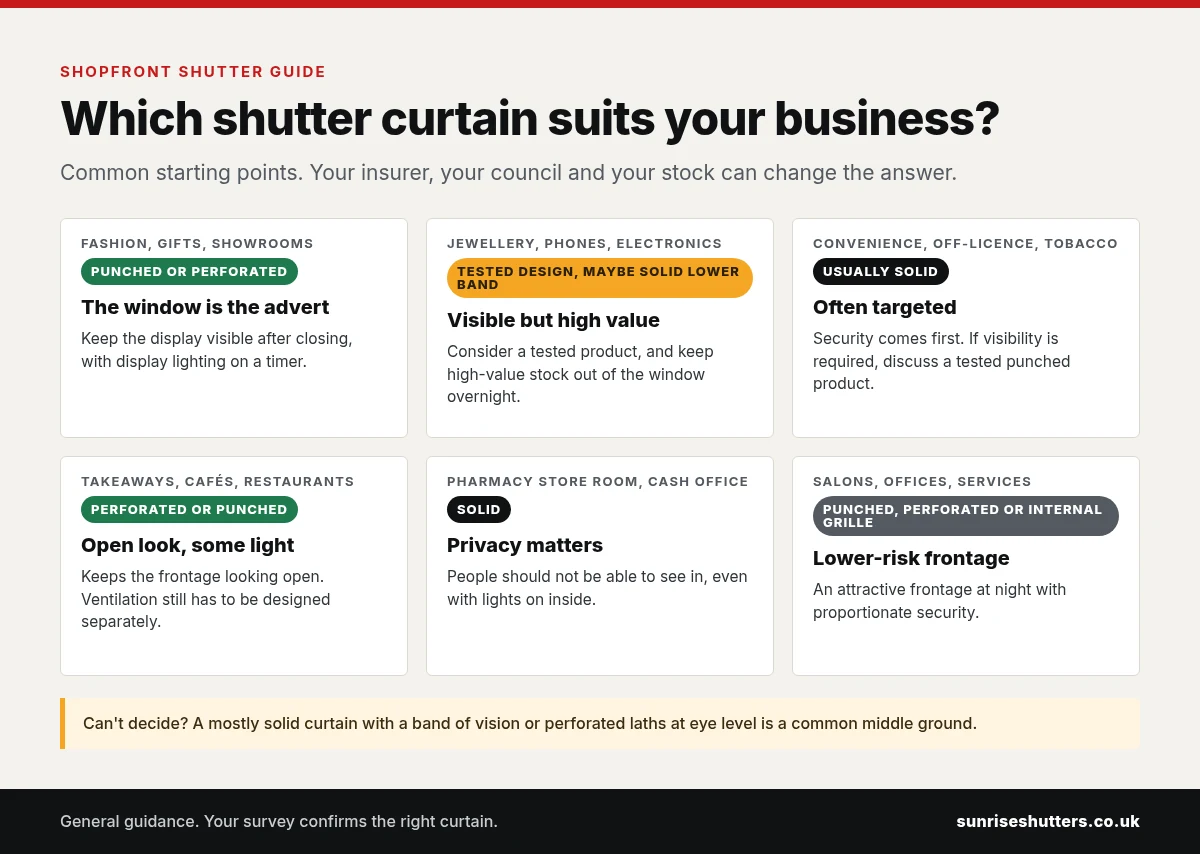
Fashion, gifts and showrooms
Perforated or punched laths, with display lighting on a timer, keep the window working after hours. The display is the point, so plan the lighting with the shutter.
Jewellery, phones and electronics
Visibility helps sales, but the stock is high value. A tested product, a solid lower band, or keeping valuable stock out of the window overnight are all sensible options.
Convenience stores, off-licences and tobacconists
These businesses are often targeted, so solid shutters are common. If the council or landlord insists on visibility, discuss a tested punched product or a mixed curtain.
Takeaways, cafés and restaurants
Perforated or punched laths keep the frontage looking open and let some light through. Extract and ventilation requirements still have to be met separately.
Salons, offices and professional services
Punched or perforated shutters, or internal grilles, often suit these lower-risk premises and keep the frontage attractive at night.
Getting the most from a see-through shutter
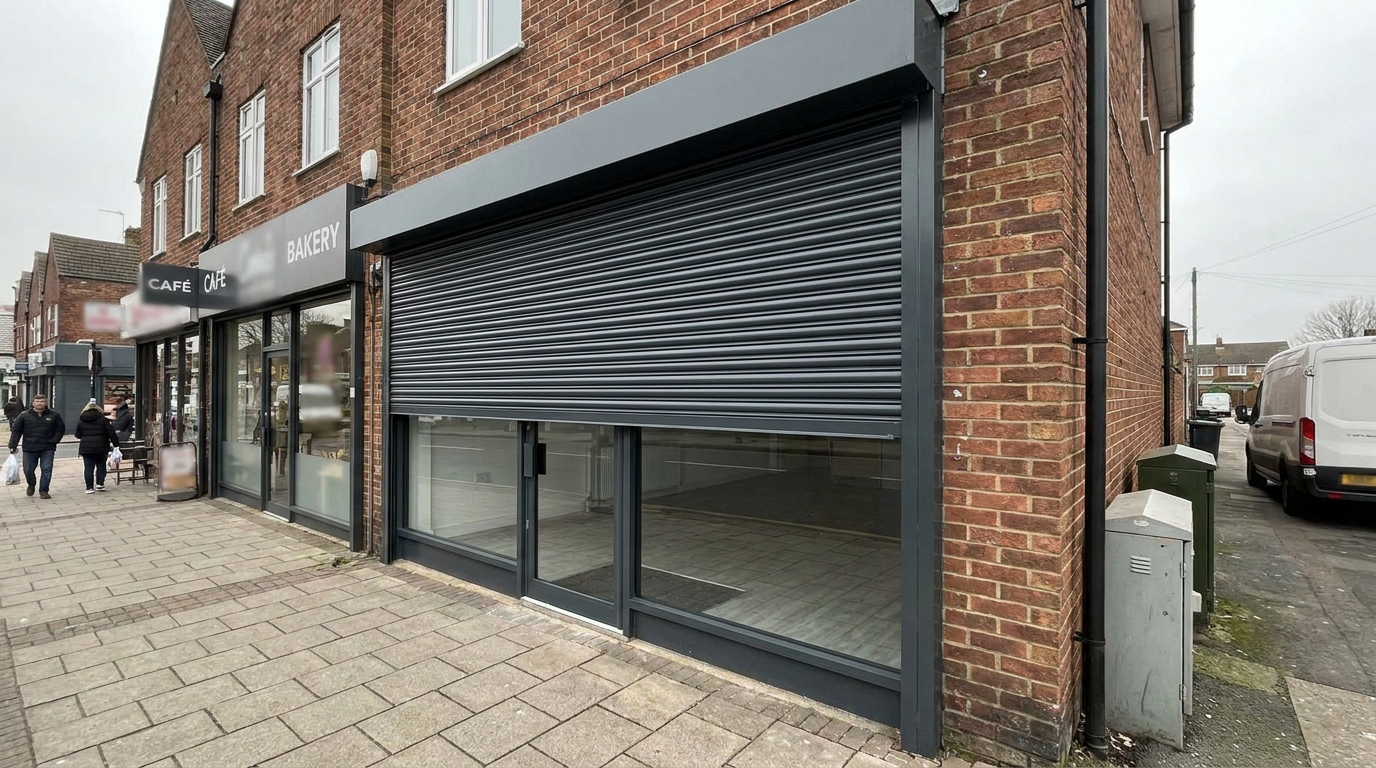
A perforated or punched shutter is only as effective as the display behind it:
- Light the display, not the whole shop. Low-energy lighting on a timer, aimed at the window, shows products through the shutter without lighting empty floor space all night.
- Keep the display close to the glass. Products a metre or two back are much harder to see through perforations than items right behind the window.
- Consider a darker finish. Dark laths reflect less street lighting back at the viewer, so they tend to be easier to see through at night than bright, reflective ones.
- Keep valuables out of sight. If people can see in, take high-value stock out of the window overnight.
- Keep it clean. Grime in the perforations makes the view murkier over time.
Common mistakes to avoid
- Ordering before checking planning. An external shutter fitted without permission can lead to enforcement action and a shutter that has to come down.
- Choosing perforations for visibility without planning the lighting. In a dark shop, a perforated shutter looks almost solid.
- Choosing visibility when the stock needs security. A great window display is no use if it tempts a break-in. Match the curtain to the risk.
- Forgetting the insurer. If a policy requires a rated product, a cheaper untested shutter can cause problems if you ever need to claim.
- Ignoring the box. A shutter box bolted to the face of a smart frontage can spoil it. Plan where the box will sit from the start.
- Comparing quotes on price alone. Two “perforated shutters” can differ in gauge, guides, locking, motor and finish. Compare like with like.
Six checks before you order
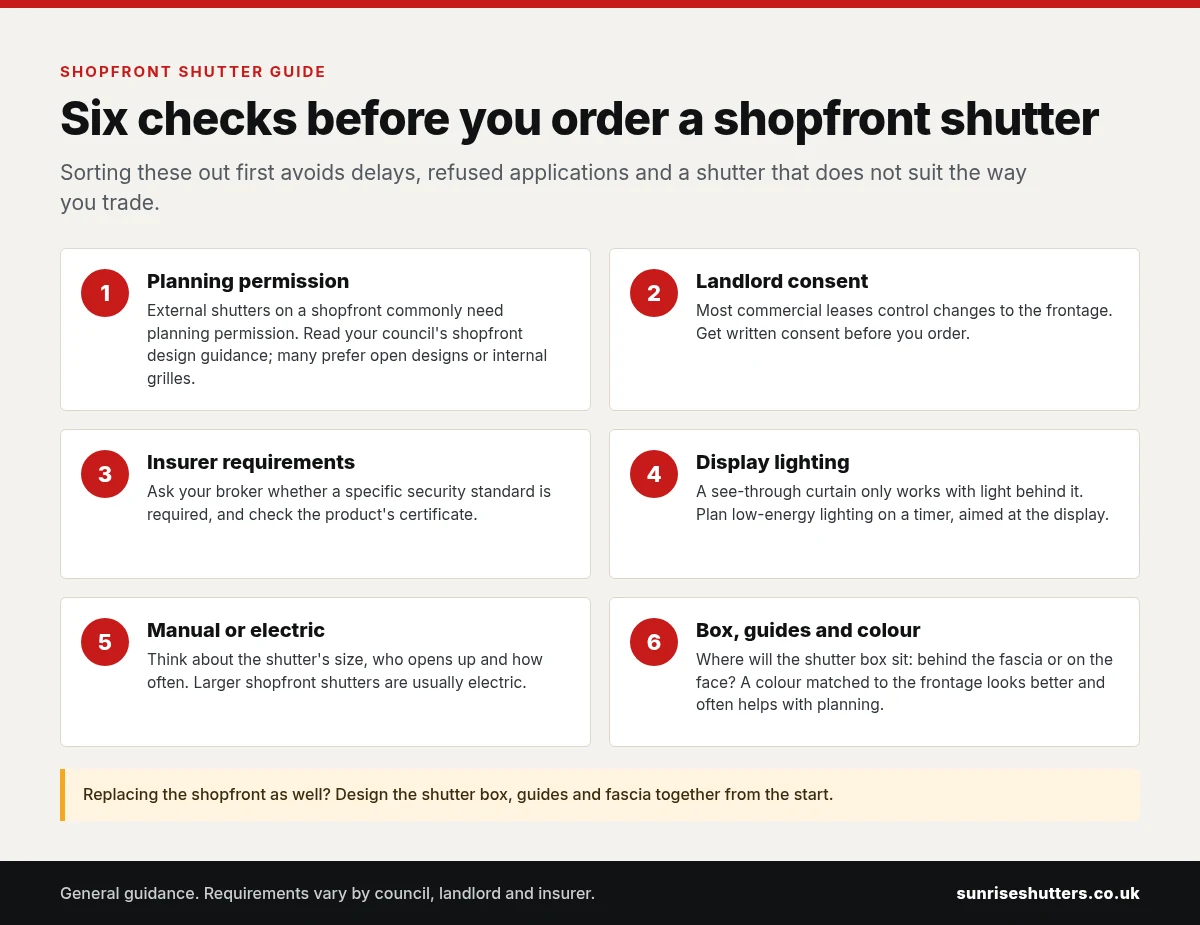
Larger shopfront shutters are usually electric; our guide to manual vs electric roller shutters explains the choice. If you are replacing the whole frontage, design the shutter with it: our shopfronts page explains how we approach this, and our guide to signs it is time to modernise your shop entrance may help. For budgeting, see roller shutter installation cost and our upcoming guide to aluminium shop front cost.

Upgrading an existing solid shutter
Many shop owners already have a solid shutter and wonder whether to switch to a see-through one, often after a refit, a change of business or a nudge from the council or landlord. There are three broad routes:
- Replace only the curtain. This can work when the existing barrel, box, guides and motor are in good condition and suit the new laths. Perforated laths of a different profile or weight may not fit the old guides or suit the old motor and springs, so this needs checking at a survey.
- Replace the whole shutter. Often the better option when the existing shutter is old, noisy, damaged or poorly fitted, or when the box position spoils the frontage. A new shutter can be built for the opening and designed to suit the street.
- Move the security inside. Remove the external shutter, fit laminated glass and add an internal grille. This route can suit conservation areas and councils that resist external shutters.
If you change an external shutter, check whether the change needs planning permission and whether existing planning conditions apply. Removing the old shutter box can also leave marks on the fascia that need making good, so allow for this in the plan.
How a perforated shutter looks by day and by night
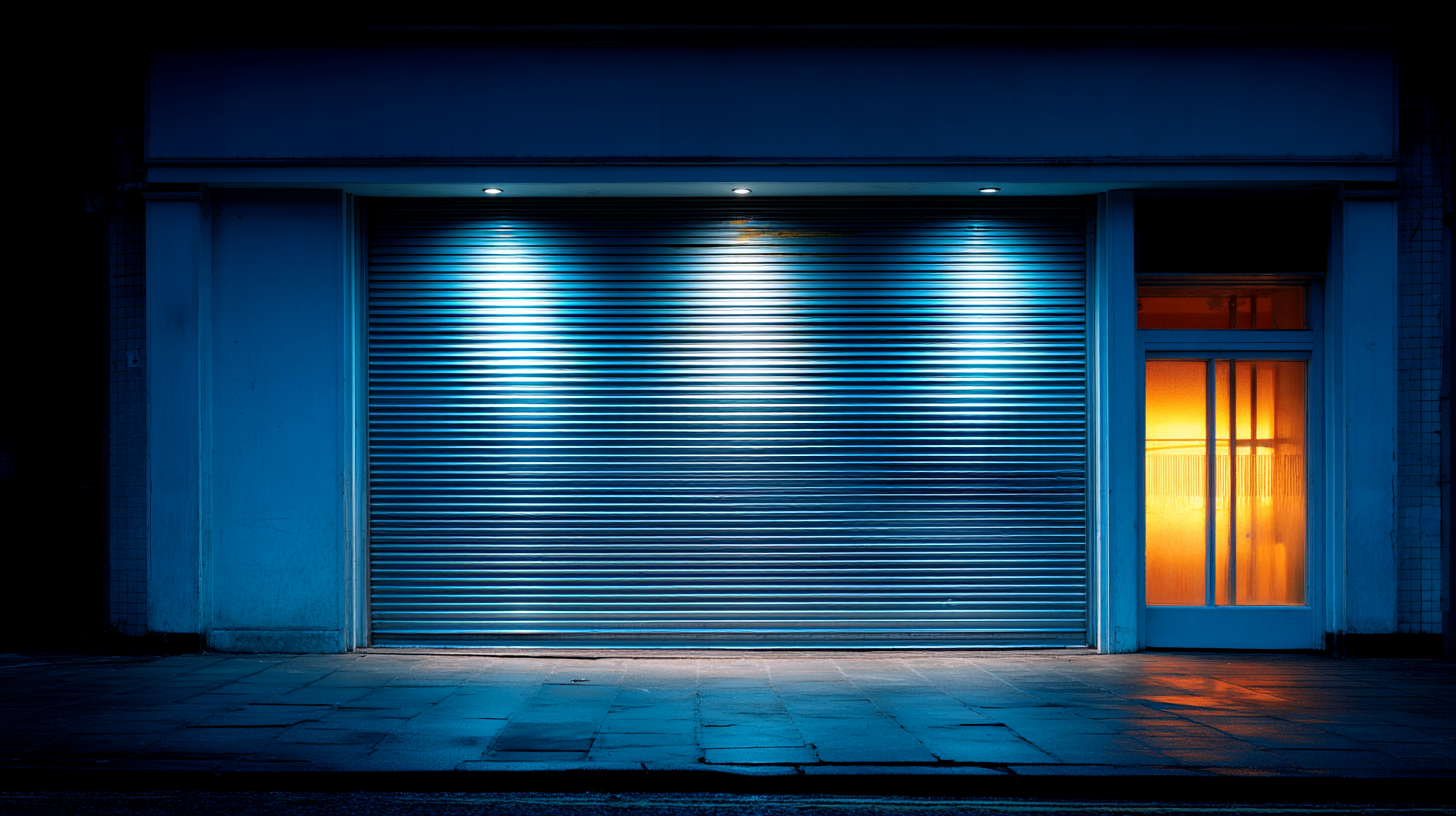
It is worth knowing what to expect before you decide. In daylight, with the shop interior darker than the street, a perforated shutter usually looks quite solid from more than a few metres away. After dark, with lights on inside, the effect reverses and the display becomes visible through the curtain. Punched laths and grilles show the inside more clearly in both conditions. If you can, look at a similar shutter on a nearby street at night before choosing.
What happens at the survey
When we survey a shopfront for a new shutter, we measure the opening and the space for the shutter box and guides, look at the fascia and any signage, and check how the shutter will be fixed to the building. We also ask how the shop trades: opening times, who opens up, whether there is an alarm, what is displayed in the window and what your insurer has asked for. That conversation usually decides between solid, perforated and punched laths, whether the shutter should be manual or electric, and which finish will suit the street.
★★★★★
“Great company! The chap who came out to do the quote was really knowledgeable and helped guide us towards the right solution for our premises. Once we’d decided to go ahead, three lads turned up literally a week later and got everything fitted. Really happy with the whole service from start to finish. Would definitely recommend!”
Natalie Clayton, Google review
To make the survey quicker, have these ready:
- ☐ Photos of the frontage, including the fascia and any existing shutter
- ☐ Approximate opening sizes
- ☐ Your trading hours and who opens and closes
- ☐ Any insurer requirement for a security rating
- ☐ Planning or landlord feedback you already have
- ☐ What you want people to see after closing
Cleaning and maintenance
Shopfront shutters run at least twice a day, every day, so they deserve a little care:
- Clean the curtain periodically, especially perforated and punched laths on busy roads.
- Keep the guides free of litter and grit, and the area under the shutter clear.
- Check clear inserts in punched laths for damage and clean them gently.
- Report new noises, uneven travel or a shutter that catches, and book planned servicing.
★★★★★
“Very quick and a great job”
strikefx uk, Google review
We make shopfront shutters for businesses across Birmingham, Sutton Coldfield, Dudley and the wider region, and install across the UK. See our roller shutters page for the full range.
Frequently asked questions
Can people see through perforated roller shutters?
Yes, especially when there is light behind the shutter and it is darker outside. From a distance in daylight they can look fairly solid; up close, or at night with display lighting on, you can see into the shop.
Are perforated shutters less secure than solid shutters?
Like for like, a perforated lath has slightly less metal. Overall security depends far more on lath thickness, guides, locking and fixing, and some perforated products are independently tested. Check the certificate if security is a priority.
Do I need planning permission for a perforated shutter?
External shutters commonly need planning permission whether they are solid or perforated, and some councils treat small perforations much like solid laths. Internal grilles are less likely to need permission. Check with your council and landlord before ordering.
What is the difference between perforated and punched laths?
Perforated laths have many small holes. Punched laths have larger slots, often in a regular pattern, and give a clearer view. Some punched designs take clear polycarbonate inserts.
Can I replace a solid shutter curtain with a perforated one?
Sometimes. It depends on whether the existing guides, barrel and box suit the new lath profile and weight, and whether planning conditions apply. A survey is needed first.
Do perforated shutters let rain in?
Some rain and wind can pass through perforations and slots, so the glazing behind must be weathertight. Clear inserts in punched laths reduce this.
Can a perforated shutter be electric?
Yes. Perforated and punched shutters can be manual, spring-assisted or electric, just like solid shutters. Larger shopfront shutters are usually electric.
Can I get a perforated shutter in my brand colour?
Perforated shutters can usually be powder coated in a chosen colour. A colour matched to the frontage looks better and can help with planning.
Are perforated shutters insulated?
No. Perforated and punched laths provide no meaningful insulation. Choose solid foam-filled laths if insulation matters.
Talk to us about your shutter
Tell us about the opening, how it is used and what matters most: security, visibility, weight or insulation. We will survey it and explain the options before anything is made.
- Installation and service line: 07931 104162
- Emergency repair line (24/7): 07931 104160
