
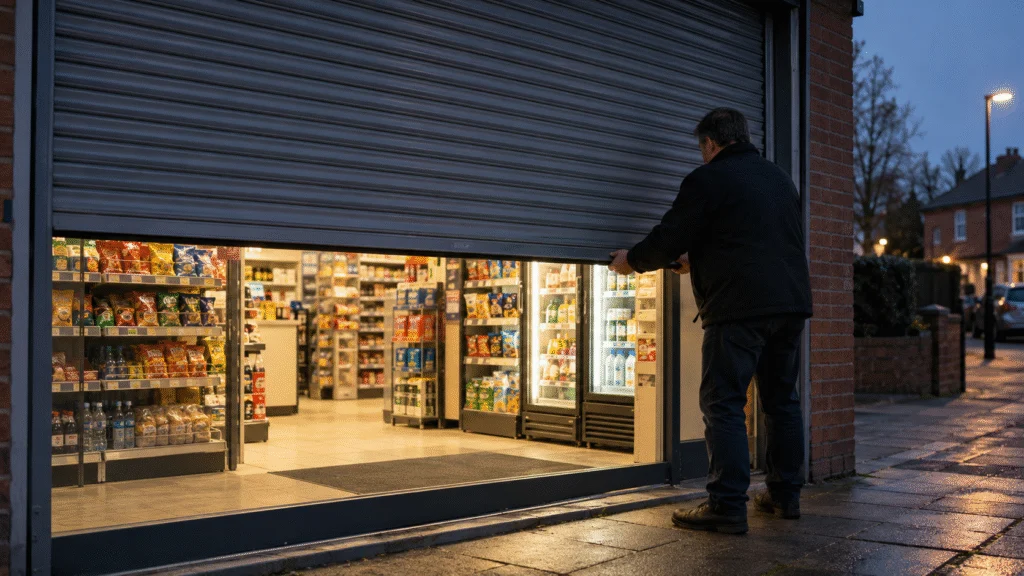
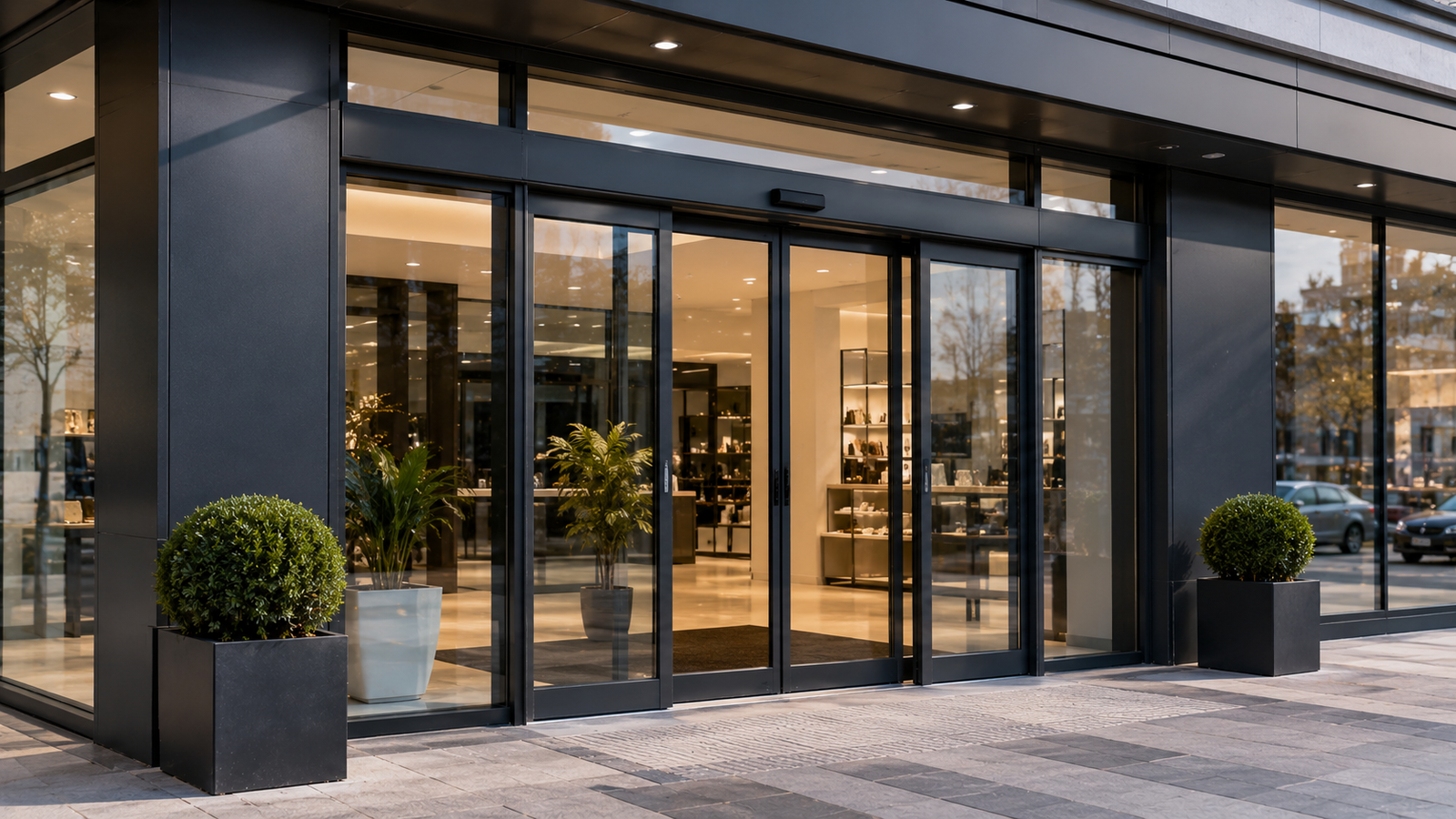
The right shop front glass protects your customers, your stock and your business. The two main types of safety glass used in shopfronts are toughened glass, which is much stronger than ordinary glass and breaks into small, relatively harmless pieces, and laminated glass, which has a plastic interlayer that holds the broken glass in place so the pane stays in the frame. Toughened glass is chosen for strength and safe breakage. Laminated glass is chosen where the pane needs to stay put after it breaks, for security and for overhead or high-risk positions. Many shopfronts use both.
This guide explains how each type behaves, what the UK rules say about where safety glass is needed, which glass suits which part of a shopfront, how to tell what you already have, and what to do if a shop window is smashed. We are Sunrise Shopfronts & Shutters, based in West Bromwich. We design, make and install aluminium shopfronts and matching security shutters, and we supply and fit replacement shopfront glass.
Key takeaways
- Toughened glass is several times stronger than ordinary glass and breaks into small, blunt pieces, but the whole pane clears from the frame.
- Laminated glass cracks but usually stays in the frame, and thicker security grades resist deliberate attack.
- Toughened laminated glass combines both, and is common for large display panes and high-risk doors.
- Approved Document K sets “critical locations” in England, including doors, panels within 300mm of a door up to 1500mm, and low-level glazing up to 800mm.
- Large glazed areas need manifestation (markings) at set heights so people do not walk into them.
- After a break, make it safe, secure the opening and replace the pane with glass that meets the rules for its location.
In this guide
- Shop front glass: the quick answer
- Why ordinary glass is a problem
- How each type of glass breaks
- Toughened glass in detail
- Laminated glass in detail
- Toughened laminated and double glazing
- What the UK rules say
- Which glass for which part of the shopfront
- Security glazing and BS EN 356
- Glass, shutters and grilles together
- How to tell what glass you have
- Questions to ask before you buy
- What to do if your shop window is smashed
- Replacing a pane, step by step
- Looking after shopfront glass
- Frequently asked questions
Shop front glass: the quick answer
| Toughened | Laminated | Toughened laminated | |
|---|---|---|---|
| How it is made | Ordinary glass heated and then rapidly cooled | Two or more sheets bonded with a plastic interlayer, usually PVB | Laminated glass made from toughened sheets |
| Product standard | BS EN 12150-1 | BS EN 14449 | Both apply to its parts |
| When it breaks | Disintegrates into small, blunt pieces; the pane clears from the frame | Cracks; fragments stick to the interlayer and the pane usually stays in place | Breaks into small pieces held by the interlayer |
| Strength | Several times stronger than ordinary glass of the same thickness | Depends on the build; thicker builds resist attack | High |
| Security | Strong, but leaves an opening once broken | Better: resists and delays entry; security grades to BS EN 356 | Good, depending on the build |
| Cut after making? | No: made to size | Yes, if not made from toughened sheets | No: made to size |
| Typical shopfront use | Doors, side panels, low-level panes | Display windows, high-risk panes, overhead glazing | Large display panes, high-risk doors, overhead glazing |
In practice, most shopfronts use a mix, chosen pane by pane according to its position, size and the security risk. The rest of this guide explains how to make those choices.
Why ordinary glass is a problem
Ordinary annealed glass, the type in many older windows, breaks into long, sharp shards. In a shop entrance, where people push doors, children run about and trolleys and bags swing into the glass, that is a real risk of serious injury.
Approved Document K does allow annealed glass in some situations: paragraph 5.5 and Diagram 5.2 give maximum pane sizes for annealed glass of different thicknesses in large areas forming shop fronts with all four edges supported, and small panes are treated separately. But the thickness needed rises quickly with pane size, and annealed glass still breaks into dangerous shards if it does break. In practice, toughened or laminated safety glass is the usual choice for new shopfronts. If your frontage is older, do not assume the glass is safety glass. Check for a mark, as explained below.

How each type of glass breaks
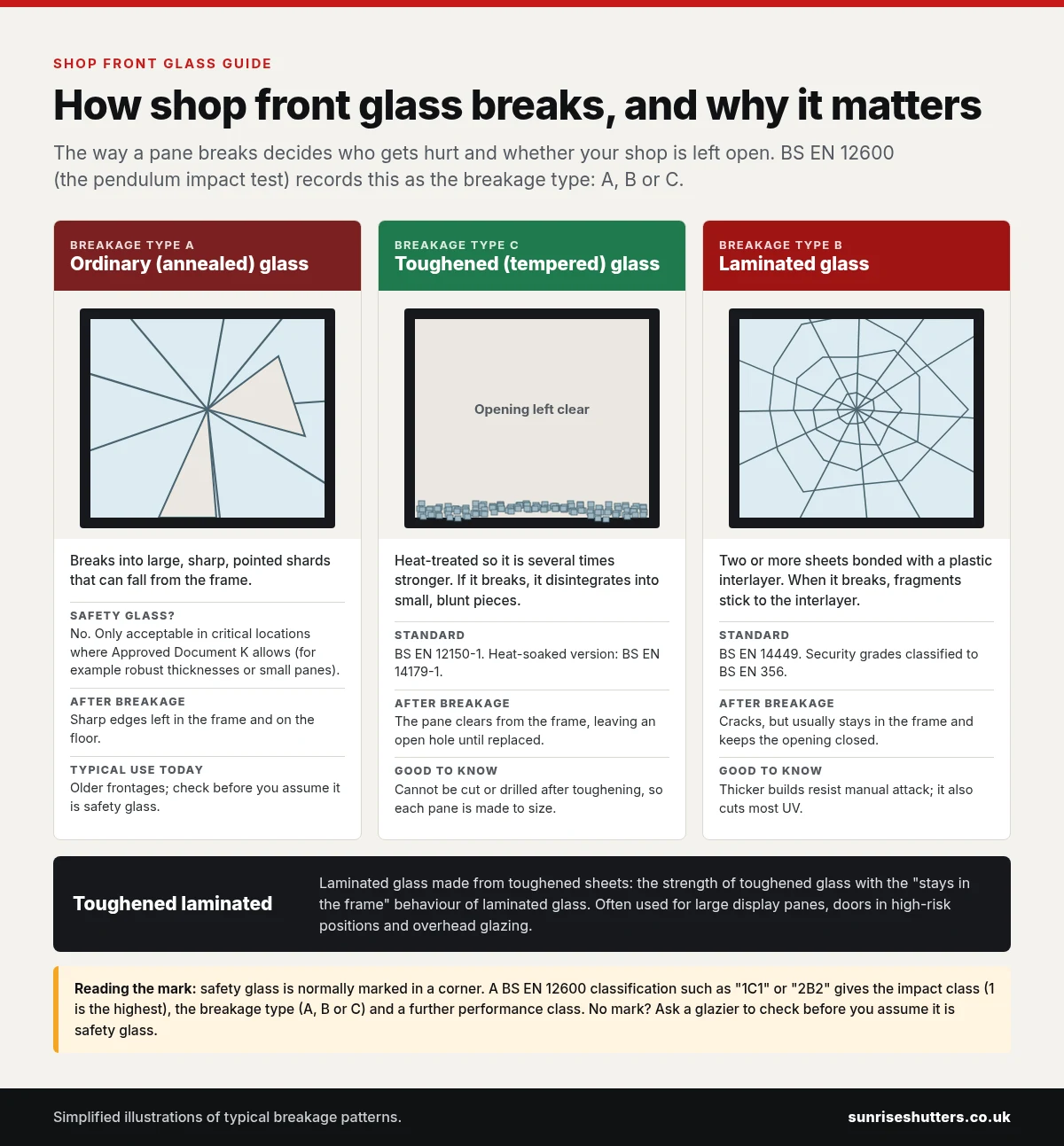
The pendulum impact test in BS EN 12600 classifies glass by how it behaves when struck. It records the breakage type: A for large sharp pieces, typical of annealed glass; B for fragments held together, typical of laminated glass; and C for disintegration into small particles, typical of toughened glass.
Toughened glass in detail
Toughened (tempered) glass is ordinary glass that has been heated and then rapidly cooled. This puts the surfaces into compression, making the pane several times stronger than annealed glass of the same thickness. In the UK and Europe it is made to BS EN 12150-1.
Advantages
- Much stronger against impact and bending than ordinary glass.
- When it does break, it disintegrates into many small, blunt-edged pieces rather than dangerous shards.
- Usually more economical than laminated glass of a similar size.
Limitations
- When it breaks, the whole pane clears from the frame, leaving an open hole until it is replaced.
- It cannot be cut or drilled after toughening, so each pane is made to order. That affects how quickly a broken pane can be replaced.
- Very occasionally, toughened glass breaks without an obvious cause because of tiny nickel sulphide inclusions. Heat-soaked toughened glass, made to BS EN 14179-1, reduces this risk and is often specified for large or overhead panes.
Laminated glass in detail
Laminated glass is two or more sheets of glass bonded together with a plastic interlayer, usually PVB. It is covered by BS EN 14449. If the glass is struck hard enough to crack, the fragments stick to the interlayer and the pane generally stays in the frame.
Advantages
- The pane stays in place when broken, so the shop is not left wide open.
- Thicker laminates with stronger interlayers resist deliberate attack, and security grades are classified to BS EN 356.
- Better at reducing street noise than a single sheet of toughened glass of similar thickness.
- The interlayer blocks most ultraviolet light, which can help reduce fading of window displays.
Limitations
- Generally more expensive than toughened glass.
- Heavier for the same overall strength, which affects frame and door design.
- A cracked laminated pane still needs replacing, even if it is still in the frame.
Toughened laminated and double glazing
Toughened laminated glass is laminated glass made from toughened sheets. It combines the strength of toughened glass with the “stay in place” behaviour of laminated glass, and is often used for large display panes, glass doors in high-risk positions and overhead glazing.
Double-glazed units can combine different glass types, such as a laminated outer pane for security and a toughened inner pane. This improves comfort and reduces condensation in heated shops as well as giving the safety and security benefits of each pane. The trade-off is weight, thicker frames and a higher replacement cost if a unit is broken.
What the UK rules say
Approved Document K: critical locations
In England, the Building Regulations guidance on glazing safety is in Approved Document K (2013 edition, PDF on GOV.UK). Wales, Scotland and Northern Ireland have their own building regulations guidance. Section 5 identifies “critical locations” where people are most likely to collide with glass. Diagram 5.1 shows them as:
- glazing in doors, and in door side panels within 300mm of either edge of the door, between floor level and 1500mm;
- glazing in internal and external walls, including windows, between floor level and 800mm.
Paragraph 7.1 adds that critical locations include large uninterrupted areas of transparent glazing in the walls and doors of shops, showrooms, offices, factories and other non-domestic buildings.
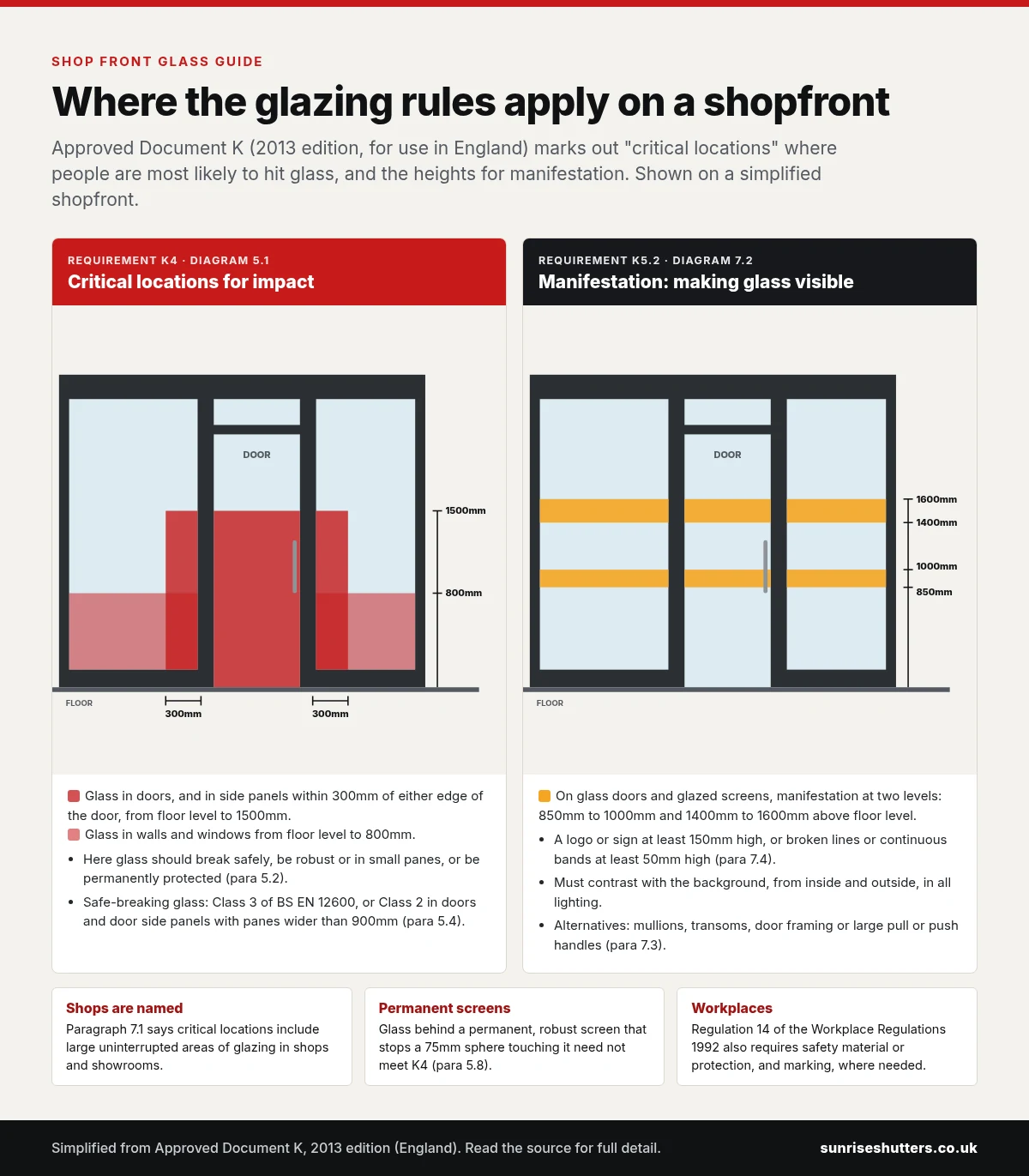
In a critical location, paragraph 5.2 says glazing should break safely, be robust or in small panes, or be permanently protected. Under paragraph 5.4, a glazing material is suitable if it meets Class 3 of BS EN 12600 or Class C of BS 6206. In a door or door side panel with a pane wider than 900mm, it should meet Class 2 of BS EN 12600 or Class B of BS 6206. Paragraph 5.8 adds that glass protected by a permanent, robust screen that stops a 75mm sphere touching it does not itself need to meet the requirement.
Manifestation: making glass visible
Section 7 of Approved Document K covers manifestation. Paragraph 7.4 and Diagram 7.2 put manifestation on glass doors and glazed screens at two levels: 850mm to 1000mm and 1400mm to 1600mm above floor level. It should contrast visually with the background seen through the glass, from inside and outside, in all lighting conditions, and can be a logo or sign at least 150mm high or a decorative feature such as broken lines or continuous bands at least 50mm high. Paragraph 7.4 also says glazed doors beside or within a glazed screen should be clearly marked with a high-contrast strip at the top and on both sides, and glass doors that may be held open should be guarded so people do not walk into the leading edge. Paragraph 7.3 allows alternative indications instead of manifestation, such as mullions, transoms, door framing or large pull or push handles.
Many shops meet the manifestation guidance neatly with branded vinyl graphics, so it doubles as signage.
Workplace Regulations
For workplaces, regulation 14 of the Workplace (Health, Safety and Welfare) Regulations 1992 requires every transparent or translucent surface in a wall, partition, door or gate, where necessary for health or safety, to “be of safety material or be protected against breakage” and to “be appropriately marked or incorporate features so as, in either case, to make it apparent”. Approved Document K points readers to this regulation for the workplace equivalent of its glazing guidance.
Replacing a broken pane? The new glass should meet the requirements for its location, not just match whatever was there before. An old annealed pane in a door should not be replaced like for like.
Which glass for which part of the shopfront
This table shows typical choices. Your installer should confirm the specification for each pane, based on its size, position and the security risk.
| Location | Typical choice | Why |
|---|---|---|
| Entrance doors | Toughened or toughened laminated safety glass | Doors are critical locations from floor level to 1500mm; laminated adds security |
| Side panels next to doors | Toughened or laminated safety glass | Within 300mm of a door edge, the critical zone runs to 1500mm |
| Main display windows | Laminated or toughened laminated | Large panes in shops are critical locations; laminated keeps the shop closed if a pane is broken |
| Low-level panes | Safety glass, or a solid stall riser instead | Glazing from floor level to 800mm is a critical location |
| Fanlights and overhead glazing | Laminated or toughened laminated | Stays in place if it breaks, so it does not fall on people below |
| High-risk premises | Laminated security glass graded to BS EN 356 | Resists and delays forced entry, and may be what your insurer expects |
Security glazing and BS EN 356
Security glazing is laminated glass designed to resist manual attack. BS EN 356 classifies it from P1A to P8B. Classes P1A to P5A are tested by dropping a steel ball onto the glass, and classes P6B to P8B are tested with an axe-type attack, so the higher classes are aimed at sustained, deliberate attempts to break through. A higher class means more resistance, but also thicker, heavier glass that may need stronger frames.
How high you go depends on what you sell, your history of attacks and what your insurer expects. If your insurer has a requirement, ask for it in writing before the glass is ordered. Shutters carry their own security ratings too, explained in our guide to roller shutter security ratings and insurance requirements.
★★★★★
“Great company! The chap who came out to do the quote was really knowledgeable and helped guide us towards the right solution for our premises. Once we’d decided to go ahead, three lads turned up literally a week later and got everything fitted. Really happy with the whole service from start to finish. Would definitely recommend!”
Natalie Clayton, Google review
Glass, shutters and grilles together
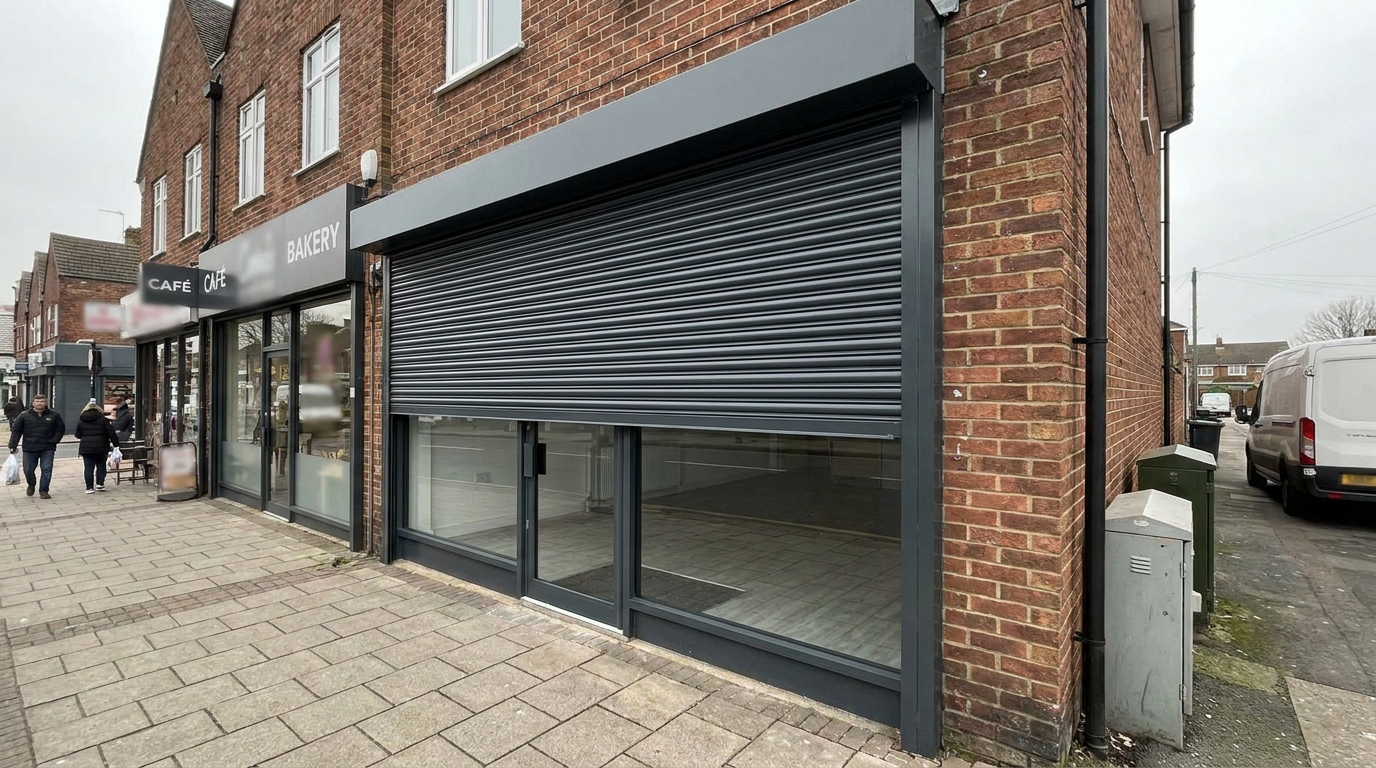
Glass alone will not stop a determined intruder for long. The strongest arrangement is usually layered: laminated glass in the display panes, a shutter or grille for out-of-hours protection, good lighting and an alarm. An intruder then has to defeat two barriers and make a lot of noise doing it.
- Solid shutters give the strongest physical barrier and protect the glass itself, but hide the display.
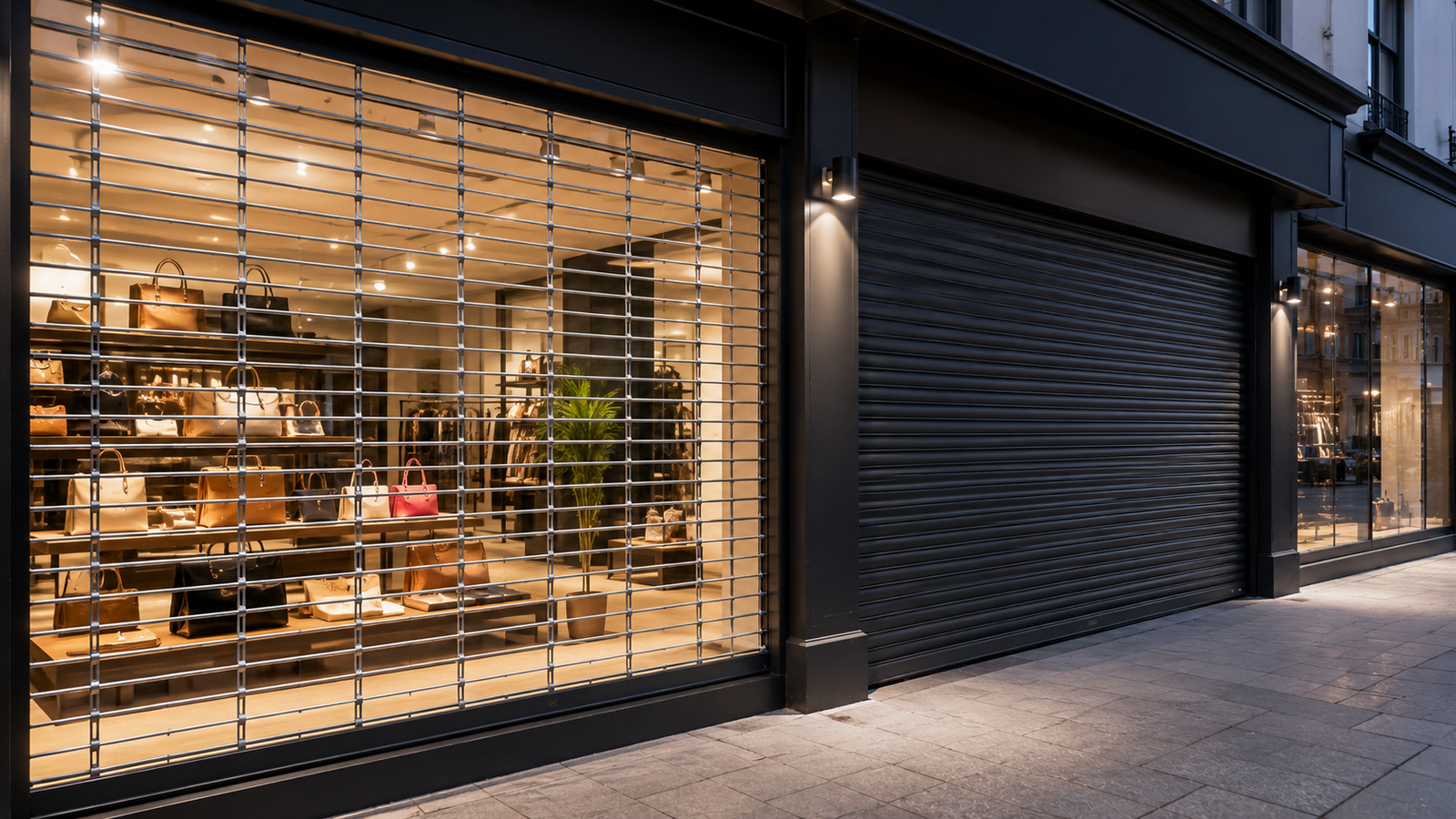
- Perforated and punched shutters let light and the display show through while closed. See our guide to perforated roller shutters.
- Security grilles fitted inside the glass keep the window display fully visible. See our security grilles.
For the trade-offs between visibility and protection, read security grilles vs solid shop shutters. Our shop roller shutters are made in our own West Midlands workshop and can be designed together with a new shopfront.


How to tell what glass you have
Safety glass is normally marked in one corner with a small permanent stamp or etching showing the standard it meets and often its classification. A BS EN 12600 classification such as “1C1” or “2B2” gives the impact class (Class 1 is the highest and Class 3 the lowest), the breakage type (A, B or C) and a further performance class. If there is no mark, or you cannot read it, ask a glazier to check before you assume it is safety glass.
Other clues can help, but are not proof on their own: laminated glass often shows a faint line of interlayer at the edge, and toughened glass that has been broken leaves small, cube-like pieces rather than long shards.
Questions to ask before you buy
- What glass is proposed for each pane? Ask for the type and thickness pane by pane, not a general description.
- Which panes are in critical locations? The installer should be able to point them out and explain how the glass meets the guidance.
- Is any of it security glazing? If so, what BS EN 356 class, and does it match what your insurer expects?
- Single or double glazed? Double glazing improves comfort in heated shops, and can combine a laminated outer pane with a toughened inner pane.
- Are large or overhead toughened panes heat-soaked? This reduces the small risk of spontaneous breakage.
- How will the glass be made visible? Manifestation can be designed into your branding rather than added later.
- How long would a replacement pane take? Sensibly sized panes in standard specifications are usually quicker to replace than very large or unusual ones.
If you are replacing the whole frontage, our guide to aluminium shop front cost explains how the glass choice fits into the overall price, and our article on the signs it is time to modernise your entrance covers when replacement makes sense.

Planning new shopfront glass?
Call our installation and service line or send us a photo of your frontage. We will talk you through the glass for each pane and how it works with any shutter or grille.
What to do if your shop window is smashed
A broken shopfront is a safety problem first, a security problem second and an insurance claim third. Work through it in that order.
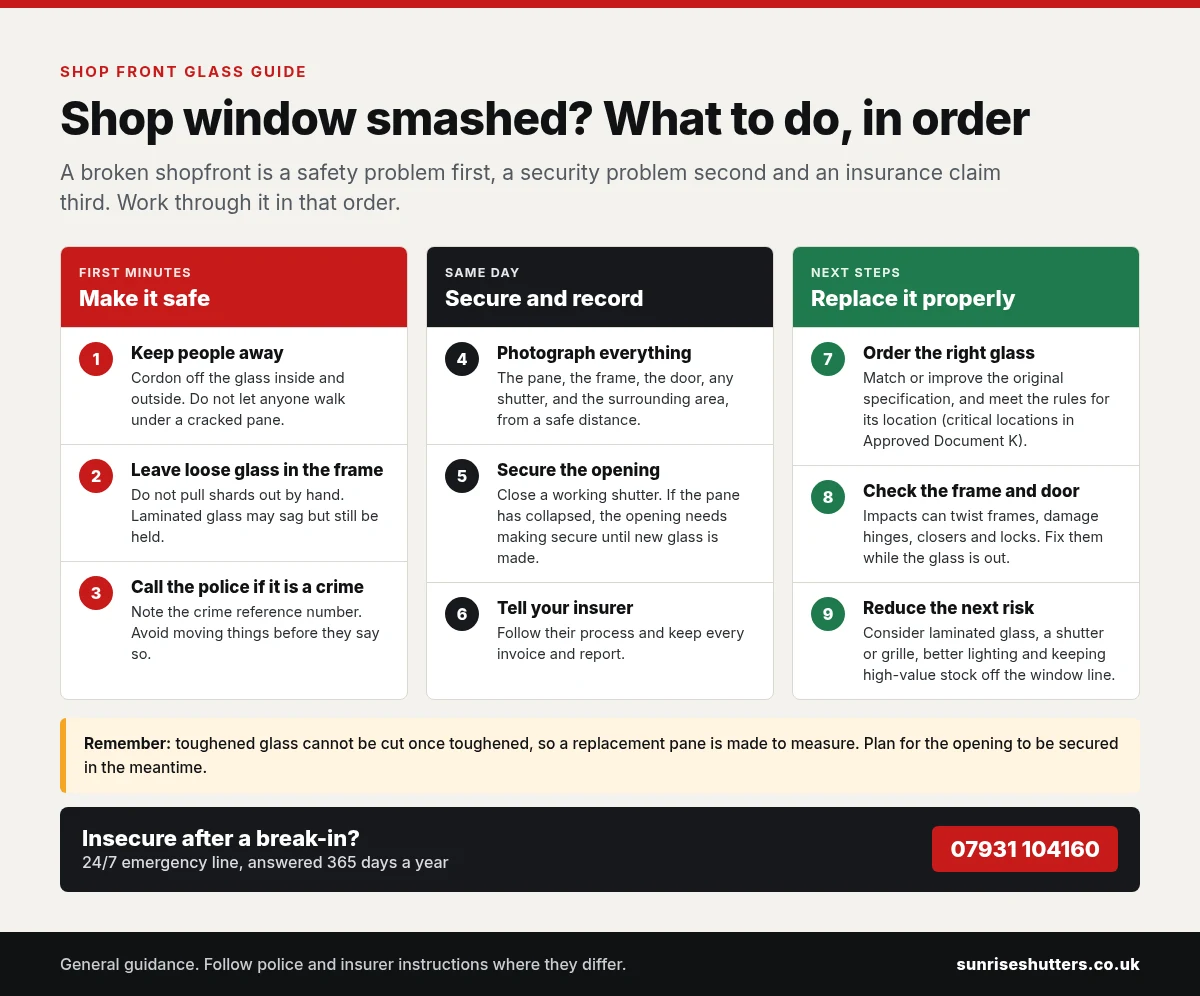
- Make the area safe. Keep people away from broken glass inside and outside, and do not try to pull loose shards out of the frame.
- Call the police if it is a crime, and keep the crime reference number.
- Photograph the damage for your insurer: the pane, frame, door and any shutter.
- Secure the opening. If you have a working shutter, close it. If a toughened pane has collapsed, the opening needs to be made secure until the replacement glass is made.
- Arrange replacement glass that meets the requirements for its location, and have the frame, door and locks checked at the same time.
If a shutter was damaged in the same incident, our guide to shutter damage after a break-in: repair vs temporary securing explains the options, and our guide to the first 30 minutes of a shutter emergency covers what to do while you wait.
★★★★★
“I had an emergency with my shutter garage door on a Sunday and was dreading the wait, but Sunrise Shopfronts and Shutters came out remarkably quickly. The engineer was professional, friendly, and got straight to work diagnosing the problem. Nothing was too much trouble for him, and he had everything fixed and working perfectly in no time.”
Kam Kang, Google review
Shop window smashed or shutter damaged?
Our emergency line is answered 24 hours a day, 365 days a year. Tell us what has happened and we will explain the next step, starting with getting the premises secure.
Replacing a pane, step by step
- Identify the existing glass from its mark, and its position in relation to the critical locations.
- Decide the specification: like for like if the existing glass meets the guidance, or an upgrade if it does not, or if you want more security.
- Measure accurately. Toughened and toughened laminated panes are made to size and cannot be trimmed on site.
- Keep the premises secure while the new pane is made.
- Fit and check: the pane, the glazing beads and seals, and the operation of any door it sits in.
- Restore manifestation if the old pane carried it, so the glass stays visible.
- Keep the paperwork showing what glass was fitted and where.

For longer-term prevention, read our guide to reducing vandalism and impact damage to shopfronts, and our advice for local businesses on emergency shutter repairs.
Looking after shopfront glass
Glass needs little maintenance, but a few habits help it last and keep it safe:
- ☐ Check for chips and cracks, especially at the edges and corners, where damage can spread. Report them early.
- ☐ Watch the door. A door that slams, drags or swings too fast puts stress on its glass. Have the closer adjusted.
- ☐ Check the seals and glazing beads for gaps, damage or signs of water getting in.
- ☐ Keep manifestation in place. If graphics are removed during a rebrand, replace them so the glass stays visible.
- ☐ Keep displays and stock back from the glass, so nothing is pushed against it.
- ☐ Clean with suitable, non-abrasive products, and check with your installer before using blades or scrapers on coated glass.
- ☐ Protect the glass out of hours with a working shutter or grille, and get any shutter fault fixed promptly.
Shopfront glass replacement and new shopfronts
We design, manufacture and install aluminium shopfronts, and we supply and fit replacement glass for damaged shopfronts, with a fast call-out so the premises are secure and presentable again. See our shopfronts page and our aluminium shop fronts in Birmingham page. Our core areas are the Midlands and South Yorkshire, and we work further afield across the UK: check the areas we cover. For powered doors and shutters on the same frontage, our guide to roller shutter safety regulations explains the safety rules.
Frequently asked questions
Is toughened or laminated glass better for a shopfront?
It depends on the position and the risk. Toughened glass is strong and breaks safely, but the whole pane clears from the frame when it breaks. Laminated glass stays in the frame when broken and resists attack better, so it is often preferred for display windows and high-risk premises. Many shopfronts use both.
Does shopfront glass have to be safety glass?
Glass in critical locations, such as doors, panels beside doors, low-level glazing and large areas of glazing in shops, should meet the guidance in Approved Document K in England: break safely, be robust or in small panes, or be permanently protected. Workplace law also requires transparent surfaces to be of safety material or protected where necessary for health or safety.
How can I tell if my shop glass is toughened?
Look for a small permanent mark in one corner showing the standard it meets. If there is no mark, ask a glazier to check. Do not assume older glass is safety glass.
Can laminated glass stop a break-in?
Laminated security glass can delay an attack and make it noisier, which deters many opportunistic thieves. Higher BS EN 356 classes offer more resistance. Combined with a shutter or grille and an alarm, it makes a shop a much harder target.
Why does replacement toughened glass take time?
Toughened glass cannot be cut after it is toughened, so each pane has to be made to the exact size. In the meantime, the opening should be made secure.
Do I need markings on my shop windows?
Approved Document K asks for manifestation on glass doors and glazed screens at 850mm to 1000mm and 1400mm to 1600mm, unless the glass is made apparent another way, such as by mullions, transoms, door framing or large handles. Branded graphics are a popular way to do it.
Is double glazing worth it for a shopfront?
For shops that are heated for long hours, double glazing improves comfort and reduces condensation. It is heavier and costs more to replace, so weigh it against how you use the space.
Can you replace just one broken pane?
Yes. We supply and fit replacement glass for damaged shopfronts. If the frame is sound, replacing the pane with the right glass for its location is usually all that is needed.
Need shopfront glass advice or a replacement?
Send us a photo of the frontage and tell us what you need. We will explain the right glass for each pane and the next step, and if your premises are insecure, call our emergency line now.
- Emergency line (24/7): 07931 104160
- Installation and service line: 07931 104162
