
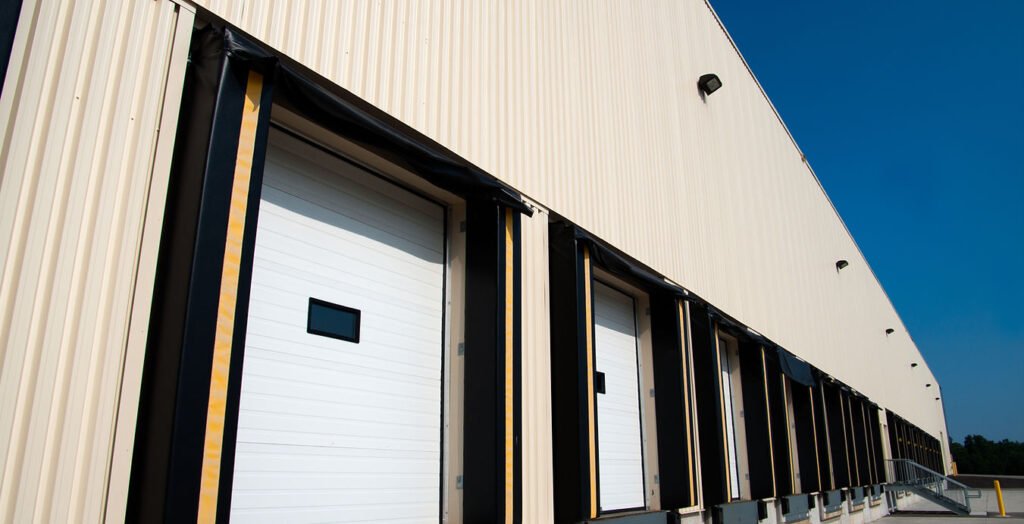
Warehouse roller shutter doors work harder than almost any other door on a commercial site. They open and close through every shift, take wind and rain on one side and forklifts, pallet trucks and lorries on the other, and when one fails at six in the morning, deliveries stop. Getting the specification right at the start is what separates a door that quietly does its job for years from one that is always slow, always being hit and always on the phone to an engineer. This guide walks through every decision in the order a surveyor makes it: how the opening is used, the space and structure, wind, power and controls, safety devices, insulation and security, impact protection, and maintenance.
We are Sunrise Shopfronts & Shutters, based in West Bromwich. We design, manufacture and install industrial roller shutters for warehouses, factories and loading bays, building every door in our own West Midlands workshop to the surveyed size of the opening. This guide is written for facilities managers, operations managers and business owners who want to brief a supplier properly and compare quotes on a like-for-like basis.

Key takeaways
- Start with how the opening is used, not with a product. Traffic, operations per day and shift patterns decide the drive, the curtain and the controls.
- Space is the first hard limit. The coil needs headroom above the opening and the drive needs side room, so measure both before anything else.
- Wide doors on exposed sites need wind thinking. Ask how the door has been specified for wind load.
- Controls decide the safety devices. Hold-to-run buttons in sight of the door need less protection than remote or automatic closing.
- Impact protection is cheaper than repairs. Guide protectors, bollards, marking and a separate pedestrian door prevent most of the damage we see.
- Plan maintenance from day one. A busy door wears faster, and a service plan keeps it running between shifts.
In this guide
- Warehouse roller shutter doors: the quick answer
- Step 1: how the opening is used
- Step 2: size, space and structure
- Step 3: wind load and exposure
- Step 4: manual or powered, and what power
- Step 5: controls and safety devices
- Step 6: security, insulation and visibility
- Roller shutter or sectional door?
- Step 7: impact protection and people
- Step 8: maintenance and downtime
- Common specification mistakes
- What happens at a survey
- How to compare warehouse door quotes
- Your legal duties
- Checklist before you order
- Frequently asked questions
Warehouse roller shutter doors: the quick answer
A warehouse roller shutter is a curtain of interlocking steel or aluminium laths that coils around a barrel in a box above the opening and runs in guide rails either side. It is popular on warehouses because it is strong, secure out of hours and needs very little space inside the building. To specify one properly, you need to answer eight questions, in roughly this order:
- Use: what passes through the opening, and how often does the door run?
- Space: how wide and tall is the opening, and how much headroom and side room is there?
- Wind: how exposed is the opening, and how wide is the door?
- Operation: manual or powered, and what power supply is near the opening?
- Controls and safety: who operates it, from where, and which safety devices does that require?
- Curtain: is security, heat, visibility or airflow the priority?
- Protection: how will vehicles be kept off the guides and people kept out of the vehicle opening?
- Maintenance: how will the door be serviced, and who do you call when it is down?
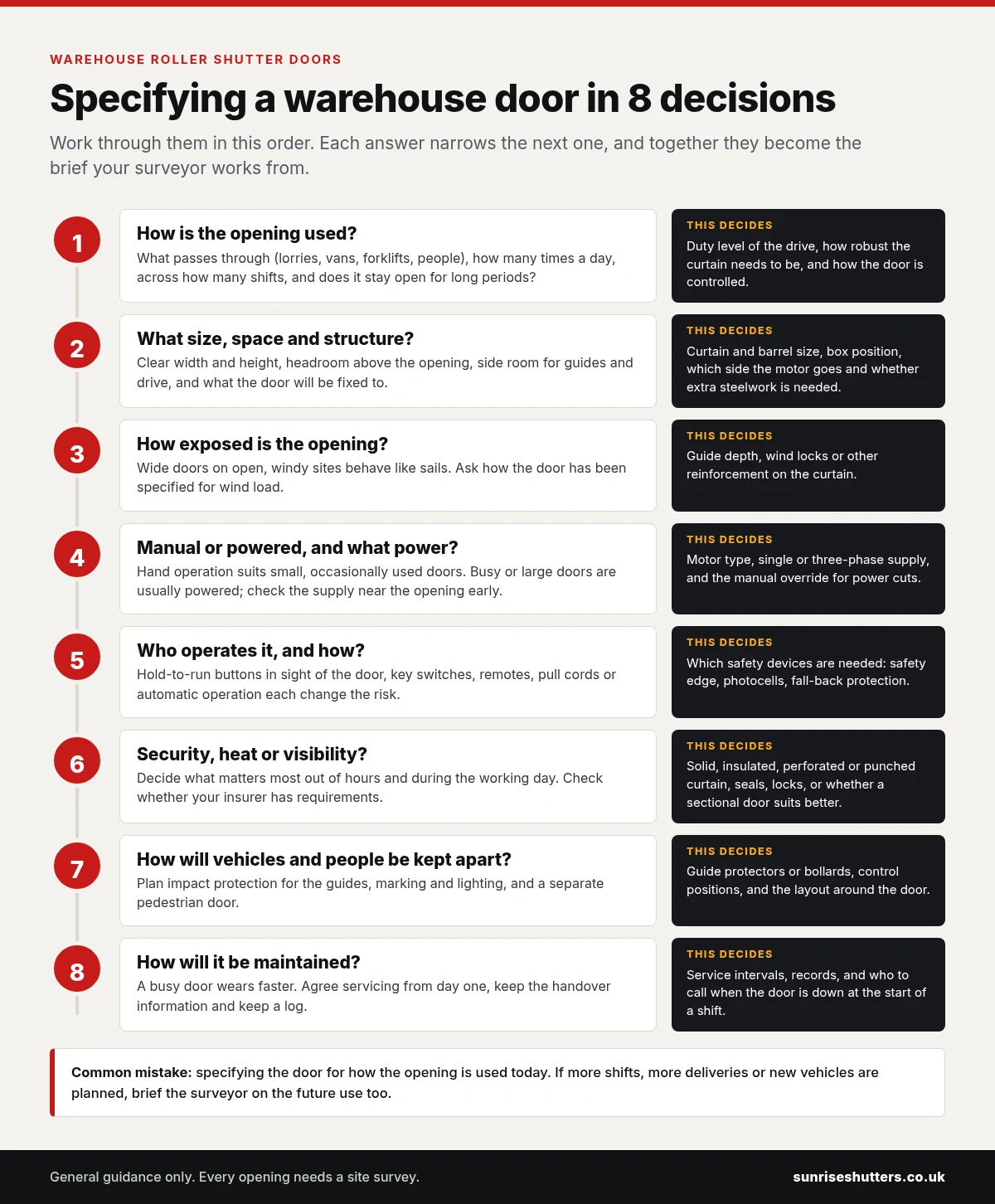
The rest of this guide takes each step in turn, with the questions a surveyor will ask and the mistakes to avoid.
Step 1: how the opening is used
Before anyone talks about laths or motors, write down how the opening actually works on a normal day and on your busiest day. These answers shape everything else:
- What passes through it? Articulated lorries, rigid vans, forklifts, pallet trucks, people on foot, or all of them. The largest vehicle and the largest load set the clear opening you need.
- How many times a day will the door run? A door opened at the start and end of the day is a very different job from one that cycles for every forklift movement across two or three shifts.
- Does it stay open for long periods, or open and close for each movement? Long open periods matter for heat loss; frequent cycling matters for the drive.
- Is it a loading bay with a dock leveller and shelter, or a ground-level drive-through opening? Dock doors interact with the leveller and the vehicles backing onto it.
- What matters most: out-of-hours security, keeping heat in, keeping weather and dust out, seeing what is on the other side, or speed of access?
- Will this change? If you plan another shift, more deliveries or larger vehicles, brief the surveyor on the future use, not only today’s.

Be honest about frequency. One of the most common reasons we see a warehouse drive wearing out early is that it was specified for a few operations a day and then used constantly. If you are not sure, count the operations on a busy day for a week before the survey.
Step 2: size, space and structure
The space around the opening is the first hard limit on what can be fitted. A surveyor will look at five things, and it helps to understand why each one matters.
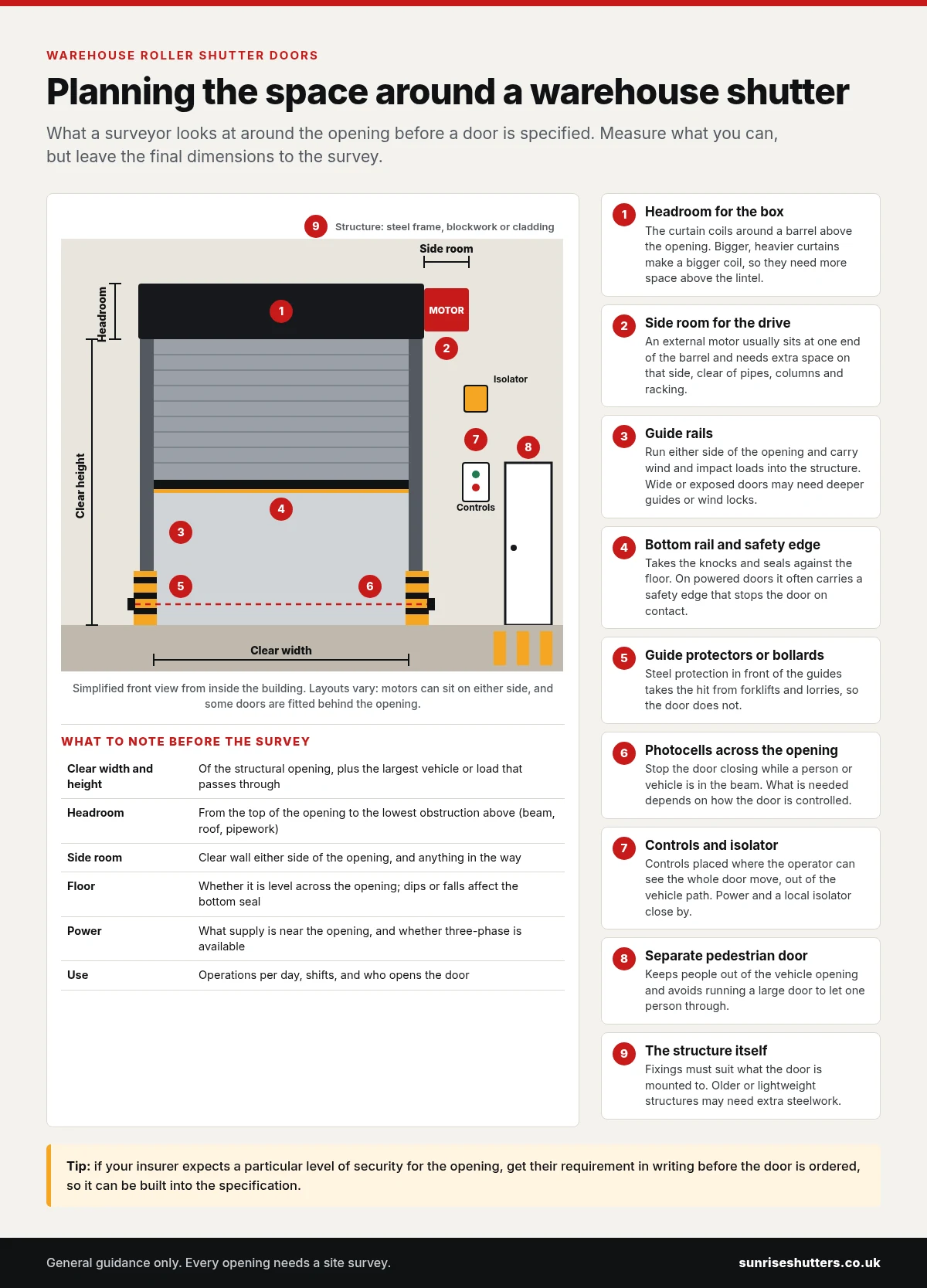
Opening size
The clear width and height of the opening decide the size and weight of the curtain, which in turn decide the barrel, the brackets and the drive. Measure the structural opening and the largest vehicle or load that passes through it, but leave the final dimensions to the survey. Because we manufacture every shutter to the surveyed size, rather than squeezing a stock size into the opening, the survey dimensions are the ones the workshop builds to. Our article on why roller shutters should be built for your opening explains why that matters for wear and reliability.
Headroom
The curtain coils around a barrel above the opening, so you need space above the lintel or the top of the opening for the coil and its box. Roller shutters need relatively little space compared with door types that run back into the building on tracks, but the space still has to be there, and larger, heavier curtains make a larger coil. Note any beams, roof steel, pipework, lighting, sprinklers or ducting just above the opening.
Side room
Guide rails run either side of the opening. On many powered warehouse doors, an external motor is mounted at one end of the barrel, so that side needs extra clear wall. Columns, downpipes, racking, electrical boards and fire alarm panels close to the opening can all affect which side the drive goes and how the door is fixed.
The floor
The bottom rail seals against the floor. If the floor dips, falls towards a drain or has a raised threshold, the seal needs careful setting, and a badly sealed door lets in wind, rain and dust however good the curtain is.
The structure
The shutter has to be fixed into something strong enough to carry its weight and resist wind. Steel portal frames, blockwork, brick and cladding rails all need different fixing approaches. On older or lightweight buildings, the surveyor may recommend additional steelwork. This is not an upsell: a heavy curtain on weak fixings is a safety problem.

Step 3: wind load and exposure
A large warehouse door acts like a sail. On an open site, or on a very wide opening, wind pressure can bow the curtain, make it rattle and drag in the guides, and in severe cases pull it out of the guides altogether. Industrial doors can be classified for their resistance to wind load under BS EN 12424, the European standard used in the UK for this purpose.
In practice, a door specified for an exposed or wide opening may need some combination of:
- Wind locks on the ends of the laths, which hook behind the guide so the curtain cannot be pulled out;
- Deeper or stronger guides, fixed securely into the structure;
- A heavier lath profile or other reinforcement across the curtain.
You do not need to know the classification yourself. What you should do is tell the surveyor if the site is exposed (open countryside, a hilltop, a coastal location, a gap between tall buildings that funnels wind), and ask how the door has been specified for wind. If one quote mentions wind and another does not, that is a useful question to put to both.

Step 4: manual or powered, and what power
Manual operation
Small warehouse shutters can be operated by hand, either pushed up with spring assistance or raised with a gearbox and hand chain. Manual operation is simple and economical for doors used a few times a day. On larger doors, or doors that cycle often, it quickly becomes slow and tiring, and people start leaving the door open, which defeats the point of having it. Our guide to manual vs electric roller shutters covers the trade-offs in more detail.
Electric operation
Most warehouse shutters are powered. The motor has to be matched to the weight and size of the curtain and to how often the door will run, which is why Step 1 matters so much. A door that will cycle all day needs a drive suitable for frequent use. Larger, heavier doors often need a three-phase supply, while smaller doors may run on single-phase. Check what power is available near the opening early, because running a new supply can affect the programme and the cost of the project.
Manual override for power cuts
Where it is necessary for health or safety, a powered door in a workplace must be capable of being operated manually unless it opens automatically if the power fails. On warehouse shutters this is usually a hand chain or a manual release. Make sure the people who open up know where it is and how to use it, and keep it accessible.
Step 5: controls and safety devices
How a door is controlled decides which safety devices it needs. This is where many specifications go wrong, because controls are often treated as an accessory rather than part of the safety design.
| Control method | How it works | Suits | Safety implications |
|---|---|---|---|
| Hold-to-run push buttons | The door only moves while the button is held | Doors operated by trained staff who can see the whole opening | Relies on the operator watching the door, so the button must have a clear view of the opening |
| Key switch | Limits operation to key holders | External operation, out-of-hours access | Position it where the user can see the door move |
| Remote control | Handset opens or closes the door from a distance | Drivers arriving at the door | The operator may not see the whole opening, so additional devices such as a safety edge and photocells are needed |
| Pull cord | A cord hung where a forklift driver can reach it from the cab | Internal doors with frequent forklift traffic | Usually combined with automatic closing protection |
| Automatic operation and interlocks | Detectors, timers or links to a dock leveller | High-traffic and loading bay doors | The highest level of protection is needed, because nobody is watching the door close |
The law sets the outcome, not a list of devices. In Great Britain, regulation 18 of the Workplace (Health, Safety and Welfare) Regulations 1992 requires any upward-opening door to have a device to prevent it falling back, and any powered door to have suitable and effective features to prevent it causing injury by trapping any person. On a warehouse shutter that usually means a combination of:
- A safety edge on the bottom rail that stops the door, and usually reverses it, on contact;
- Photocells across the opening so the door will not close on a person or vehicle in the beam;
- Fall-back protection, such as a safety brake or anti-fall-back device, in case a drive component fails;
- A manual override for power cuts, as described above.
The British Standards behind this, including BS EN 12453 for the safety in use of power-operated doors, are explained in plain English in our guide to roller shutter safety regulations in the UK. The short version: if you plan to add a remote, a pull cord or automatic closing later, say so at the start, because it changes the safety devices the door needs.
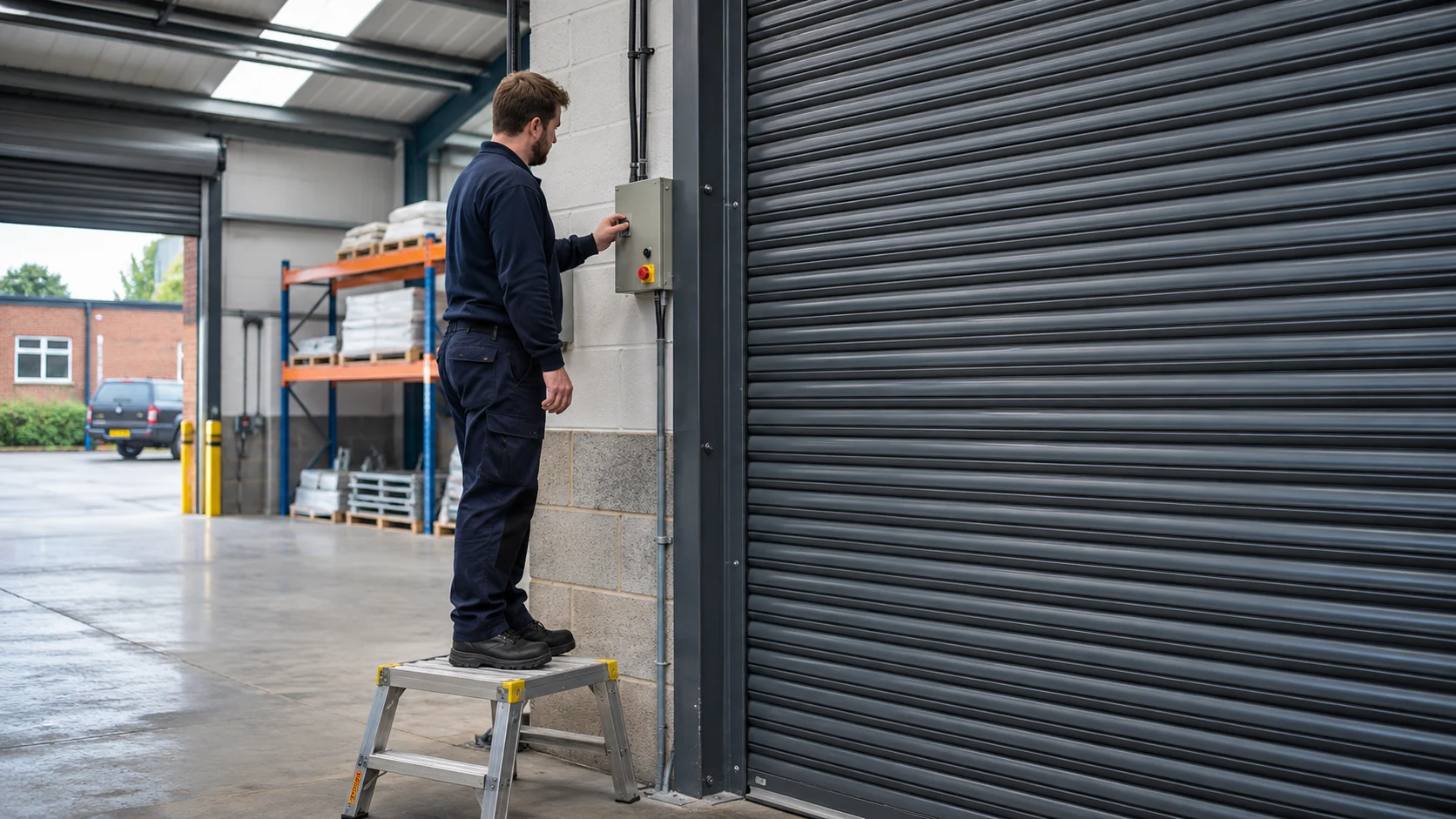
Position controls with care. A push button behind racking, around a corner or on the wrong side of the opening means the operator cannot see the bottom of the door while it moves. Put controls where the whole door is visible, out of the path of vehicles, and at a height staff can reach without stretching.
Step 6: security, insulation and visibility
The curtain is where you choose between priorities. Most warehouses need some balance of all four of these, so decide which one comes first.
Security out of hours
For many warehouses the shutter is the main barrier protecting stock overnight. Solid steel-lath curtains, secure guides, a strong bottom rail and the motor’s brake all contribute. If your insurer requires a specific level of protection, ask them for the requirement in writing before you order, and ask your supplier about independently tested products. Our guide to roller shutter security ratings and insurance requirements explains what to look for, and our comparison of steel and aluminium roller shutters covers how each material behaves.
Keeping heat in
If the building is heated, or you store goods that need a stable temperature, a single-skin curtain will lose heat. Insulated laths, which are double-skinned and foam-filled, reduce heat loss and draughts. They are heavier and thicker, so the barrel, box and drive need to be sized for them. Our article on whether insulated roller shutters are worth it explains what they can and cannot do.
Visibility and airflow
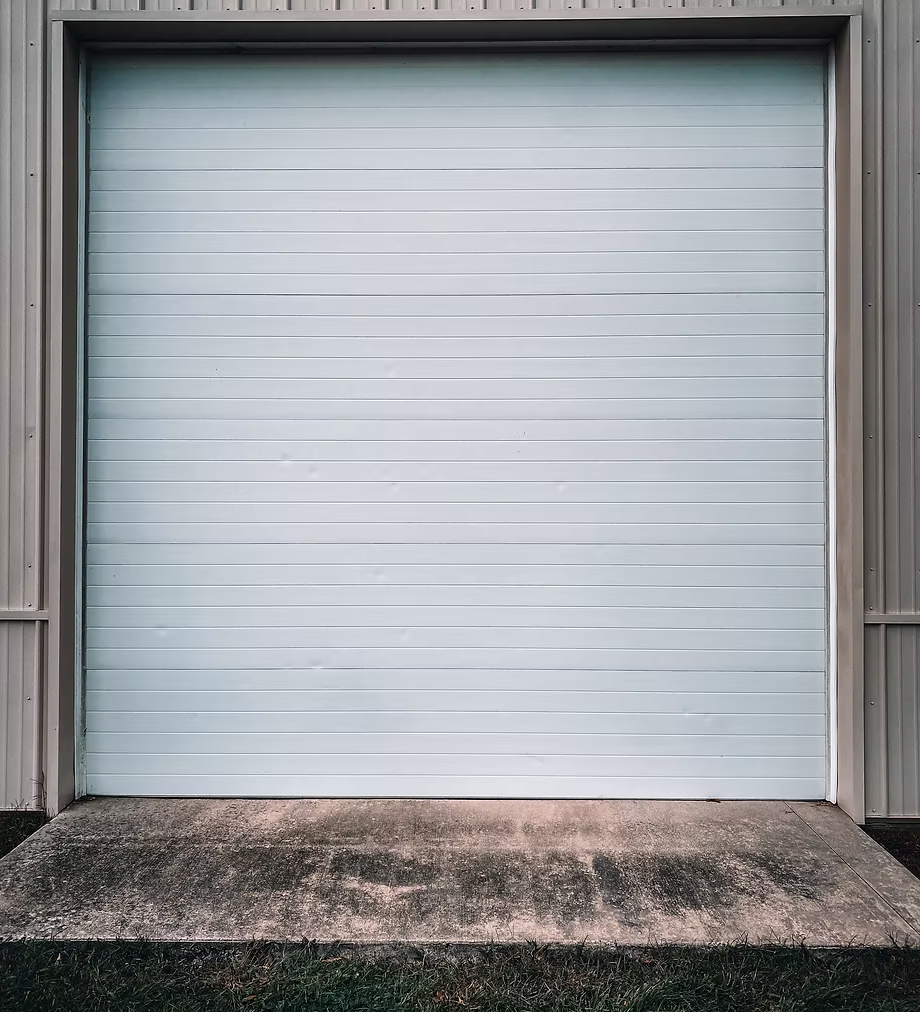
Perforated laths have many small holes and punched laths have larger cut-outs. Both let light and some air through and allow staff to see what is on the other side, which suits internal doors between warehouse zones, or areas that need ventilation. They are less secure and less weathertight than a solid curtain, so they are usually chosen for internal or secondary openings. Our guide to perforated roller shutters compares the options.
Seals and weather
Brush or rubber seals in the guides, a rubber seal on the bottom rail and a seal at the head help keep wind, rain and dust out. Seals are wear items: they should be checked at every service, especially on doors that run constantly.

Roller shutter or sectional door?
Many warehouse buyers end up comparing a roller shutter with an insulated sectional door. Sectional doors are made of horizontal insulated panels that lift up and back into the building on tracks. They are often the stronger choice for thermal performance, but they need clear space above and behind the opening for the tracks. Roller shutters coil above the opening, which keeps the ceiling space inside free for lighting, racking, cranes and services.
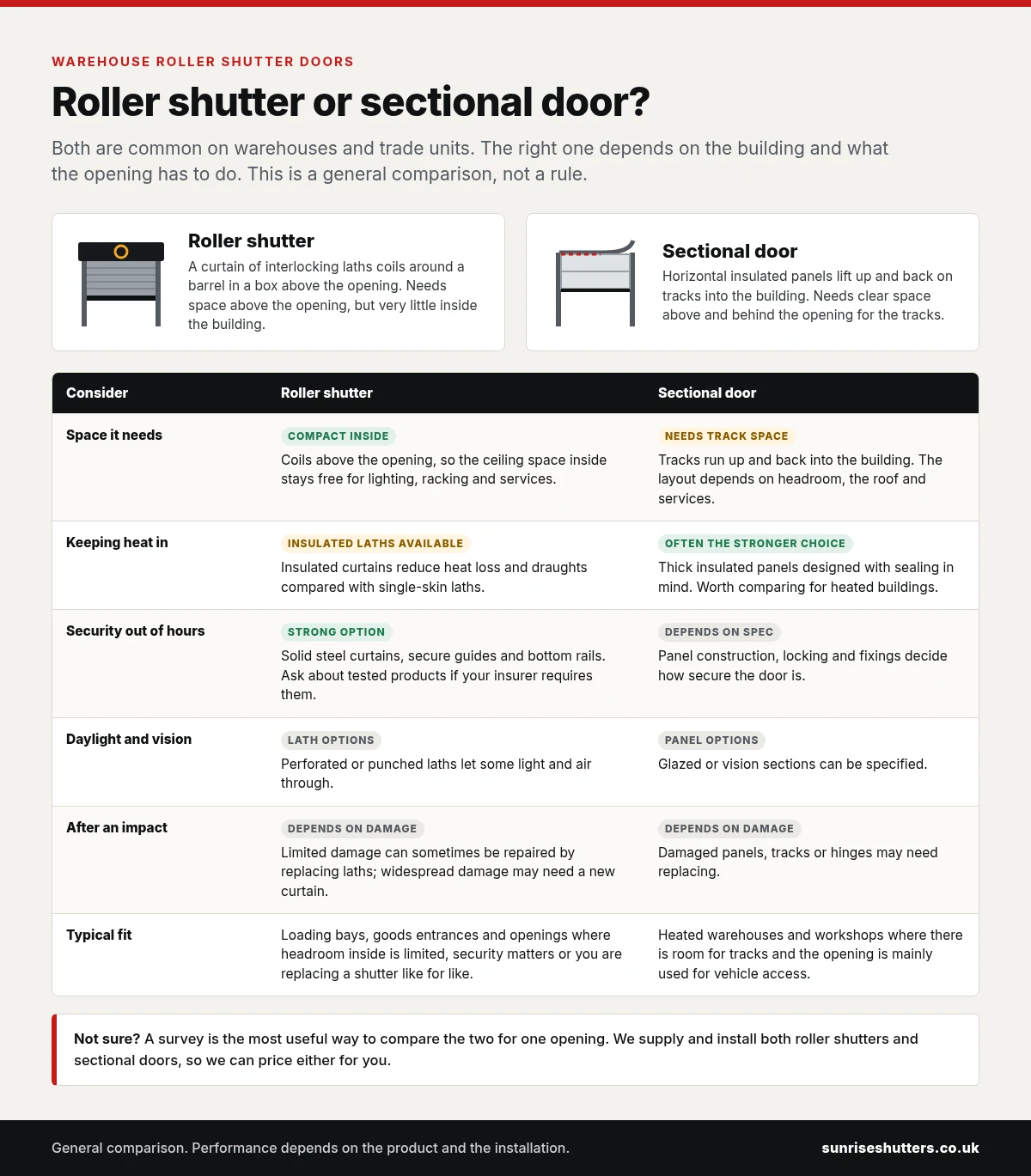
As a rough guide, a roller shutter suits openings where space above or inside is limited, where security matters most, or where you are replacing a shutter like for like. An insulated sectional door is worth pricing where the building is heated for long hours, there is enough headroom for the tracks, and the opening is mainly used for vehicle access. We supply and install both, so a survey can compare them for your opening. Read more on our sectional doors page and in our article on why insulated sectional doors suit warehouses, workshops and trade units.
★★★★★
“Great company! The chap who came out to do the quote was really knowledgeable and helped guide us towards the right solution for our premises.”
Natalie Clayton, Google review
Step 7: impact protection and people
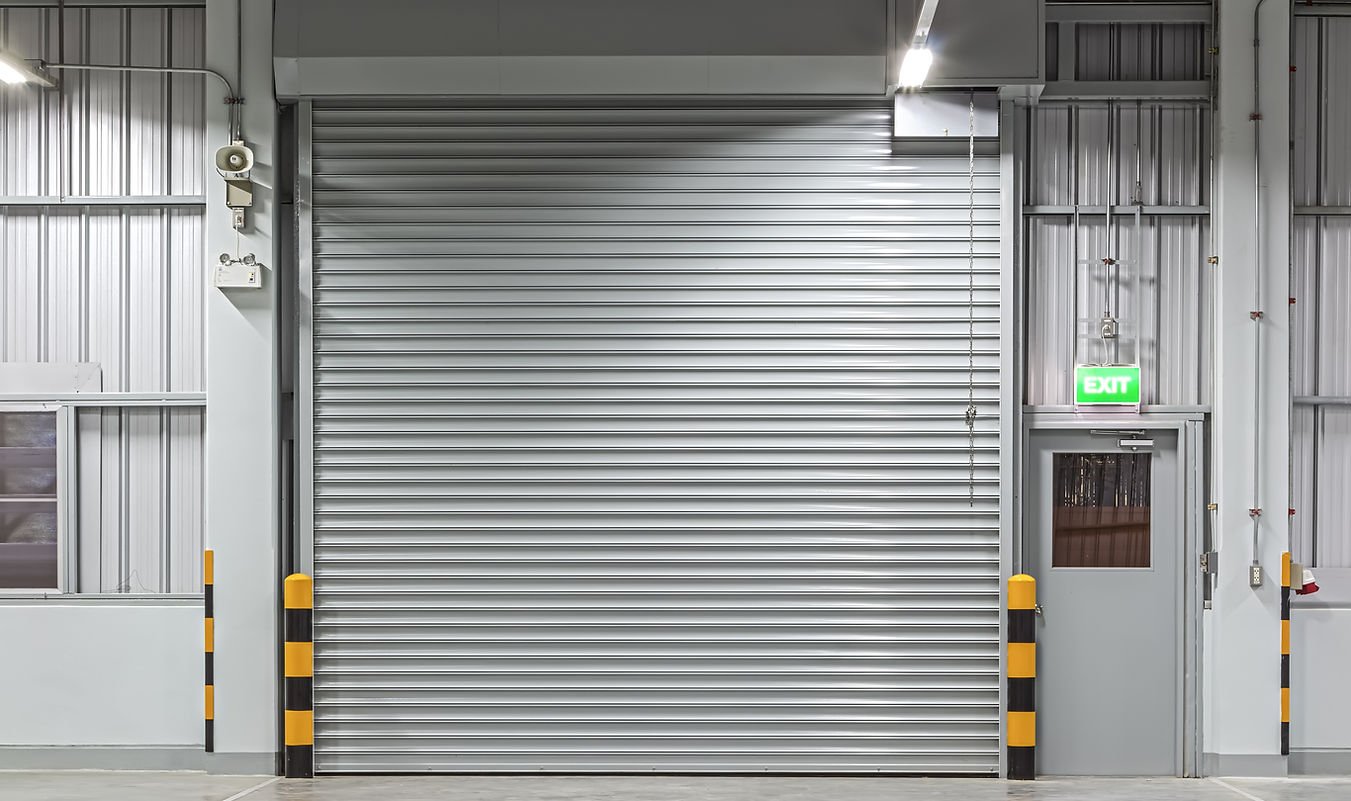
Vehicle impact is one of the most common causes of warehouse shutter repairs. A forklift mast clipping the bottom rail, a lorry reversing into a guide or a pallet caught under a closing curtain can put a door out of action in seconds. Protection is far cheaper than repeated repairs.
Protect the guides
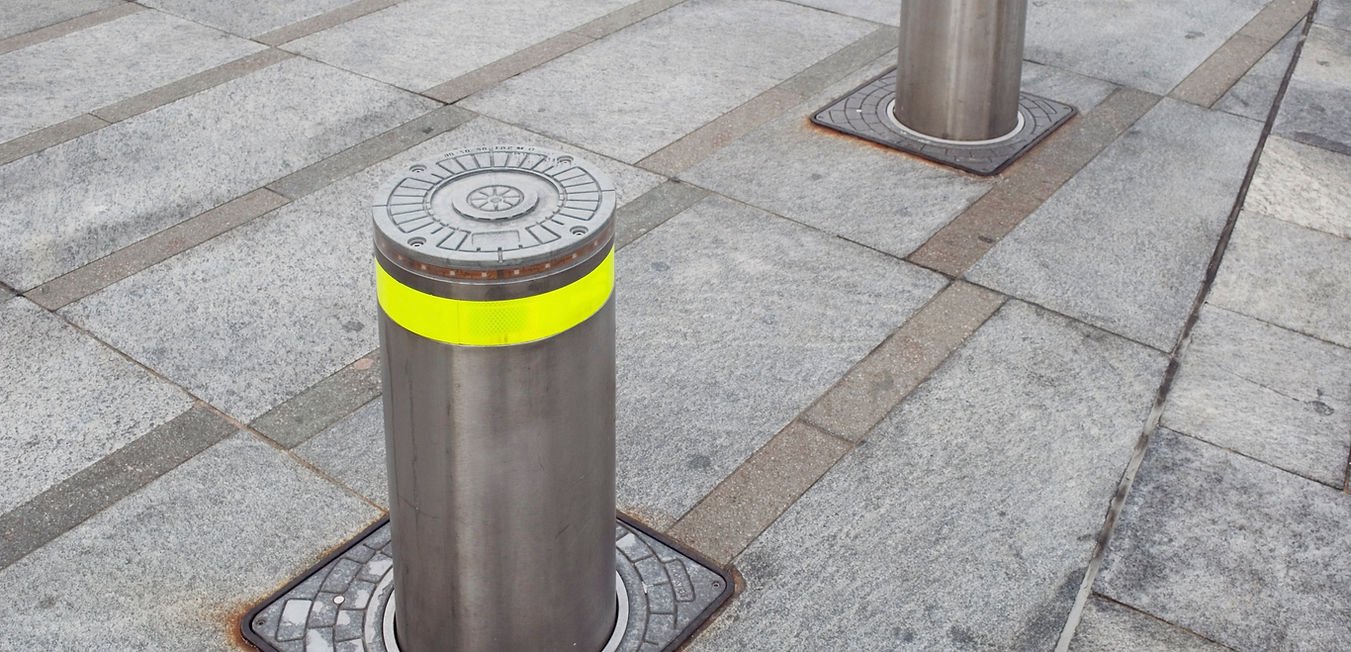
- Fit steel guide protectors or bollards in front of the guide rails, positioned so vehicles hit the protection, not the door.
- Mark the opening with high-visibility paint or tape on the protectors and the floor, and keep it well lit.
- Make sure the door is fully open before vehicles pass through. Interlocks, photocells and clear signals help, but so does training.
- Train drivers not to creep under a door that is still rising, and not to use the forks to push a curtain.
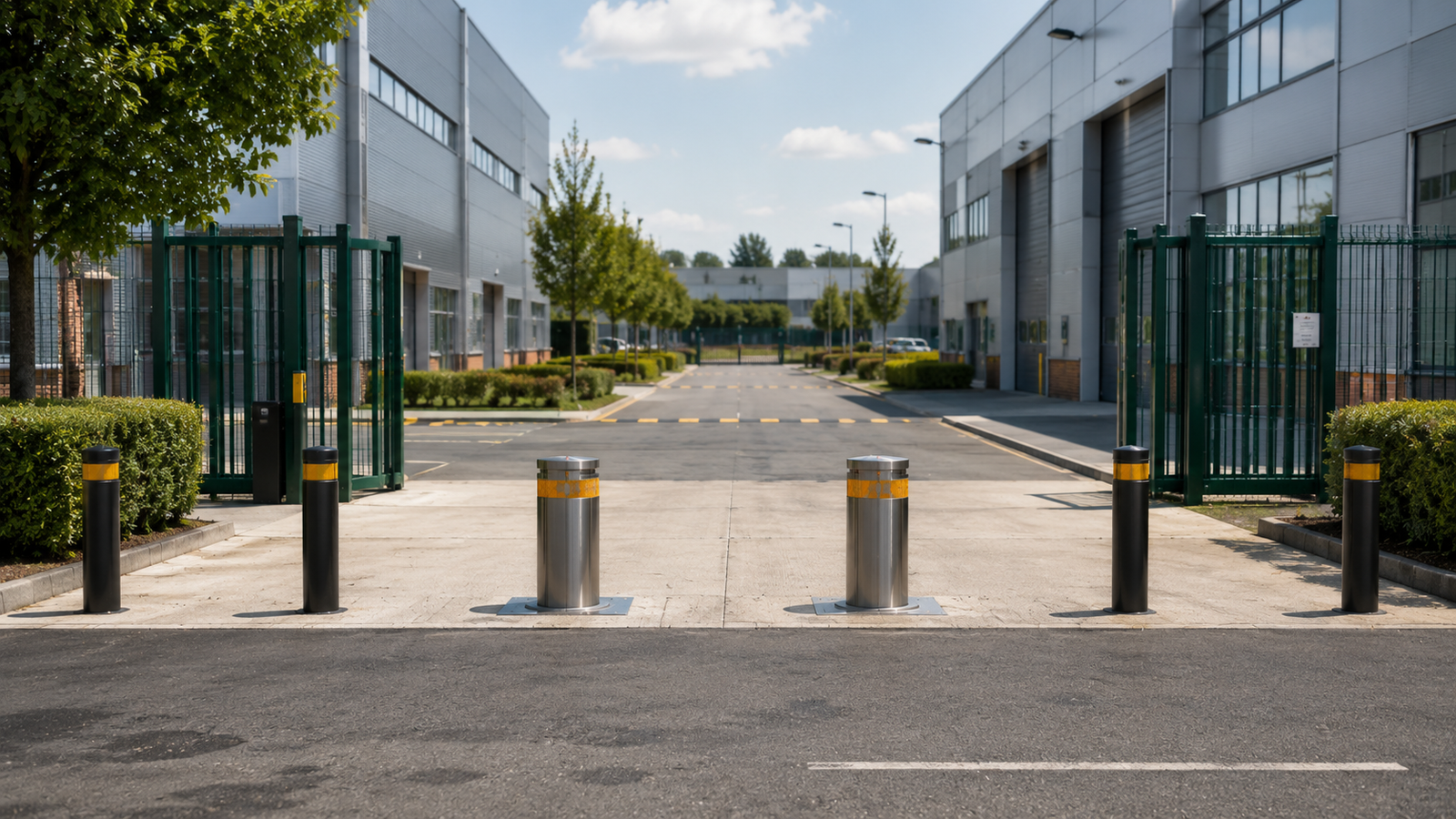
If you are planning wider site access control too, think about where vehicles are stopped, queued and turned before they reach the door: bollards and gates at the yard entrance keep traffic away from pedestrian routes and from the building itself.
Keep people out of the vehicle opening
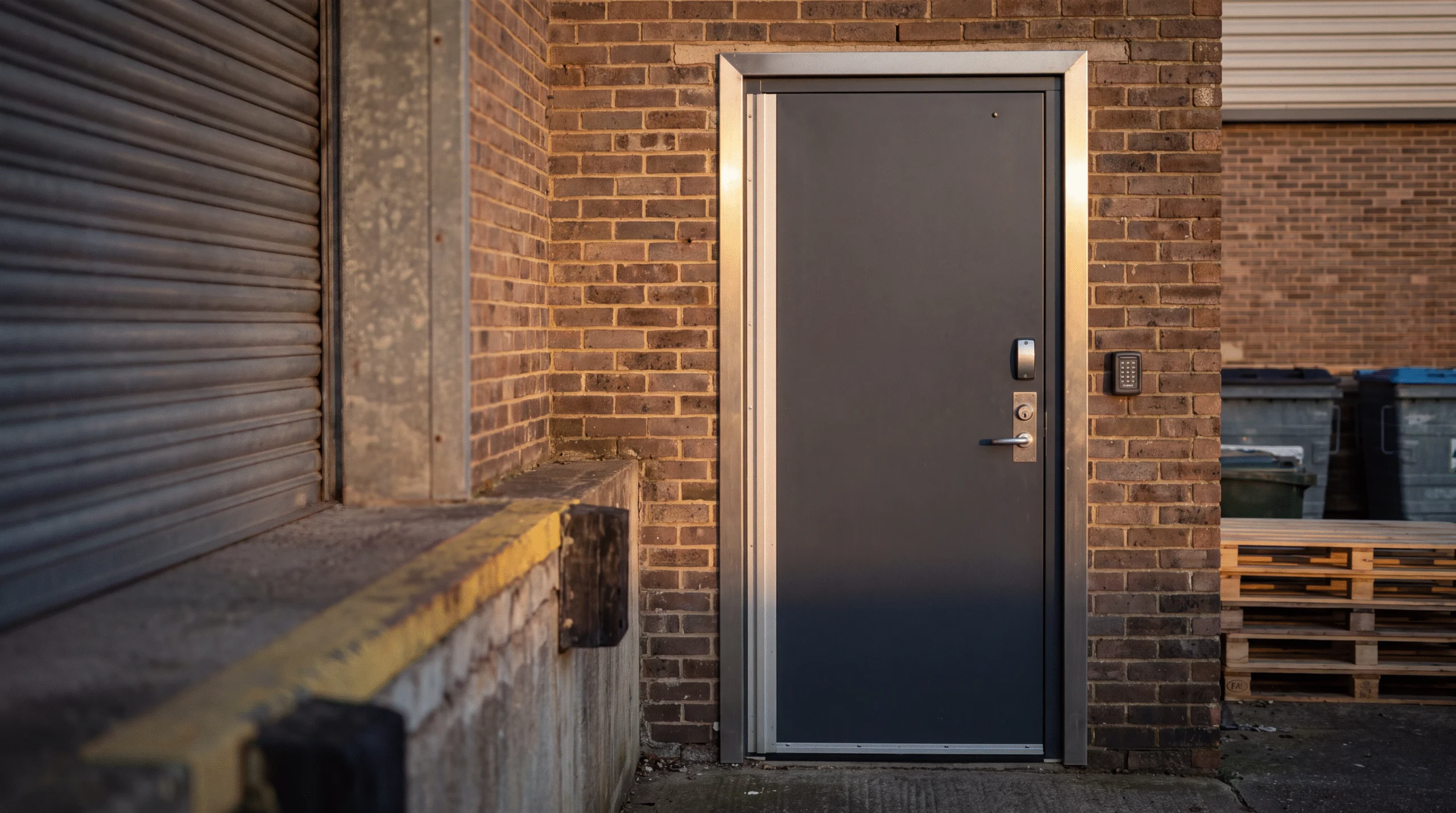
Roller shutters are generally not designed to include a pass door in the curtain, so staff should use a separate personnel door rather than walking under a moving or part-open shutter. It also saves running a large door just to let one person through. Regulation 17 of the Workplace Regulations requires workplaces to be organised so pedestrians and vehicles can circulate safely, including sufficient separation of vehicle routes from doors that pedestrians use. The HSE’s guidance on separating pedestrians and vehicles explains what that looks like in practice. Specify the personnel door with the same care as the shutter: it needs to be as secure as the opening beside it.
Planning a new warehouse door?
Call our installation team or send us the opening size, what passes through it and a photo. We will arrange a survey, record the dimensions, headroom, side room, power and how the door is used, then talk you through the specification.
Step 8: maintenance and downtime
A warehouse door that fails at the start of a shift can hold up deliveries and despatch for hours. Busy doors wear faster than shop shutters: seals, guide liners, the safety edge, the brake and the drive all see far more cycles. Planned servicing catches wear before it causes a breakdown, and a written record helps you spot patterns, such as one door that keeps being hit.
When you specify the door, ask for:
- The handover information: what was fitted, how the controls work, where the manual override is and what checks your staff can safely do;
- A service plan that reflects how often the door actually runs, rather than a one-size interval;
- A clear route for breakdowns, including out of hours.
Our roller shutter maintenance service plans visits around how each door is used, and our 24/7 emergency shutter repair line is answered 24 hours a day, 365 days a year, usually with an engineer with you within 2 hours. Our upcoming roller shutter servicing guide explains what a service includes and how often you need one.

Common specification mistakes
When a warehouse door gives constant trouble, the cause can often be traced back to decisions made before it was ordered. These are the mistakes we see most often:
- Undersizing the drive for the real workload. A drive that copes with a few operations a day can overheat or wear quickly on a door that runs constantly. Specify for the busiest realistic day.
- Ignoring the wind. Wide doors on exposed elevations need to be specified for wind load. Without it, the curtain can rattle, drag or come out of the guides in a storm.
- Controls in the wrong place. Buttons hidden behind racking, or placed where the operator cannot see the bottom of the door, create a safety risk and encourage people to leave the door open.
- Adding a remote later without upgrading safety devices. Changing how a door is controlled can change the protection it needs.
- No impact protection. A door fitted without guide protection on a busy yard is very likely to be hit.
- Forgetting pedestrians. Without a separate personnel door, people walk through the vehicle opening and under part-open curtains.
- Choosing an insulated curtain without sizing the drive for it. Insulated laths are heavier; the barrel, box and motor must suit the extra weight.
- Choosing on price alone. The cheapest door is rarely the cheapest over its life if it breaks down at the start of a shift and holds up deliveries.
What happens at a survey
A proper survey is the foundation of a warehouse door that fits and works. This is how we approach it for every industrial opening:
- Survey the opening. We record dimensions, headroom, side room, power and how the door is used through the day.
- Agree the specification. Curtain, guides, operation, controls and finish are matched to the site and the brief.
- Build in our workshop. The shutter is manufactured to the surveyed size and checked by our team before it leaves the workshop.
- Install and hand over. Our installers fit the door, test it under load and explain the controls and the maintenance route.

If you would like a feel for what affects the price of a new door before the survey, our guide to roller shutter installation cost explains the main factors. We do not publish a price list, because a warehouse door is priced on the surveyed opening and the agreed specification.
★★★★★
“Contacted this company on Saturday, owner answered and advised he was on holiday in Spain but gave me a verbal quote , agreed to measure up on Monday, arrived as agreed. I placed the order , and they came and fitted on Friday.”
Martin Thompson, Google review
How to compare warehouse door quotes
Two quotes for “a roller shutter” can describe very different doors. Put them side by side against these points:
| Check | A good quote | A warning sign |
|---|---|---|
| Survey | Based on a site survey of the opening, headroom, side room and power | A price from a width and height given over the phone |
| Use | States how often the door is expected to run, and sizes the drive for it | No mention of frequency of use |
| Curtain | Lath type, material and finish stated | “Steel shutter” with no detail |
| Wind | Explains how wide or exposed openings are dealt with | Not mentioned on a wide door on an open site |
| Controls and safety | Lists the controls and the safety devices that go with them | A remote offered with no safety edge or photocells |
| Power | States the supply needed and who provides it | Electrical work left vague |
| Protection | Includes or recommends guide protection on busy yards | No mention on a forklift route |
| Handover and aftercare | Testing, handover, guarantee and servicing explained | Nothing after “fit” |
Your legal duties
A warehouse door is workplace equipment. As well as regulation 18 on doors and gates and regulation 17 on traffic routes, regulation 5 of the same regulations requires equipment and devices covered by them to be maintained in an efficient state, in efficient working order and in good repair. Industrial and commercial doors are assessed against the product standard BS EN 13241, which is the basis for a door’s declaration of performance and conformity marking. If your warehouse door doubles as a fire separation, it is a different product with its own requirements: see our fire shutters page. If you are unsure what applies to your site, take advice from your health and safety adviser.
Checklist before you order
- ☐ Approximate width and height of the opening, and the largest vehicle or load
- ☐ What passes through and how many times a day the door will run, now and in future
- ☐ Headroom above the opening and side room either side, with any obstructions
- ☐ The structure the door will be fixed to, and the condition of the floor
- ☐ How exposed the elevation is to wind
- ☐ Power near the opening, and whether three-phase is available
- ☐ How the door will be controlled, by whom, and from where
- ☐ Your priority: security, insulation, visibility or weather
- ☐ Insurer requirements for security, in writing
- ☐ Impact protection and a separate pedestrian door
- ☐ A maintenance plan from day one
★★★★★
“Quick turnaround, installed within 24 hours”
strikefx uk, Google review
Warehouse doors across the West Midlands and the UK
We have worked with businesses of every size, including KFC, Lidl and JD Sports. Our workshop is in the West Midlands, and we fit industrial doors across the region and further afield, including roller shutters in Birmingham and Wolverhampton. For other locations, see the areas we cover or call and we will confirm attendance for your site. For a closer look at the components that make up your door, see our guide to roller shutter parts explained.
Frequently asked questions
What size roller shutter do I need for a warehouse?
That depends on the vehicles and loads using the opening. Measure the structural opening and the largest vehicle or load that passes through, then leave final sizing to the surveyor, who will also check headroom, side room, the structure and the floor.
Are roller shutters or sectional doors better for warehouses?
Neither is better everywhere. Roller shutters need little space inside the building and are strong and secure. Insulated sectional doors are often stronger on thermal performance but need room for tracks. The right choice depends on headroom, heating and how the opening is used.
Do warehouse shutters need three-phase power?
Not always. Smaller doors may run on single-phase, while larger and heavier doors often need three-phase. The surveyor will confirm the requirement for your door; check what supply is near the opening as early as possible.
Can a warehouse roller shutter have a pass door?
Roller shutters are generally not designed to include a pass door in the curtain. A separate personnel door beside the shutter is the usual answer, and it keeps people out of the vehicle opening.
How can I stop forklifts damaging the shutter?
Fit guide protectors or bollards, mark and light the opening, make sure the door is fully open before vehicles pass, and train drivers. Prevention costs far less than repeated repairs to guides, bottom rails and curtains.
Can you insulate an existing warehouse shutter?
Sometimes the curtain can be replaced with insulated laths, but they are heavier, so the barrel, box and drive must be checked to see whether they suit the extra weight. A survey will tell you whether a new curtain, a new shutter or a sectional door makes more sense.
How often should a warehouse shutter be serviced?
It depends on how heavily it is used, its environment and the manufacturer’s guidance. Doors that run many times a day need more frequent servicing than lightly used doors. We plan visits around how each door is actually used.
Can an existing industrial shutter be repaired instead of replaced?
Often, yes. Our repair team covers mechanical, electrical and impact damage. Where a shutter is beyond economic repair, we will say so and quote for a replacement.
Talk to us about your warehouse door
Whether you are fitting out a new unit or replacing a door that keeps letting you down, tell us about the opening and how it is used. We build every industrial shutter in our own West Midlands workshop to the surveyed size of the opening.
- Installation and service line: 07931 104162
- Emergency repair line (24/7): 07931 104160
