
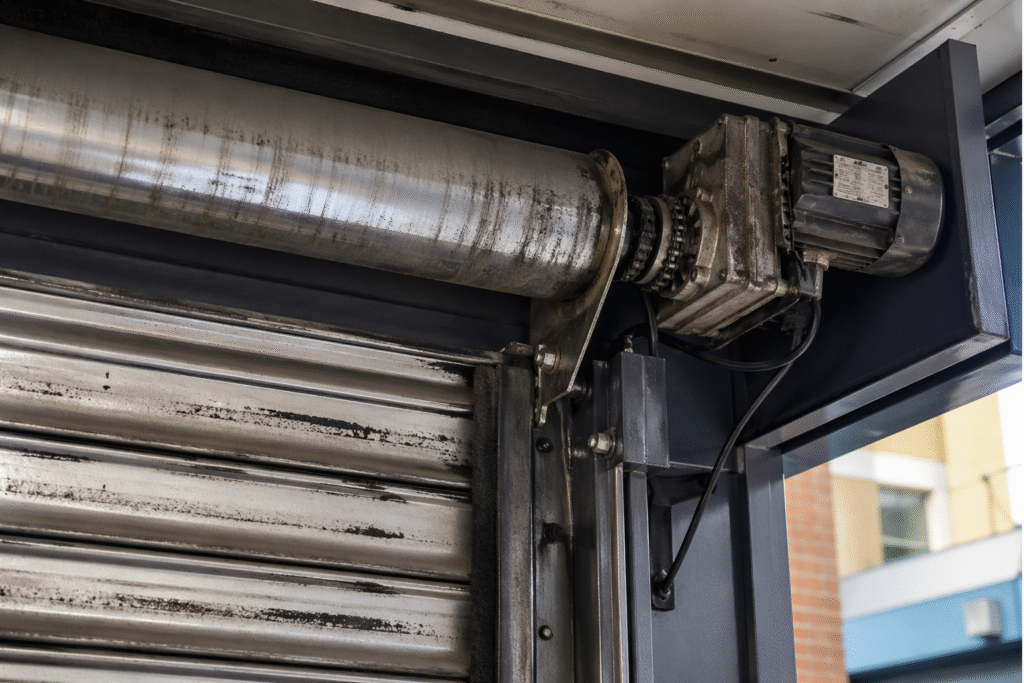
Knowing the main roller shutter parts makes it much easier to describe a fault, understand a repair quote and spot problems before they become breakdowns. Every roller shutter, from a small shopfront shutter to a large warehouse door, is built from the same core components: a curtain of interlocking laths, a bottom rail, two guide rails, a barrel the curtain coils around, end plates or brackets that carry the barrel, and a box that covers it all. What changes from one shutter to the next is how it is lifted and held: springs and a handle, a gearbox and hand chain, or an electric motor with its controls and safety devices. This plain-English guide explains what each part does, what typically goes wrong with it, and what you can and cannot safely check yourself.
We are Sunrise Shopfronts & Shutters, a roller shutter manufacturer and repairer based in West Bromwich. Because we build shutters in our own West Midlands workshop, we know how each component fits and works with the others, and that is the knowledge we have tried to put into this guide.

Key takeaways
- Every shutter shares the same frame: curtain, end locks, bottom rail, guides, barrel, end plates and box.
- The drive is what differs: springs for push-up shutters, a gearbox and chain for heavier manual doors, or a tubular or external motor.
- Some parts store energy or carry the curtain’s weight. Springs, the barrel, brakes and motors are engineer-only.
- Safety devices are parts too: safety edges, photocells and fall-back protection should be repaired, never bypassed.
- Seals, liners, end locks and safety edges wear fastest, especially on busy doors.
- Using the right names, plus a photo, helps an engineer arrive with the right parts and fix it first time.
In this guide
- Roller shutter parts: the quick answer
- Inside a roller shutter: the side view
- The curtain and laths
- End locks and wind locks
- The bottom rail
- Guide rails
- The box, barrel and end plates
- Springs
- Manual or electric: which parts you have
- Motors, brakes and limits
- Controls and the control panel
- Safety devices
- How the parts work together
- The parts that wear fastest
- How to describe a fault
- Replacement parts
- Glossary of shutter parts
- Frequently asked questions
Roller shutter parts: the quick answer
These are the main parts of a roller shutter, from the bottom up:
- Bottom rail: the heavier section at the base of the curtain, usually with a floor seal and, on many powered shutters, a safety edge.
- Curtain: the moving door, made from horizontal laths that interlock along their length.
- End locks and wind locks: clips on the ends of the laths that keep the curtain in line and in the guides.
- Guide rails: the vertical channels either side of the opening that the curtain runs in.
- Barrel: the tube the curtain is fixed to and coils around.
- End plates or brackets: carry the barrel and the weight of the curtain into the building.
- Box (hood): covers the coiled curtain and the drive.
- Drive: springs, a gearbox and hand chain, or an electric motor with a brake and limits.
- Controls: locks on a manual shutter; key switches, push buttons, remotes and a control panel on an electric one.
- Safety devices: fall-back protection on all workplace shutters, and on powered shutters the features that stop the door trapping anyone, such as a safety edge and photocells.
Inside a roller shutter: the side view
Most people only ever see a shutter from the front. Looking at it from the side makes it much easier to understand what is inside the box, where the weight goes and why some faults show up where they do. The diagram below is a simplified cut-through of a face-fixed electric shutter, with three close-ups that engineers often refer to: how laths interlock, how the curtain sits in the guide, and the three ways the barrel can be turned.
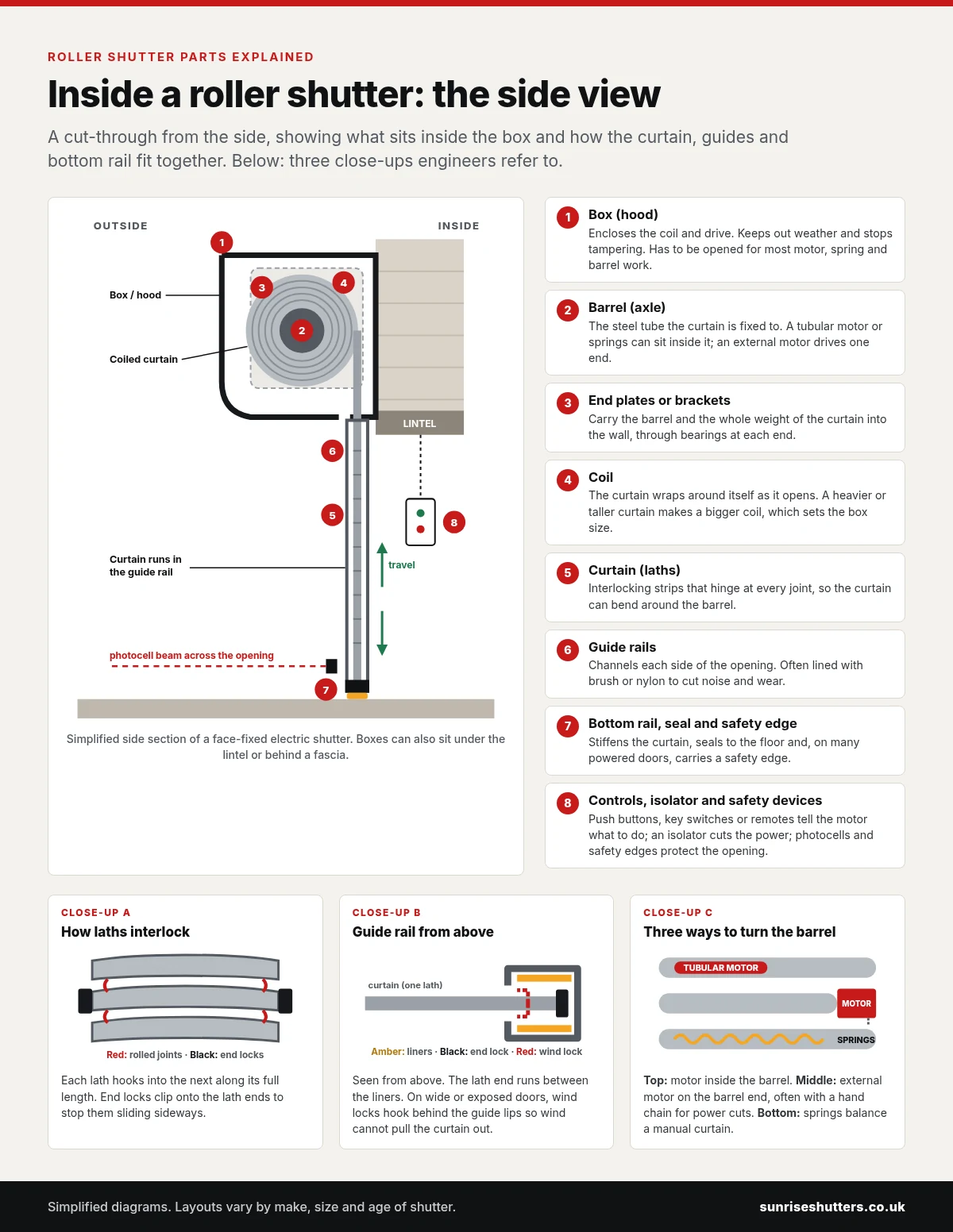
For a front view showing which of these parts most often fail, and the symptoms each one causes, see the anatomy diagram in our guide to roller shutter repair cost.
The curtain and laths
The curtain is the part that moves up and down. It is made from horizontal strips called laths (sometimes called slats) that hook into each other along their whole length. Each joint acts like a hinge, which is what lets the curtain bend around the barrel as it opens and hang flat when it closes.
Laths are usually roll-formed from galvanised steel or aluminium, and they come in different profiles and types. The type of lath decides how the shutter looks, how much it lets through, how heavy the curtain is and which replacement sections will match.
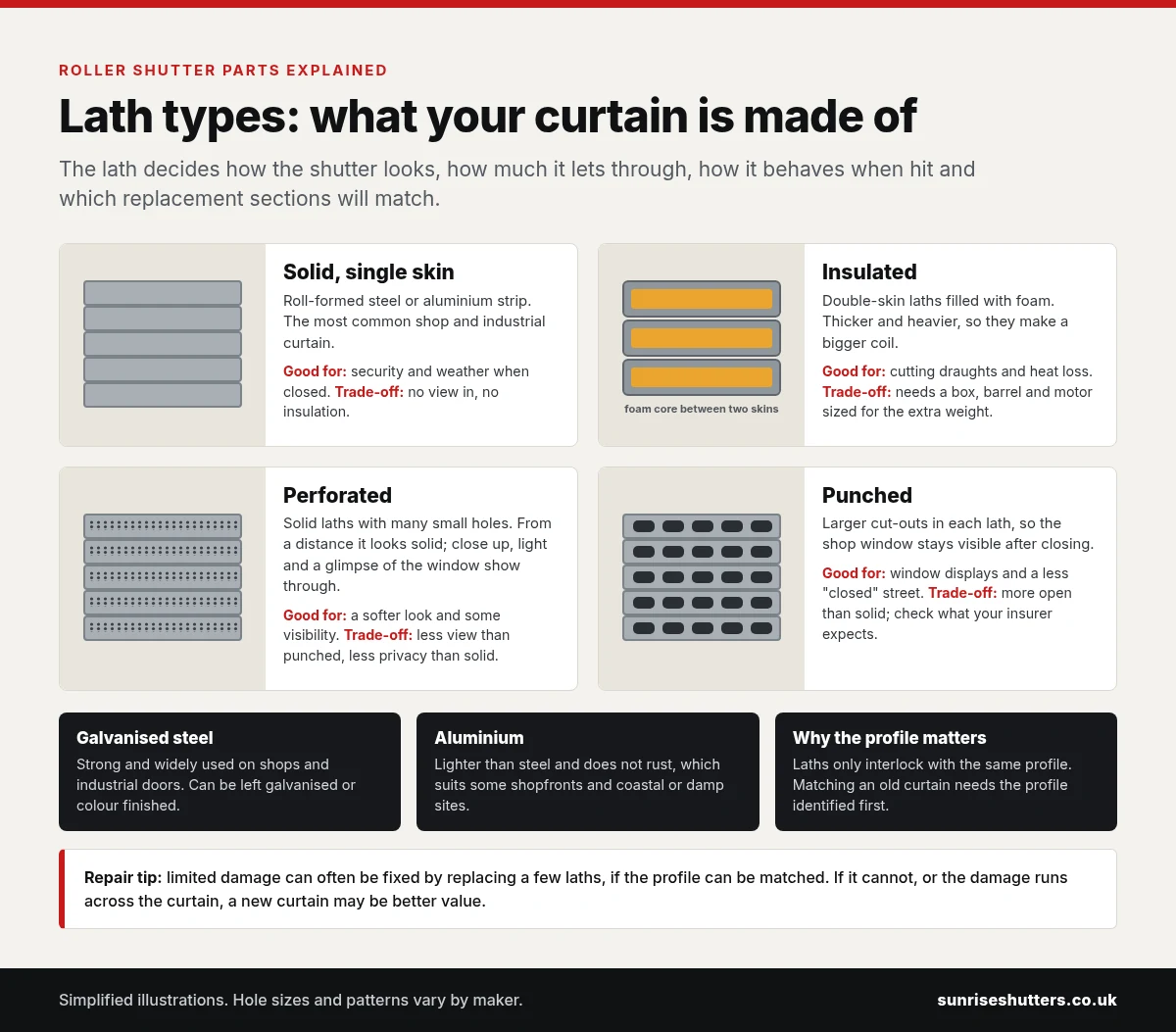
- Solid laths are the most common choice for shopfront and industrial shutters, where security and weather protection come first.
- Insulated laths have two skins with a foam core. They cut draughts and heat loss but are heavier and thicker, so they need a box, barrel and drive sized for them. Our article on whether insulated roller shutters are worth it goes into more detail.
- Perforated laths have many small holes, so light and a glimpse of the window show through.
- Punched laths have larger cut-outs that keep a display visible after closing. Our guide to perforated roller shutters compares perforated, punched and solid curtains, and our article on security grilles vs solid shop shutters covers the most open options.

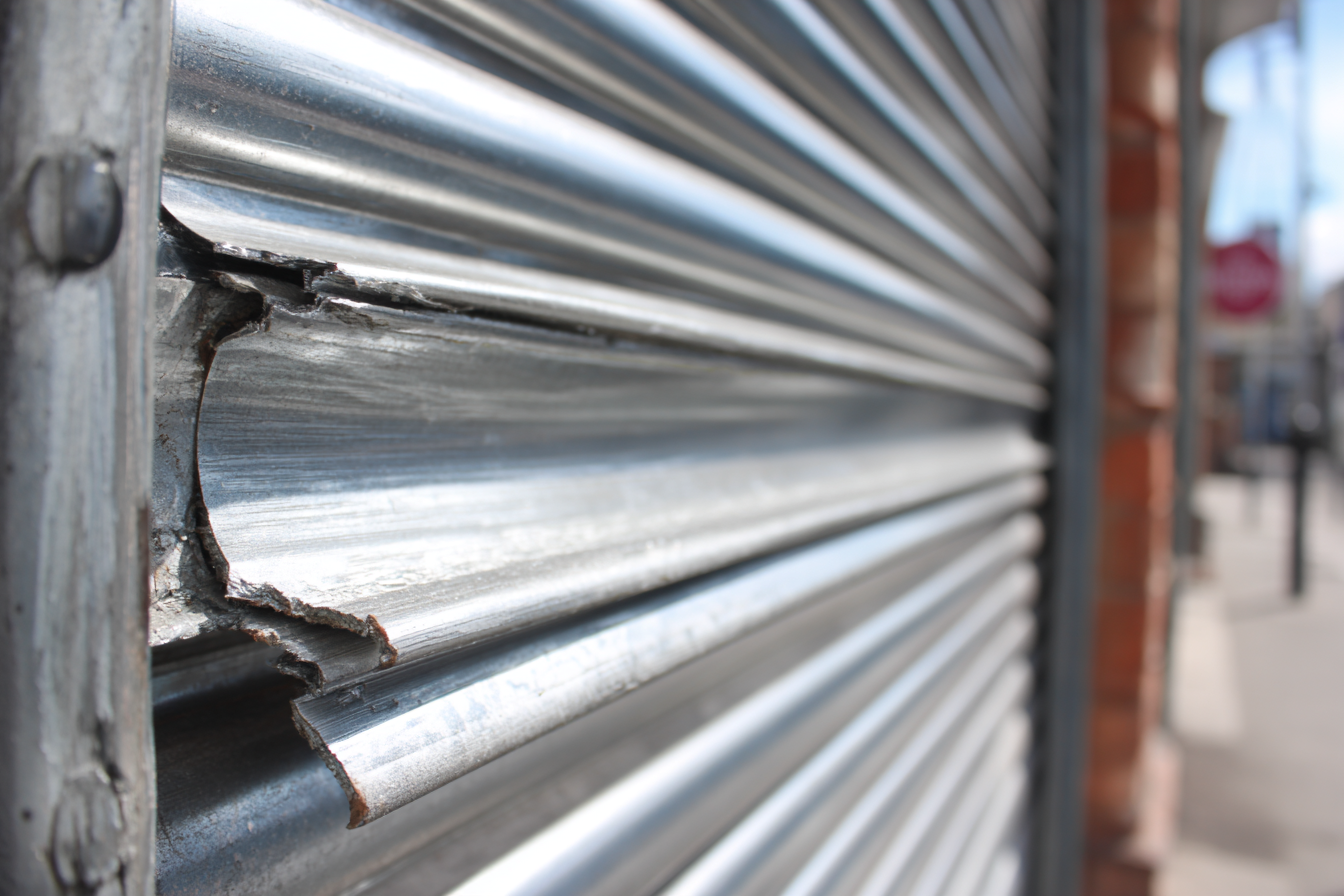
What goes wrong: laths get dented, bent or split by vehicles, trolleys, forced entry or the curtain being closed onto an obstruction. A damaged lath can catch in the guides, make the shutter run crooked, stop it closing or tear further each time it coils. The material also changes how damage behaves; our comparison of steel vs aluminium roller shutters explains the difference.
End locks and wind locks
End locks are small clips, usually plastic or metal, fitted to the ends of the laths. They stop the laths sliding sideways and help keep the curtain running centrally in the guides. Wind locks are stronger versions designed to hook behind the guide, so wind pressure cannot pull the curtain out. They matter most on wide doors and exposed elevations.
What goes wrong: end locks crack, wear or fall out over time. Once they are missing, laths start to drift sideways. You may notice laths sticking out at one side, the curtain rubbing on one guide, a scraping noise, or a shutter that starts to run crooked. Caught early, this is usually a small repair; left alone, it can lead to the curtain coming out of the guides.
The bottom rail
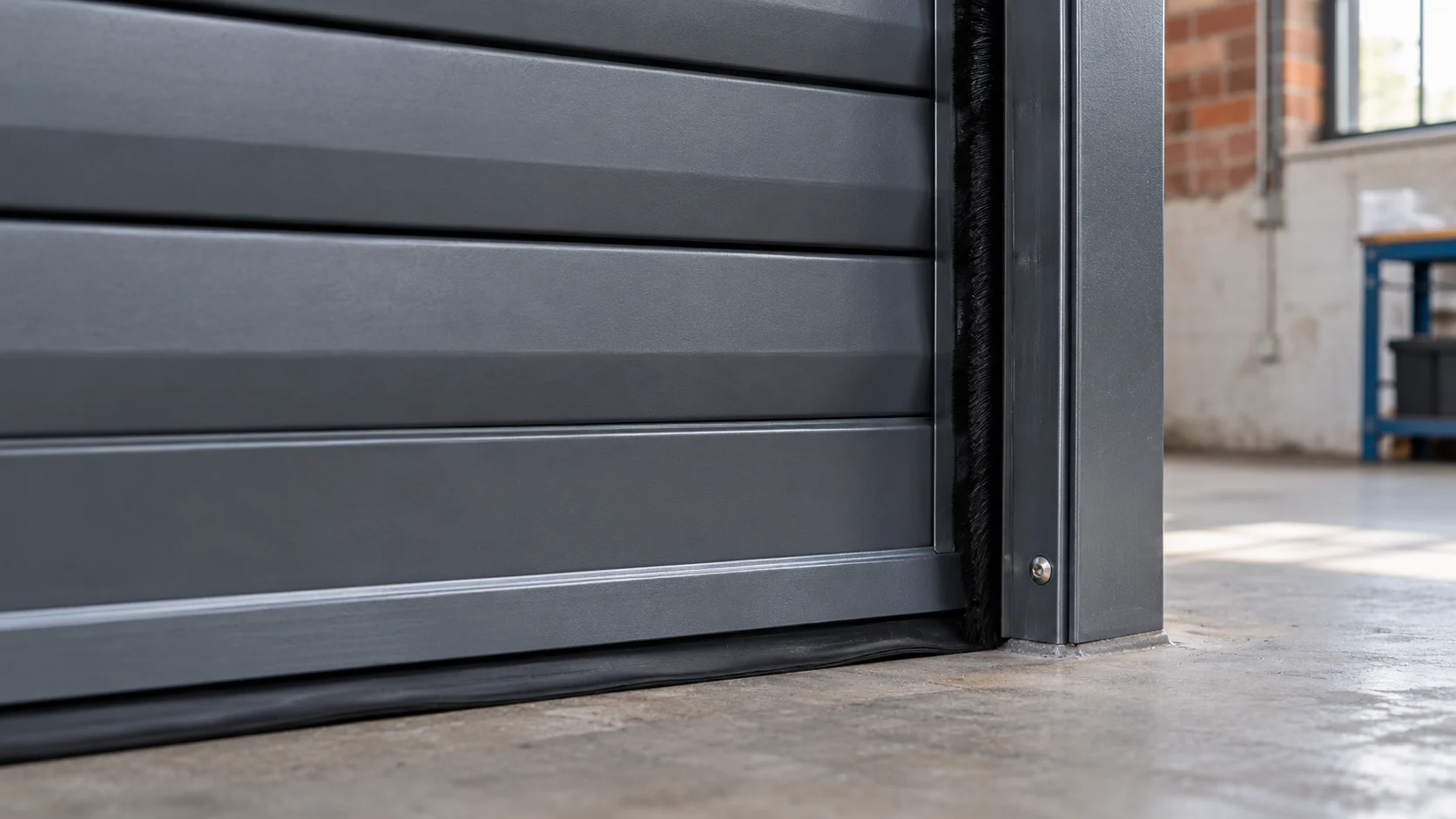
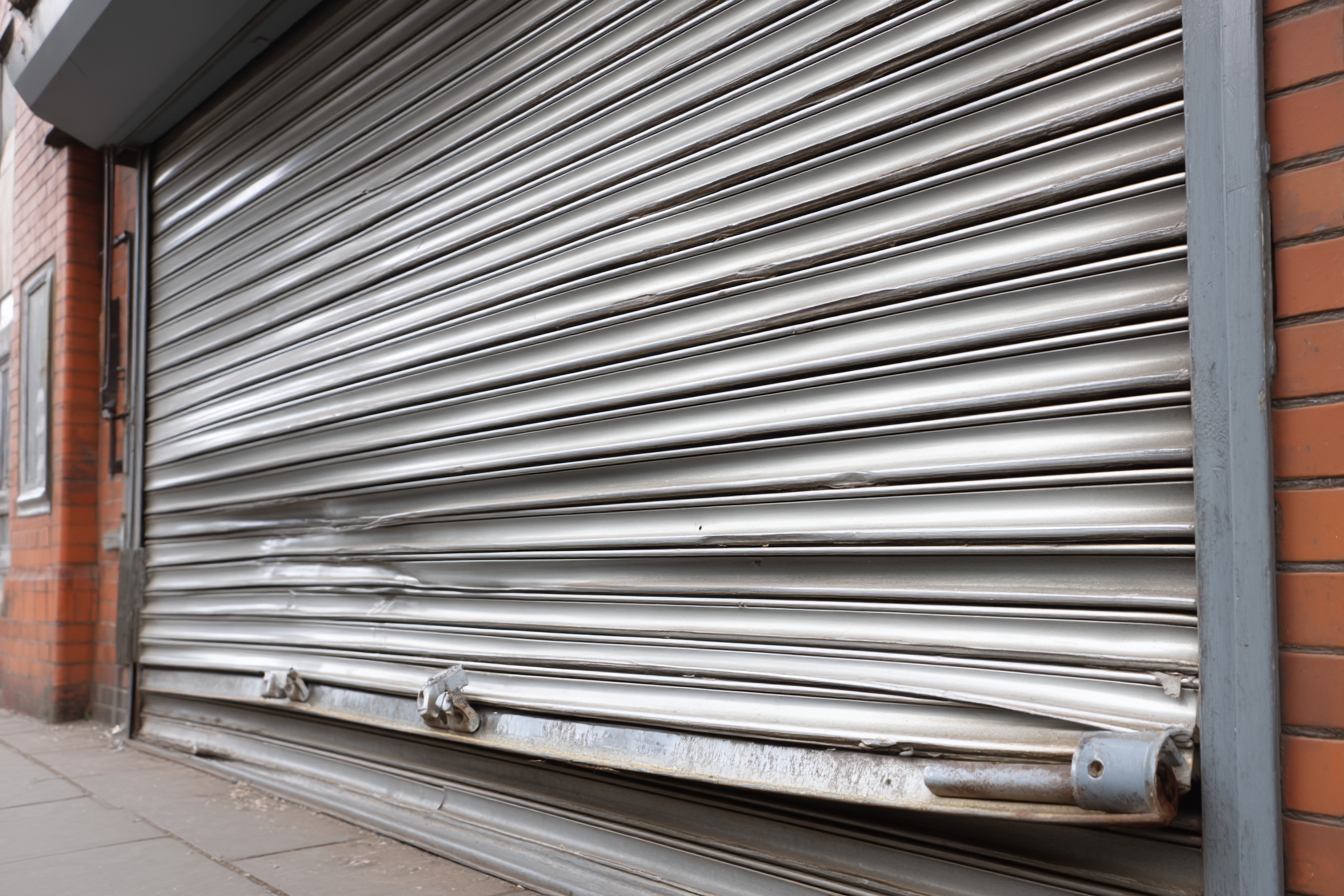
The bottom rail (also called the bottom bar or bottom slat) is the heavier section at the base of the curtain. It adds weight and stiffness, carries the floor seal, and on many powered shutters carries the safety edge. On manual shutters it often carries the locks as well.
What goes wrong: the bottom rail takes more punishment than any other part. Vehicles clip it, trolleys hit it, and the curtain gets closed onto stock, bins or A-boards left in the drop zone. A bent bottom rail can stop the shutter closing fully or locking, and a damaged safety edge can make a powered shutter stop or reverse for no visible reason. Worn seals let in draughts, rain and dust.
Guide rails
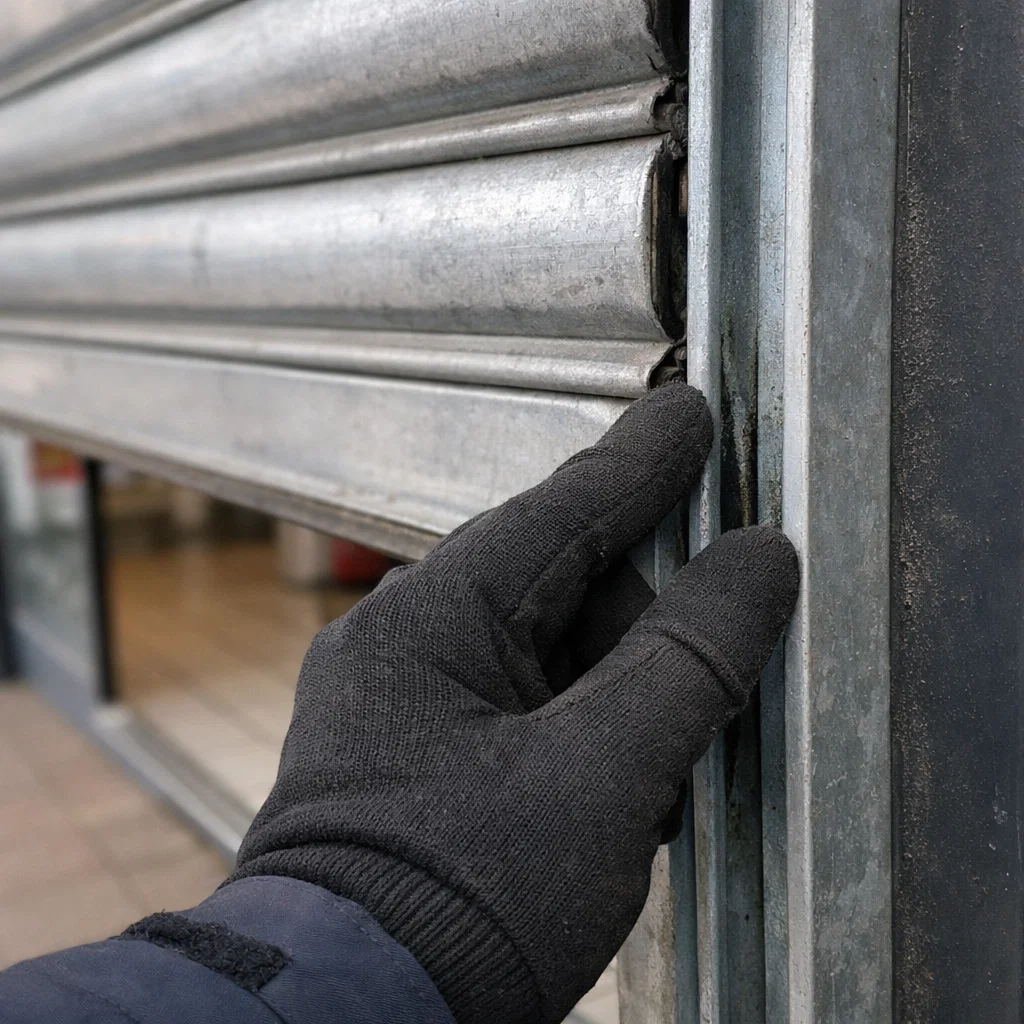
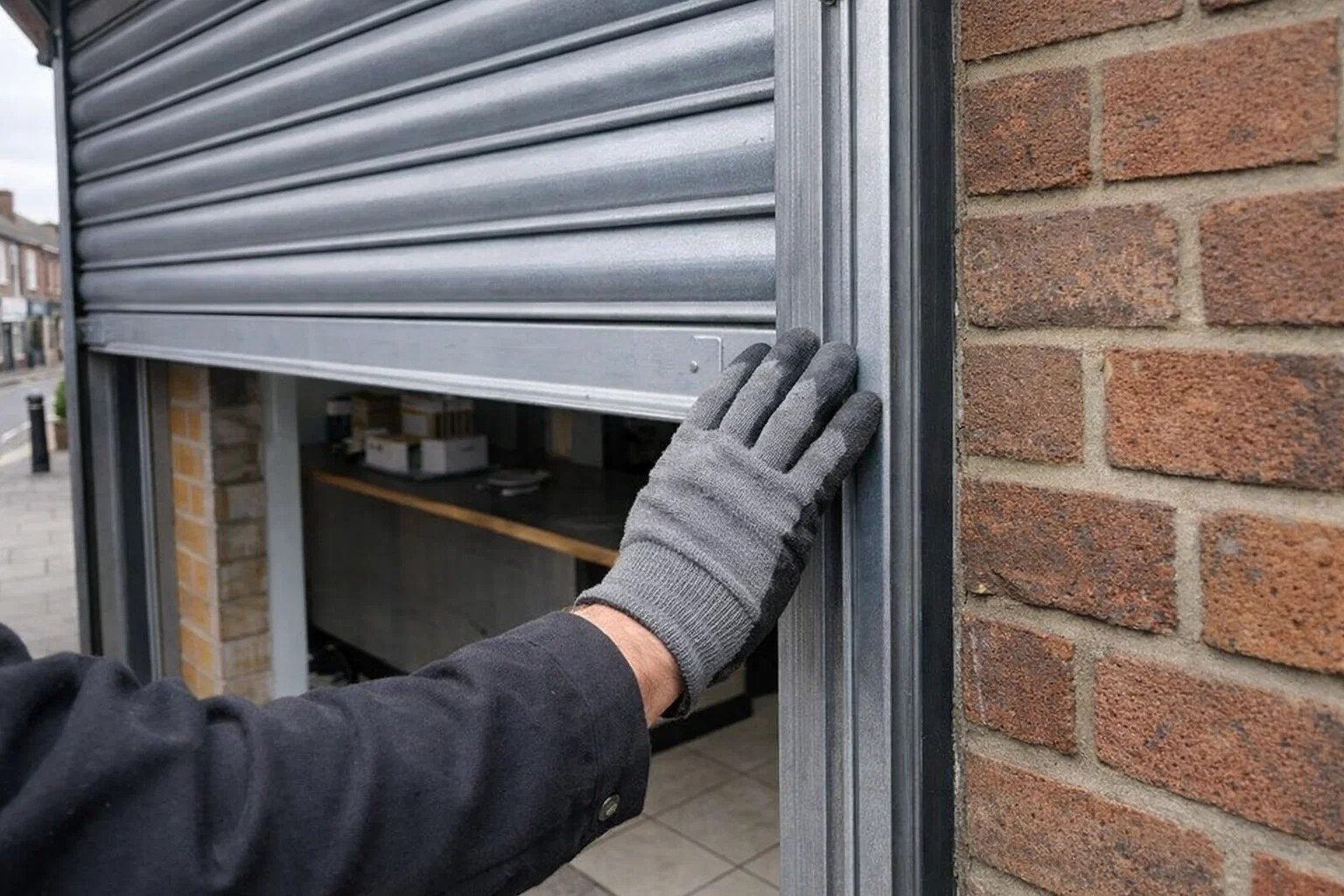
The guide rails are the vertical channels either side of the opening that the curtain runs in. Many are lined with brush, wool pile or nylon strips that reduce noise and wear and help seal the edges. Deep guides make it harder to lever the curtain out, which helps security, and on wide doors the guides carry wind load into the structure.
What goes wrong: guides get bent by vehicles and forced entry, work loose from their fixings, or fill with grit, leaves and packaging straps. A bent guide can jam the curtain at one point, and running a shutter through a damaged guide spreads the damage to the laths and makes the motor work harder. Worn liners make the shutter noisier and let it rattle in the wind.

The box, barrel and end plates
The box (hood)
The box covers the coiled curtain and the drive. It protects the mechanism from weather and tampering and gives a neater finish. Boxes can be fixed on the face of the wall, tucked under a lintel, or hidden behind a fascia or inside the building. Most motor, spring and barrel work means opening the box, so its position also affects how easily an engineer can get to the mechanism.

What goes wrong: boxes get dented, lose fixings or let water in if damaged. Water inside the box can reach the motor and its wiring.
The barrel (axle)
The barrel is the tube the curtain is fixed to and coils around. On spring-balanced shutters, the springs sit inside or around the barrel. On electric shutters, a tubular motor may sit inside it, or an external motor may drive it from one end. The barrel has to be strong enough for the full weight of the curtain without bending.
What goes wrong: a barrel can bend if a shutter is overloaded, struck or fitted with a heavier curtain than it was designed for. A bent barrel makes the curtain coil unevenly and run crooked.
End plates, brackets and bearings
End plates or brackets at each end hold the barrel in position and transfer the weight of the shutter into the building, through bearings that let the barrel turn smoothly. They need to be fixed securely into sound structure.
What goes wrong: bearings wear on busy shutters, usually showing first as grinding, knocking or squealing at the top of the shutter. Fixings can work loose, especially in poor or crumbling masonry.
Springs
On manual push-up shutters, and on some other manual designs, springs inside or around the barrel balance the weight of the curtain. That is what lets one person lift a heavy curtain by hand and makes it stay up when open. To do that job, springs store a great deal of energy.
What goes wrong: springs gradually lose tension with use and can break. A shutter that suddenly becomes heavy to lift, will not stay up, or drops quickly may have a spring problem.
Never adjust or release shutter springs yourself. They can release their energy suddenly and cause serious injury. If a manual shutter drops on its own, keep people clear and call an engineer.
Shutter stuck, damaged or leaving you insecure?
Our emergency line is answered 24 hours a day, 365 days a year, and we usually have an engineer with you within 2 hours to make the opening safe and plan the right repair.
Manual or electric: which parts you have
The parts above are shared by every roller shutter. What differs is how the curtain is lifted, held and controlled. Most shutters you will meet in the UK fall into one of four set-ups:
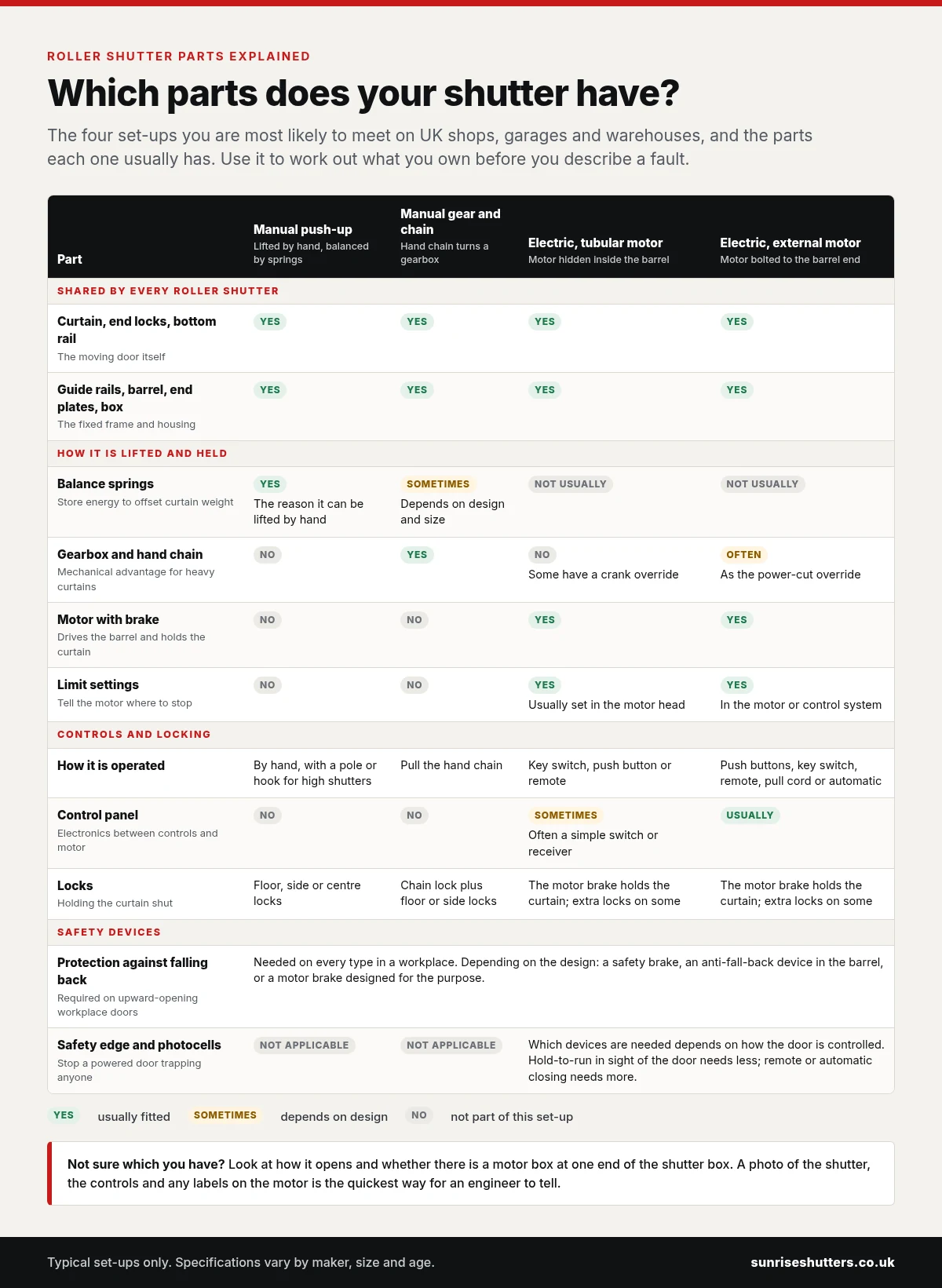
- Manual push-up: lifted by hand, balanced by springs, locked with floor, side or centre locks. Common on smaller shopfronts and garages.
- Manual gear and chain: a hand chain turns a gearbox that turns the barrel, giving one person enough mechanical advantage to raise a heavier curtain.
- Electric, tubular motor: the motor sits hidden inside the barrel. Common on lighter shopfront and domestic garage shutters.
- Electric, external motor: the motor is mounted at one end of the barrel, outside it. Common on heavier commercial and industrial doors, and often fitted with a hand chain for operation in a power cut.
If you are weighing up the two approaches for a new shutter, our guide to manual vs electric roller shutters compares cost, convenience and security, and our upcoming guide to warehouse roller shutter doors covers drives and controls for busy industrial openings.
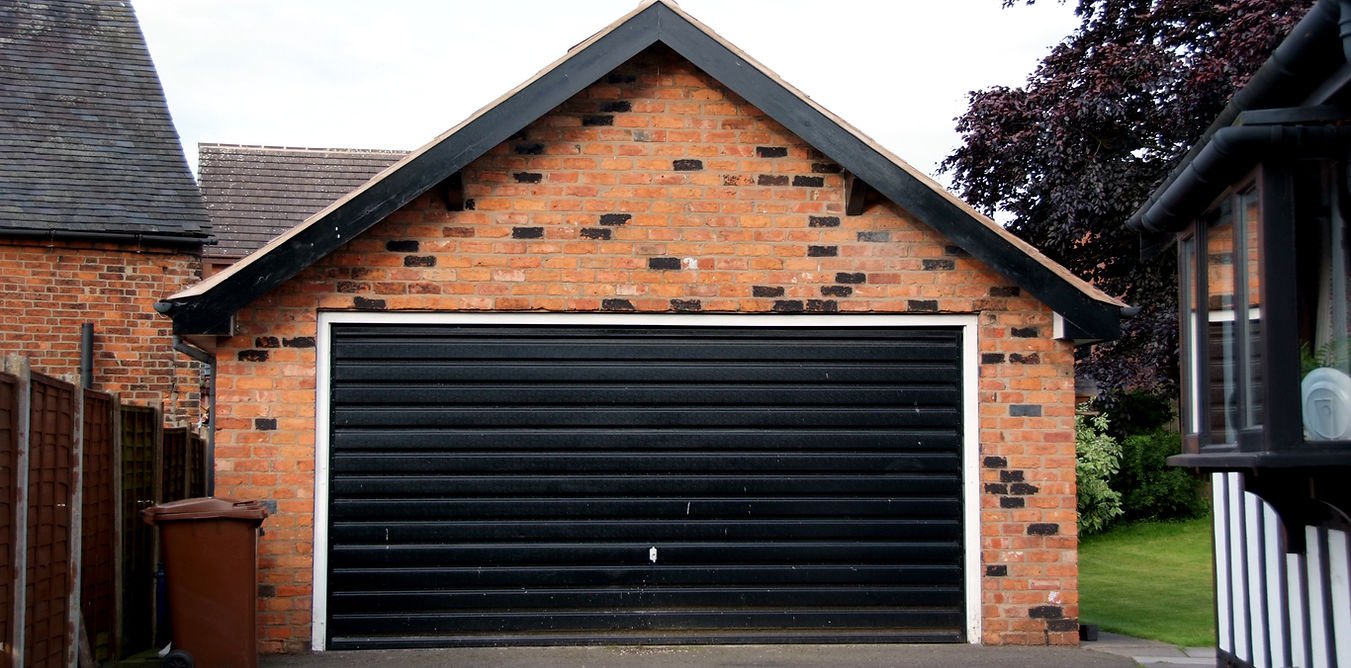
Motors, brakes and limits
The motor
An electric shutter motor turns the barrel to raise and lower the curtain. It has to be matched to the size and weight of the curtain and to how often the shutter runs. A motor that is too small for the curtain, or for the workload, will struggle, overheat and wear early.
The brake
The motor includes a brake that holds the curtain still when the motor stops, whether the shutter is fully open, fully closed or stopped part way. That is why an electric shutter does not slide down on its own when the power is off.
Limits
Limit settings tell the motor where to stop at the top and bottom of travel. They are set when the motor is installed. If they drift, the shutter may stop short of the floor, leave a gap at the bottom, strain at the top, or over-run.
Thermal cut-out and manual override
Many shutter motors have a thermal cut-out that stops them if they overheat after repeated use; leave them to cool before trying again. Where it is needed for safety, a powered shutter in a workplace must be capable of manual operation unless it opens automatically if the power fails. On external motors this is often a hand chain; some tubular motors have a crank override.
What goes wrong: motors can overheat, lose power, develop brake faults, drift out of their limits or fail altogether. A motor that hums but does not turn, runs slower than it used to or cuts out part way needs an engineer, and the cause is not always the motor itself; a curtain dragging in a damaged guide makes any motor struggle. Our article on the signs it is time to upgrade your shutter motor explains the warning signs and why a like-for-like swap is not always the right answer.
Controls and the control panel
Electric shutters can be operated in several ways, often more than one on the same shutter:
- Key switches, usually outside, so only key holders can operate the shutter;
- Push buttons, typically open, stop and close, often hold-to-run so the shutter only moves while the button is held;
- Remote handsets and the receiver that listens for them;
- Pull cords, timers and detectors on industrial doors.
On many commercial and industrial shutters, the controls connect to a control panel that houses the electronics managing the motor and the safety devices. Smaller shutters may just have a switch or receiver. An isolator nearby lets an engineer, or you in an emergency, cut the power to the shutter.
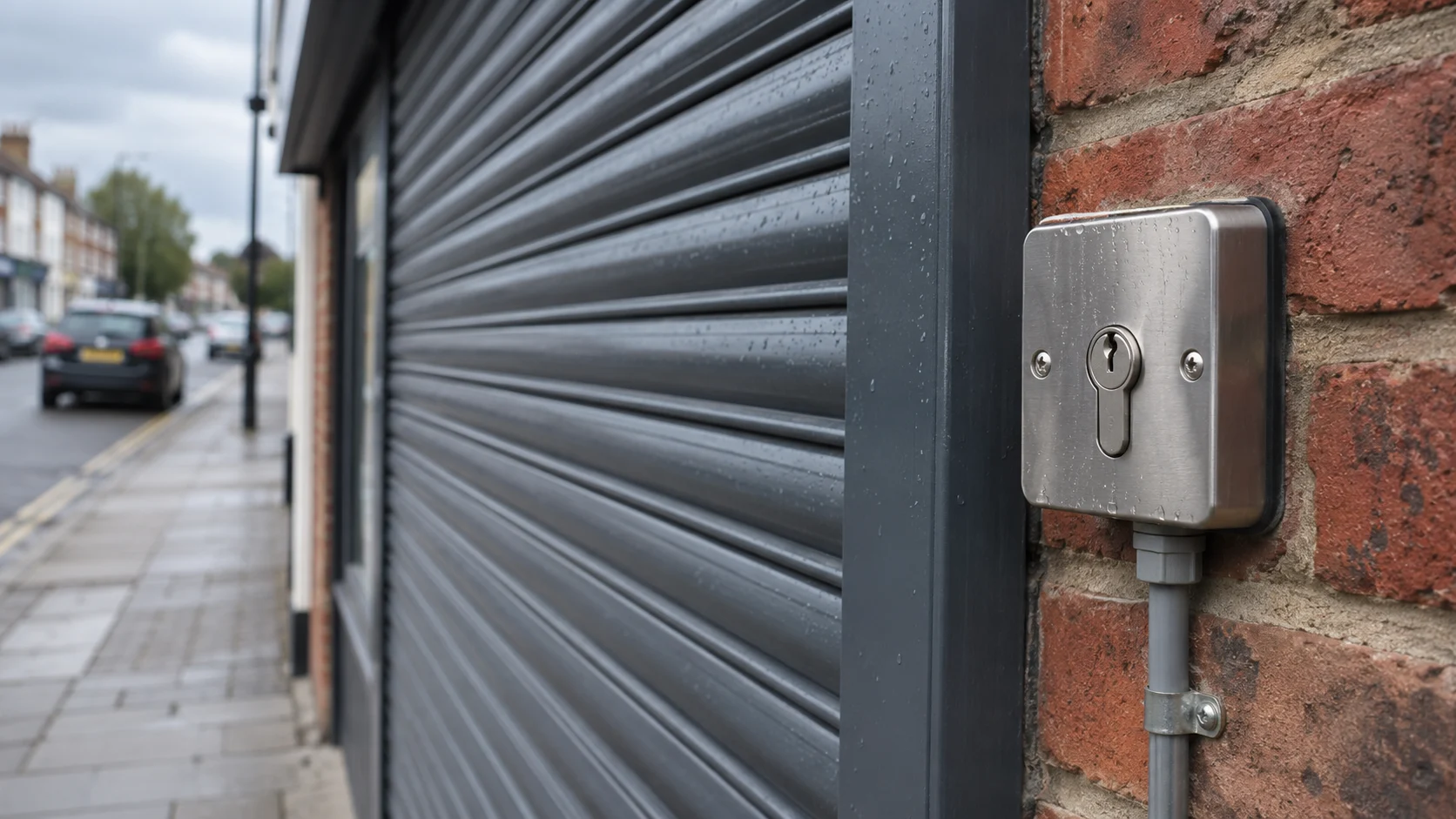
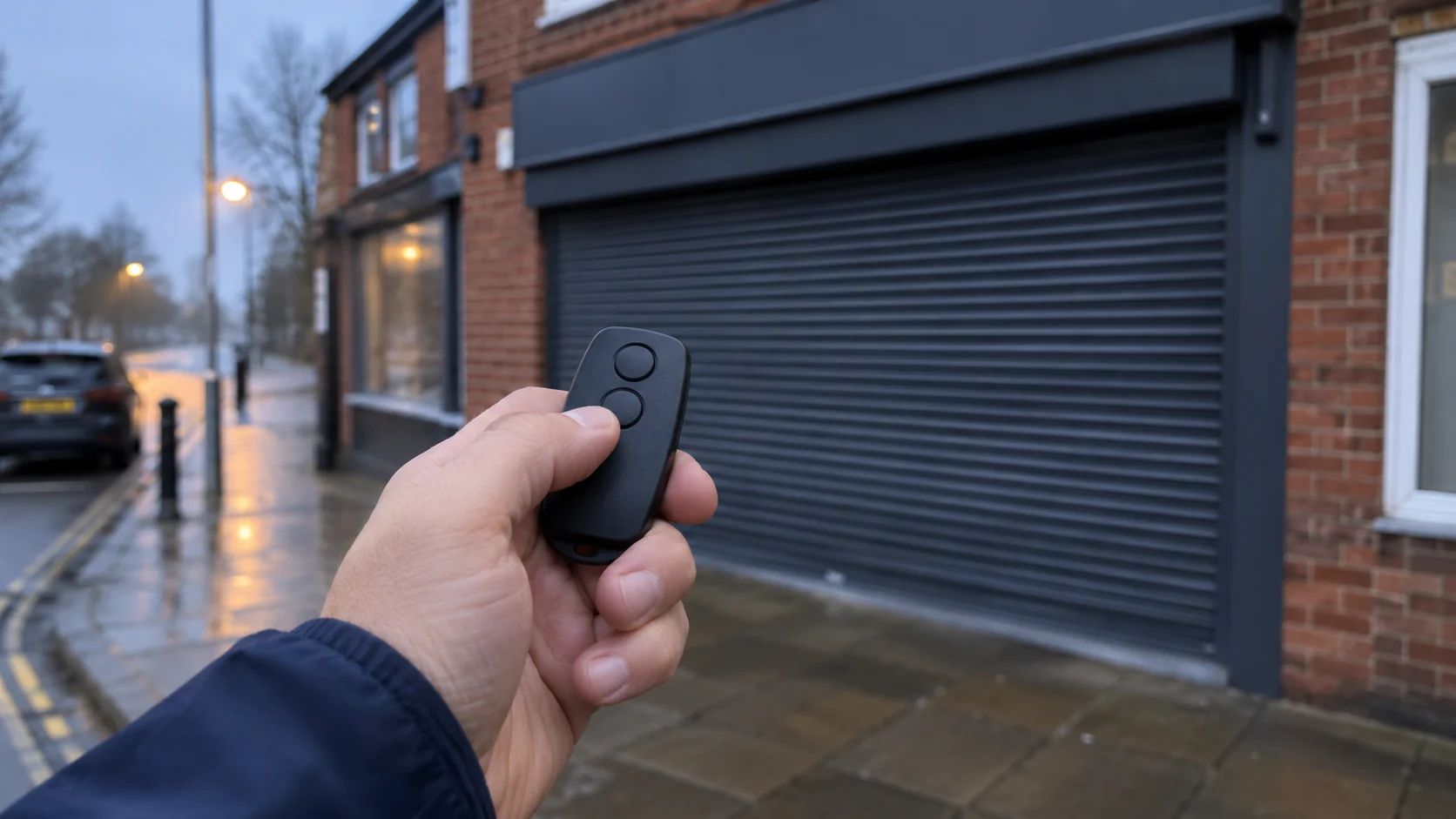
What goes wrong: handset batteries go flat, handsets lose their programming, receivers fail, key switches get damaged or let water in, and cables are damaged. Water in a control box is a common cause of intermittent faults. If your issue is with a remote or fob, our guide to what to do when a roller shutter remote is not working covers the safe checks you can make first. Never open the control panel yourself: it carries mains voltage.
Safety devices
Safety devices are as much a part of the shutter as the curtain. In Great Britain, regulation 18 of the Workplace (Health, Safety and Welfare) Regulations 1992 requires upward-opening workplace doors to have a device to prevent them falling back, and powered doors to have suitable and effective features to prevent them trapping anyone. The devices you are most likely to see are:
| Device | Where it is | What it does | Signs of a problem |
|---|---|---|---|
| Safety edge | Along the bottom rail | Senses contact while closing and stops the shutter, usually reversing it | Shutter stops or reverses for no reason; visible damage to the edge or its cable |
| Photocells | Either side of the opening, near floor level | An infrared beam; if it is broken the shutter will not close | Shutter refuses to close; dirty, knocked or misaligned lenses |
| Fall-back protection | In or on the barrel, or built into the drive | Stops the curtain falling if a spring, chain, gearbox or drive part fails | Only an engineer can test it properly |
| Hold-to-run controls | The push buttons | The shutter only moves while the button is held, so the operator can stop it instantly | Shutter keeps moving after the button is released |
| Manual override | Hand chain, crank or release | Lets the shutter be opened in a power cut | Missing handle, seized chain, nobody knows where it is |
Which devices a powered shutter needs depends on how it is controlled. Hold-to-run buttons with a clear view of the opening need less protection than remote or automatic closing. These devices should be repaired when they fail, never bypassed. Our guide to roller shutter safety regulations in the UK explains the rules and standards in plain English, and the HSE’s Approved Code of Practice and guidance (L24) explains the workplace duties in full.
How the parts work together
Following one operating cycle of an electric shutter shows why a fault in one part affects the whole system:
- You press “up”. The control sends the signal to the control panel or the motor.
- The brake releases and the motor turns the barrel. The curtain coils onto the barrel, guided straight by the rails, with the end locks keeping each lath in line.
- The upper limit stops the motor and the brake holds the curtain open.
- You press “down”. The safety devices are now watching the opening: photocells across it, the safety edge on the bottom rail.
- The curtain unrolls under control. If the beam is broken or the edge touches something, the shutter stops, and usually reverses.
- The lower limit stops the motor as the bottom rail meets the floor and the seal closes the gap. The brake holds the curtain shut.
If any one of these parts is damaged, worn or out of adjustment, the whole system is affected. A bent guide makes the motor work harder; a drifted limit can leave a gap under the bottom rail; a damaged safety edge stops the shutter closing at all. That is why a good repair starts with diagnosing the cause rather than replacing the most obvious part.
★★★★★
“The engineer was professional, friendly, and got straight to work diagnosing the problem. Nothing was too much trouble for him, and he had everything fixed and working perfectly in no time.”
Kam Kang, Google review
The parts that wear fastest
Some components naturally wear faster than others, especially on shutters that run many times a day. Knowing which ones helps you plan for them instead of meeting them as a breakdown.
| Part | Why it wears | Early warning signs | Who deals with it |
|---|---|---|---|
| Bottom seal and safety edge | Meets the floor on every closing and takes most impacts | Torn or flattened rubber, draughts, false stops | Engineer |
| Guide liners and brushes | Rub against the curtain every time it moves | More noise, rattling in wind | Engineer |
| End locks | Small parts under constant side load | Laths sticking out at one side, scraping | Engineer |
| Springs | Lose tension gradually with use | Heavier to lift, will not stay up | Engineer only |
| Bearings | Carry the turning barrel on every cycle | Grinding or knocking at the top | Engineer |
| Remote handsets | Dropped, lost, batteries run down | Works only close up, or only sometimes | You (battery) or engineer (programming) |
| Motor and brake | Work hardest on busy or heavy doors | Slower travel, humming, cutting out | Engineer |
Catching these early is one of the main purposes of planned servicing. Our roller shutter maintenance service checks condition and operation and records wear, and our simple monthly roller shutter maintenance checklist covers the checks your own team can safely do between visits. Our upcoming roller shutter servicing guide sets out what a professional service should cover.
How to describe a fault
Using the right names helps the engineer understand the problem before they arrive, bring the right parts and fix it first time. Work through these steps from a safe distance:
- Say what type of shutter it is: manual push-up, gear and chain, or electric, and how it is controlled.
- Say what it is doing: for example “the motor hums but the barrel does not turn” or “it stops about a metre from the floor and goes back up”.
- Say which part looks wrong: for example “the left-hand guide is bent at about waist height” or “three laths are sticking out on the right”.
- Mention anything that happened: an impact, attempted break-in, power cut, storm or heavy rain.
- Take photos or a short video of the whole shutter, the guides, the bottom rail and the controls.
- Photograph any labels on the motor, control box or box end, which can identify the make and model, and say if you know who fitted it.
Do not open the box, the control panel or the motor cover, and do not try to release springs or brakes. If your shutter will not close at all, our guide to why a roller shutter won’t close and when to call an emergency repair takes you through the likely causes.
Not an emergency? Book a planned repair
If your shutter still opens, closes and locks but is noisy, slow or unreliable, call our installation and service line or send us the details and a photo. We will explain the likely next step before any work starts.
Replacement parts
Most shutter faults are fixed by replacing or adjusting one part, but the replacement has to work with the rest of the system:
- Laths only interlock with the same profile, so the profile has to be identified and matched. Limited damage can often be fixed by replacing a few laths; damage across the width, or a profile that can no longer be matched, may mean a new curtain.
- Motors must be matched to the curtain’s weight and the door’s workload. If the curtain has been changed since the shutter was fitted, a like-for-like motor may not be the right choice.
- Springs must suit the curtain weight and are fitted and tensioned by an engineer.
- Safety devices must suit the way the shutter is controlled and be tested after fitting.
- Controls such as handsets and receivers have to be compatible with each other.
Because we manufacture shutters in our own workshop, we can talk you through the options when matching parts for an older shutter are hard to find, including a new curtain built for the existing opening. Our roller shutter repairs page explains how we diagnose and fix faults. If the whole shutter no longer suits the opening, our article on roller shutters built for your opening explains why a made-to-measure replacement lasts longer.
★★★★★
“Their service is reliable, efficient, and professional. We really appreciate their quick response and excellent workmanship.”
Paramjot Dhaliwal, Google review
Glossary of shutter parts
Different firms use different names for the same parts. This A to Z covers the terms you are most likely to hear.
| Term | What it means |
|---|---|
| Anti-fall-back device (safety brake) | Stops the curtain falling if a drive part fails |
| Barrel (axle) | The tube the curtain coils around |
| Bottom rail (bottom bar, bottom slat) | The heavier section at the base of the curtain |
| Box (hood, canopy) | The cover over the coiled curtain and drive |
| Brake | Part of an electric motor that holds the curtain when the motor stops |
| Control panel | The box of electronics between the controls, the safety devices and the motor |
| Crank (winding handle) | A removable handle used to wind some shutters by hand |
| Curtain | The whole moving door made of laths |
| End lock | A clip on the end of a lath that stops it sliding sideways |
| End plate (bracket) | Carries the barrel at each end and fixes it to the building |
| External motor | A motor mounted at the end of the barrel, outside it |
| Guide rail (guide, channel) | The vertical channel the curtain runs in |
| Hand chain | A loop of chain that turns a gearbox to raise or lower the curtain |
| Hold-to-run (dead man) | A control that only moves the shutter while it is held |
| Isolator | A switch that cuts the power to the shutter |
| Lath (slat) | One horizontal strip of the curtain |
| Limits | Settings that tell the motor where to stop at the top and bottom |
| Photocell | An infrared beam across the opening that stops the shutter closing on something |
| Safety edge | A contact-sensitive strip on the bottom rail |
| Tubular motor | A motor that fits inside the barrel |
| Wind lock | A stronger end lock that hooks behind the guide to resist wind |
Shutter repairs and parts across the West Midlands and the UK
Our engineers repair manual and powered shutters on shops, warehouses, factories, garages and trade units, and our 24/7 emergency shutter repair line is answered 24 hours a day, 365 days a year. We are based in West Bromwich, with priority response across Birmingham and the West Midlands, including roller shutter repairs in West Bromwich and shutter repair in Birmingham. For other areas, call and we will confirm attendance for your site.
Frequently asked questions
What are the main parts of a roller shutter?
The curtain (made of laths), end locks, bottom rail, guide rails, barrel, end plates or brackets and the box, plus the drive: springs, a gearbox and hand chain, or an electric motor with a brake, limits, controls and safety devices.
What is the difference between a lath and a slat?
Nothing: they are two names for the same thing, one horizontal strip of the curtain. This guide uses “lath” throughout.
Can I replace roller shutter parts myself?
Replacing a remote handset battery is fine. Anything involving springs, brakes, motors, the barrel, the control panel or work at height should be left to a trained engineer. These parts store energy, carry the curtain’s weight or run on mains power.
Can individual laths be replaced?
Often, yes, if the damage is limited and a matching lath profile is available. If the curtain is damaged across its width, or the profile can no longer be matched, a new curtain may be better value.
What is the difference between a tubular and an external shutter motor?
A tubular motor sits inside the barrel and is common on lighter shopfront and garage shutters. An external motor mounts at the end of the barrel and is common on heavier commercial and industrial doors, often with a hand chain for power cuts.
Why does my shutter stop before reaching the floor?
Common causes include a drifted lower limit, an obstruction, a damaged guide or curtain, or a safety edge or photocell stopping the shutter. Have it checked rather than forcing it down, which can bend laths or damage the motor.
What does a safety edge do?
It is a contact-sensitive strip along the bottom rail of a powered shutter. If it touches a person, vehicle or object while the shutter is closing, the shutter stops and usually reverses. If it is damaged, the shutter may refuse to close; it should be repaired, never bypassed.
How do I know which motor my shutter has?
If there is a motor housing visible at one end of the box, it is probably an external motor. If the box is plain and the shutter is electric, the motor is probably inside the barrel. A photo of any label on the motor or the control box helps an engineer identify it.
Need a shutter looked at?
Tell us what the shutter is doing and, if you can, send a photo. We will explain the likely next step before any work starts, and we will always tell you plainly whether repair or replacement makes more sense.
- Emergency repair line (24/7): 07931 104160
- Installation and service line: 07931 104162
