
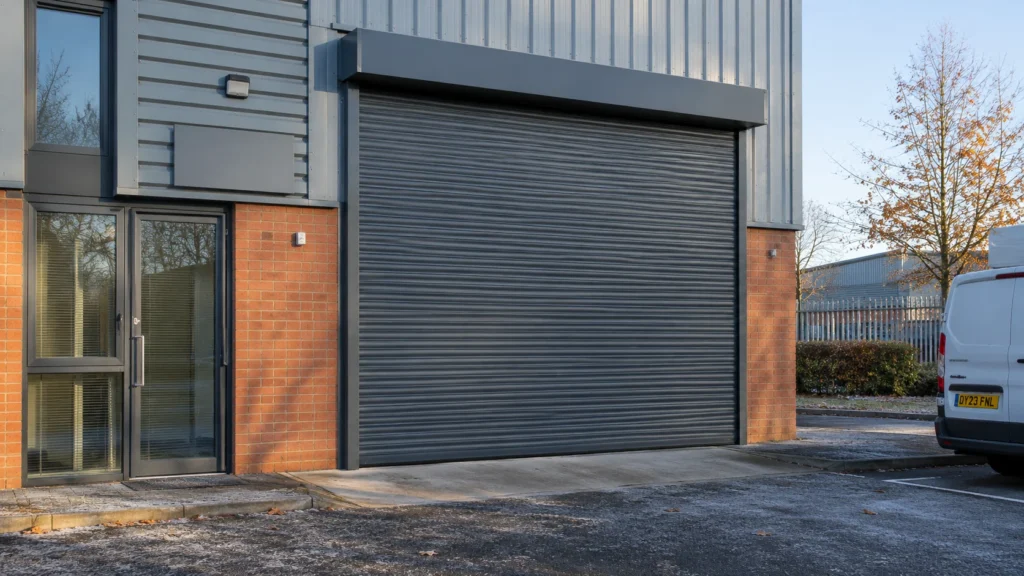
Most people choose a roller shutter for security. However, once winter arrives, many business owners start asking a second question: does the shutter do anything to keep the heat in? That is where insulated roller shutters come in. They use foam-filled laths instead of single-skin slats, so the closed curtain does more than block access.
This guide explains how insulated roller shutters work, what they can and cannot do for energy use, and how they compare with standard shutters and insulated sectional doors. Consequently, you can decide whether insulation is worth specifying for your shop, workshop or unit before you commit to a new shutter.
Insulated roller shutters: the quick answer
An insulated roller shutter uses double-skinned laths with an insulating foam core. When the shutter is closed, that construction slows heat loss through the opening, cuts draughts and can reduce noise compared with a single-skin steel curtain.
They are usually worth considering when:
- the building is heated, or staff work close to the shutter
- the shutter stays closed for long periods, such as overnight or across the weekend
- the opening is the main weak point in an otherwise well-insulated building
- condensation, cold spots or road noise are already a problem
- you want a quieter, more solid feel to the curtain when it operates
However, insulation is not always the priority. For an unheated storage unit, or an opening that stays open all day, the benefit may be small. Therefore, the right choice depends on how the building is actually used.
How an insulated roller shutter works
A standard roller shutter curtain is made from single-skin laths. They are strong and compact, but a thin sheet of metal does very little to stop heat passing through it. On a cold night, the inside face of the curtain becomes cold too.
An insulated lath is different. It has an inner and an outer skin, usually aluminium or steel, with insulating foam sealed between them. As a result, the curtain itself resists heat transfer far better than a single sheet of metal.
Seals matter as much as the laths
Heat and draughts do not only pass through the curtain. They also find their way around it. That is why the details around the shutter make a real difference:
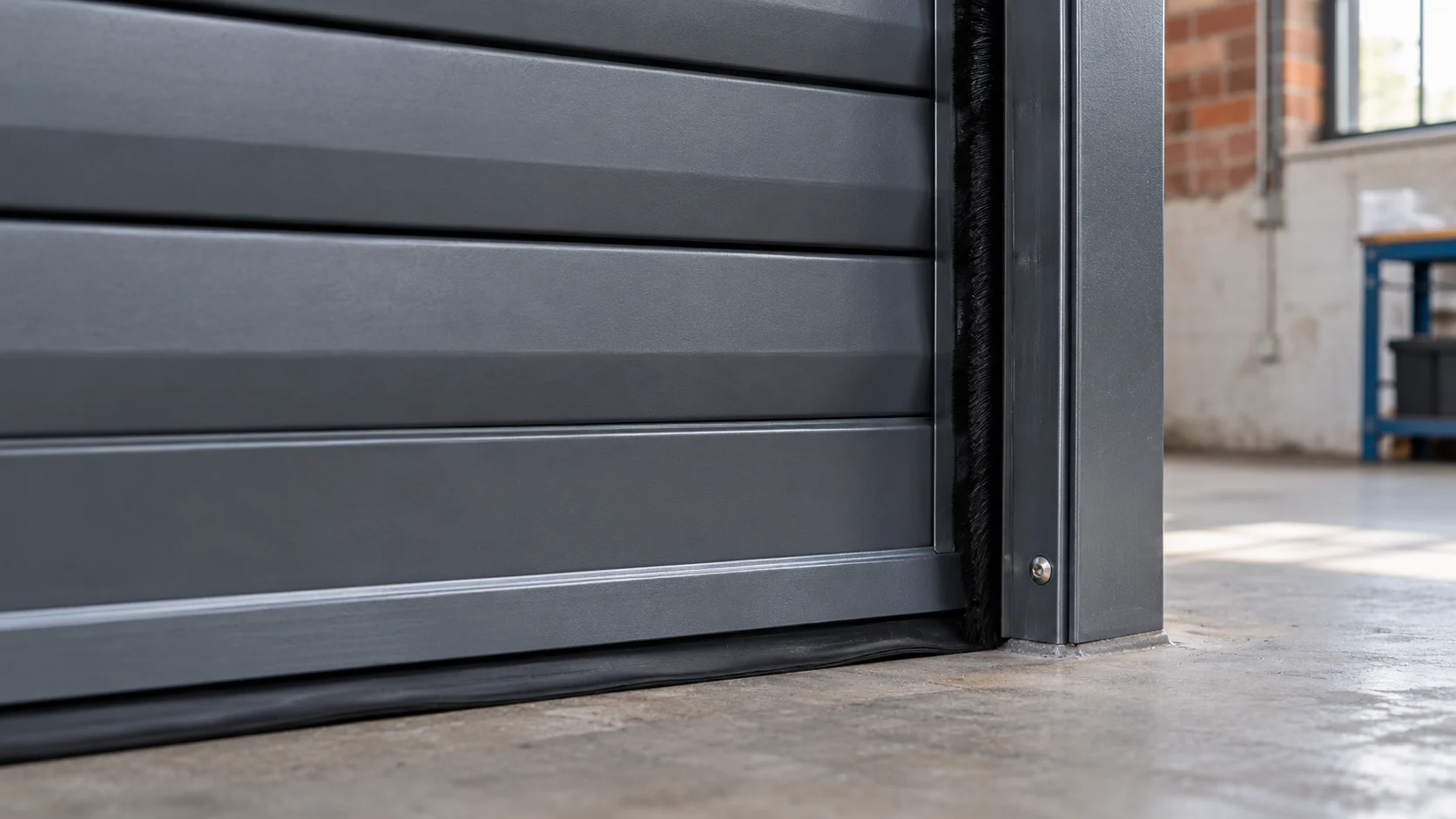
- Bottom rail seal: a rubber seal along the bottom rail closes the gap at floor level.
- Guide brushes or seals: brush strips or weather seals in the side guides reduce draughts at the edges.
- Shutter box and head: the area around the barrel can let air through if it is not sealed or boxed in properly.
- Floor level: an uneven or damaged floor leaves gaps that even a good seal cannot close.
In other words, an insulated curtain fitted to a poorly sealed opening will not perform as well as it could. Because every shutter we make is made to order, these details can be considered at the survey stage rather than left to chance.
What insulated roller shutters can do for your business
Help reduce heat loss and heating waste
A large opening covered by a thin metal curtain can be one of the coldest parts of a building. When that opening is closed with an insulated curtain and good seals, less heat escapes through it. Consequently, heating systems may not need to work as hard to keep the space comfortable.
The actual saving depends on many factors, including the size of the opening, how long the shutter stays closed, how the rest of the building is insulated and how the premises are heated. Therefore, be cautious of anyone who promises a fixed percentage saving without knowing your building.
Cut draughts and cold spots
Staff who work near a shutter often notice the difference first. Insulated laths and proper seals reduce cold air movement around the opening, which can make tills, workbenches and packing areas more comfortable through the colder months.
Reduce condensation on the inside face
When warm, moist indoor air meets a cold metal surface, condensation can form. Over time, that moisture can drip onto stock, floors or equipment. Because the inner skin of an insulated lath stays closer to room temperature, condensation is less likely to form on it.
Lower noise
Foam-filled laths tend to sound more solid than single-skin slats. They can help reduce some road noise from outside, and the curtain is often quieter as it rolls. For takeaways, shops and units close to busy roads or homes, that can be a welcome side benefit.
What insulated roller shutters cannot do
It is just as important to be realistic about the limits.
- They only insulate when closed. If the shutter is open all day for trading or deliveries, it does nothing for heat loss during those hours.
- They are not a substitute for a well-insulated building. A shutter is one part of the envelope, alongside walls, roof, glazing and doors.
- They are not automatically higher security. Insulation and security are different things. If security matters, ask about the lath, guides, locking and any tested rating separately. Our guide to roller shutter security ratings explains what to look for.
- They are not fire shutters. Insulated laths are about heat retention in normal use. If an opening needs fire resistance, it needs a tested fire shutter.
Insulated roller shutter or insulated sectional door?
If thermal performance is the main goal for a large loading opening, an insulated sectional door is often worth comparing. Sectional doors use thick insulated panels that lift up and back into the building, and they are designed with sealing in mind.
On the other hand, a roller shutter coils into a compact box above the opening. That makes it easier to fit where there is little headroom or where the ceiling space is needed for lighting, racking or services.
As a general guide:
- choose an insulated roller shutter when space above the opening is limited, when you want the familiar roller format, or when you are replacing an existing shutter like for like
- consider an insulated sectional door when the building is heated for long hours, there is enough headroom and the opening is mainly used for vehicle access
Our article on insulated sectional doors for warehouses and workshops goes into that option in more detail, and you can see what we make on our sectional doors page.
Is it worth upgrading an existing shutter?
You cannot usually add insulation to an existing single-skin curtain. Upgrading normally means replacing the curtain, and sometimes the guides, barrel or motor, because insulated laths are thicker and heavier.
That makes the decision easier at certain moments:
- when the existing curtain is damaged or worn out
- when you are already planning a new shutter for a refit or a change of use
- when the motor or barrel is due for replacement anyway
- when you are moving into a unit and setting it up for the long term
If the existing shutter still works well, it may be more sensible to improve the seals first and plan an insulated replacement later. A survey will show which option makes sense for your opening.
Questions to ask before you buy
- Is the building heated, and for how many hours a day?
- How long is the shutter closed each day and week?
- How much headroom is there above the opening?
- Does the current motor and barrel suit a heavier insulated curtain, or will they need replacing?
- What seals will be fitted at the bottom rail, guides and head?
- What level of security does the opening actually need?
- What servicing will the shutter need to keep the seals and moving parts in good order?
Cost is affected by many of the same factors. Our guide to what affects roller shutter installation cost explains them in more detail.
How we help
We survey the opening, ask how the premises are used and talk through the options, including lath type, seals and whether an insulated sectional door would suit the space better. Every roller shutter is built in our own workshop and installed by our own team, and we offer ongoing maintenance and repairs afterwards.
We work across Birmingham, the West Midlands and beyond. See the areas we cover for details.
Frequently asked questions
Do insulated roller shutters really keep heat in?
They help when the shutter is closed. Foam-filled laths resist heat transfer much better than single-skin slats, and good seals reduce draughts around the edges. However, the overall effect depends on the building and how long the shutter stays closed.
How much can I save on heating with an insulated shutter?
There is no honest single figure. Savings depend on the size of the opening, the building, the heating system and how the shutter is used. Be wary of fixed percentage promises.
Can my existing shutter be insulated?
Usually not. Insulation is built into the laths, so upgrading normally means replacing the curtain and checking whether the barrel and motor suit the extra weight.
Are insulated roller shutters more secure?
Not automatically. Insulation and security are separate. If security is important, ask about the lath, guides, locking and any tested security rating.
Do insulated shutters reduce noise?
They can help. Foam-filled laths generally sound more solid and can reduce some outside noise compared with single-skin slats.
Final thoughts
Insulated roller shutters make the most sense where a heated building relies on a shutter that stays closed for long periods. They can reduce heat loss, draughts, condensation and noise, but only when the curtain, seals and installation are right for the opening.
If you are planning a new shutter, or your current one is due for replacement, Sunrise Shopfronts & Shutters can survey the opening and help you choose the right option.
Speak to the team: call 07931 104162 for installation and servicing, 07931 104160 for 24/7 emergencies, or email info@sunriseshutters.co.uk.
