
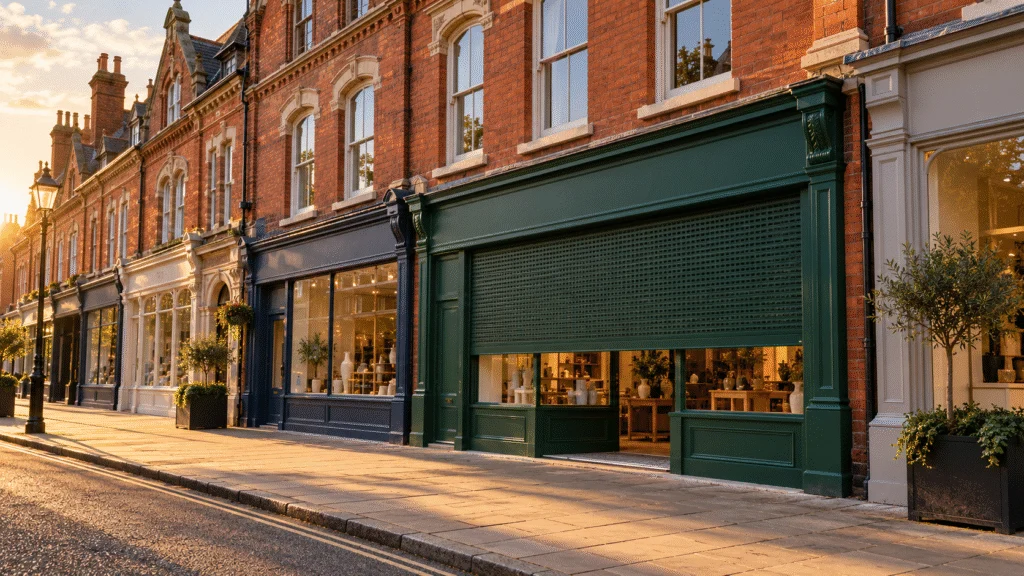
A new roller shutter can transform the security of a shop or commercial unit. However, it also changes how the building looks from the street, and that is why planning permission for roller shutters is a question many businesses only ask after the work is booked. By then, a delay or refusal can be costly.
This guide explains when consent is usually needed, why councils pay close attention to shutters, and how leases and landlords fit into the picture. Consequently, you can plan the installation with fewer surprises and choose a design that is more likely to be accepted.
Please note that rules vary between local authorities. Therefore, use this guide as a starting point and always confirm the position with your council and, where relevant, your landlord.
Planning permission for roller shutters: the quick answer
In many cases, an external roller shutter on a shopfront needs planning permission because it materially changes the appearance of the building. Internal shutters and grilles fitted behind the glass are less likely to need planning permission. However, they may still need consent in some situations.
The answer usually depends on:
- whether the shutter is fitted externally or internally
- whether the building is listed
- whether the property sits in a conservation area
- the design, colour and type of lath
- where the shutter box and guides will sit
- whether any part projects over the public pavement
- what your lease allows
In practice, the safest approach is to check before you commit to a design.
Why councils care about roller shutters
Shutters affect the street as well as the individual shop. A row of solid, closed shutters can make a high street feel inactive and less welcoming after dark. As a result, many local councils publish shopfront design guidance that sets out what they expect.
Common themes in that guidance include:
- a preference for internal shutters or grilles where possible
- a preference for perforated, punched or open-lattice designs over solid laths
- shutter boxes concealed behind the fascia rather than fixed on the face of the building
- guide rails that sit neatly within the shopfront frame
- colour-coated finishes that suit the shopfront instead of bare galvanised steel
These are not universal rules. However, they show the direction many councils take, particularly in town centres across Birmingham and the wider West Midlands.
Conservation areas and listed buildings
Conservation areas
If your premises sit in a conservation area, the council is likely to look more closely at any change to the frontage. Design, materials and visual impact carry more weight. Consequently, a discreet internal grille or a carefully designed perforated shutter often stands a better chance than a solid external one.
Listed buildings
Listed buildings have extra protection. Works that affect the character of a listed building, inside or outside, usually need listed building consent as well as any planning permission. Therefore, even an internal shutter may need consent if it affects historic fabric.
Carrying out unauthorised works to a listed building is treated seriously. As a result, owners and tenants should always speak to the local planning authority before any work starts.
Internal shutters and grilles: a common alternative
Where an external shutter is unlikely to be accepted, an internal system can provide a practical balance. Internal shutters and security grilles sit behind the glazing, so the frontage keeps its original appearance.
In addition, internal grilles allow customers to see window displays after closing. That can support the business while still placing a strong physical barrier between the glass and the interior.
However, internal systems do not protect the glass itself. Therefore, consider glazing, alarms and the wider security plan when you choose this route.
Designing a shutter that is more likely to be accepted
A well-designed shutter often makes the planning process smoother. When planning a new installation, consider:
- Position: can the shutter be fitted internally, or can the box sit behind the fascia?
- Lath type: would a perforated or punched lath meet your security needs while keeping some visibility?
- Colour: does a powder-coated finish suit the shopfront and the wider street?
- Guides: can they sit within the reveals or the shopfront frame?
- Proportions: does the shutter respect the shape of the opening and any architectural details?
Because we manufacture every shutter to order, we can build colour, finish and sizing around the frontage rather than forcing a stock product into it. Our shop roller shutters are designed with appearance and practicality considered together.
The public highway
Some shutter boxes, canopies or fittings project slightly beyond the building line. If any part of the installation sits over the public pavement, the council may have further requirements. Therefore, mention this early when you speak to the planning or highways team.
Landlord consent and your lease
Planning permission is only one part of the picture. If you rent your premises, your lease will almost certainly control alterations to the building.

Most commercial leases include an alterations clause. In practice, this often means:
- you need written consent from the landlord before fitting a shutter
- the landlord may ask for drawings and product details
- you may need to remove the shutter and make good at the end of the lease
- the landlord may set rules about appearance across a parade or retail park
Similarly, in mixed-use buildings, a freeholder or managing agent may control the outside of the building, even if you lease the ground floor. Consequently, approval may involve several parties.
Ask early. A landlord who is involved from the start is usually easier to work with than one who discovers a new shutter after it has been fitted.
What happens if you install without permission?
If a shutter needs planning permission and you fit it without consent, the council can take enforcement action. That may involve a retrospective application, changes to the design or, in some cases, removal.
Similarly, fitting a shutter without landlord consent can put you in breach of your lease. As a result, the cost of getting it wrong is usually far higher than the time spent checking first.
Don’t forget safety and escape routes
Planning and lease approval are not the only checks. If the opening forms part of a fire escape route, the shutter must not trap people inside. In addition, powered shutters must operate safely where staff and members of the public pass close by.
Therefore, speak to your fire risk assessor if the opening is on an escape route, and choose an installer who considers safety alongside appearance and security.
How we help
When you plan a new shutter, we survey the opening, discuss how the shutter will be used and advise on design options such as internal fitting, lath type, colour and box position. That information can help you prepare for conversations with your council and landlord. Our made-to-measure roller shutters are then built in our own workshop and installed by our own team.
We work across Birmingham, the West Midlands and beyond. See the areas we cover for details.
Frequently asked questions
Do I need planning permission for a roller shutter on my shop?
Often, yes, if the shutter is fitted externally, because it changes the appearance of the building. However, rules vary between councils, so check with your local planning authority before you go ahead.
Do internal roller shutters need planning permission?
Internal shutters and grilles are less likely to need planning permission. However, listed building consent may still apply if the building is listed.
Can a neighbouring shop’s shutter be used as a precedent?
Not safely. A neighbouring shutter may pre-date current policy, may have been installed without consent or may have been approved for different reasons. Your application will be judged on its own merits.
Do I need my landlord’s permission?
In most cases, yes. Commercial leases usually require landlord consent for alterations, and some require the shutter to be removed at the end of the lease.
How long does planning permission take?
Timescales vary between councils and depend on the application. Therefore, build time for consent into your plans rather than booking the installation first.
Final thoughts
Planning permission for roller shutters is easy to overlook, but it can decide whether an installation goes ahead smoothly. External shutters, conservation areas, listed buildings and lease terms all affect what you can fit and how it must look.
The best approach is to check with your council and landlord early, then choose a design that protects the premises without harming the frontage. If you are planning a new shutter in Birmingham or anywhere across the West Midlands, Sunrise Shopfronts & Shutters can survey the opening and help you choose a design that suits both your security and the street.
Speak to the team: call 07931 104162 for installation and servicing, 07931 104160 for emergencies, or email info@sunriseshutters.co.uk.
