
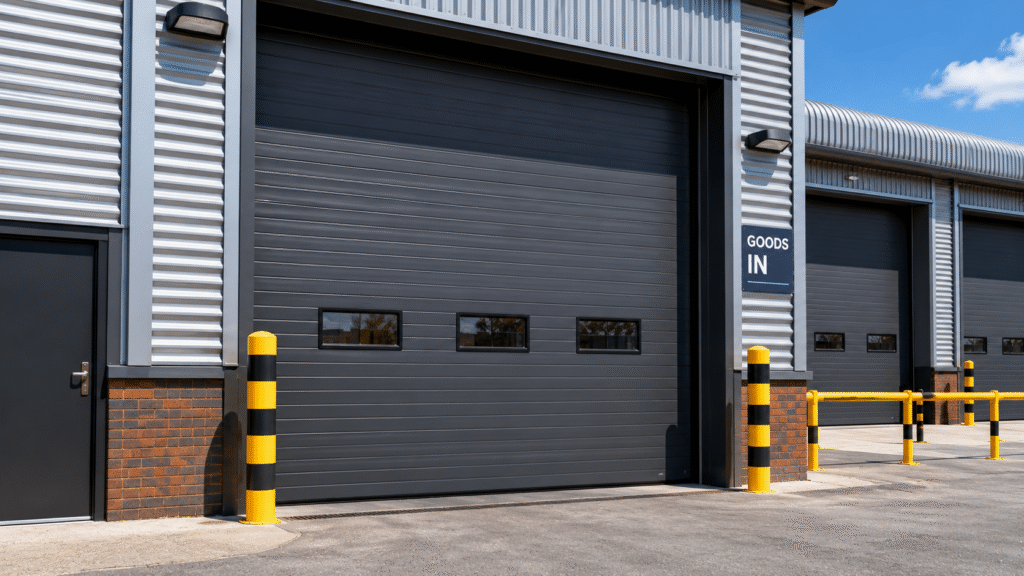
When a business looks at insulated sectional doors, it is rarely just trying to replace an old opening. More often, it is trying to solve several problems at once, including heat gain in summer, heat loss in colder months, awkward access, rising energy waste and a door that no longer suits the pace of daily work. Sunrise Shopfronts & Shutters positions its sectional doors exactly in that space, describing them as space saving, secure, well insulated and built to specification from its Birmingham workshop for customers across the West Midlands and beyond.
That matters even more heading into summer. Large commercial openings can make warehouses, workshops and trade units feel inconsistent from one part of the day to the next. Government guidance on heat and buildings says improving energy efficiency increases thermal comfort and reduces energy demand, while the Building Regulations framework for non-domestic buildings treats doors as part of the building fabric that affects overall performance. As a result, the right commercial door is no longer just about security. It is also about comfort, control and running costs.
Why this upgrade matters more in summer than many businesses expect
Summer is often when operational frustration becomes obvious. A cold, draughty unit is easy to notice in January, but a warm, inconsistent unit can be just as disruptive in June or July, especially when staff are moving in and out through a large opening all day. Government strategy on buildings makes the bigger point clearly: improving energy efficiency helps reduce wasted energy, cut bills and improve thermal comfort.
For warehouses and trade units, that can affect more than comfort. It can influence how hard cooling, ventilation or extraction systems have to work, how stable stock conditions feel, and how pleasant the workspace is for staff and visitors. Therefore, a door upgrade becomes a practical business decision rather than a cosmetic one.
What insulated sectional doors actually offer
Sunrise describes its overhead sectional doors as space saving, well insulated, secure and built to your specifications. It also states that every sectional door it supplies is custom-made to order in its dedicated Birmingham workshop after a site consultation and measurement process. That detail matters because busy commercial openings rarely behave like standard openings, and a made-to-order approach usually gives a better result than trying to force a generic solution onto a demanding site.
The insulation side is especially important. DHF says the thermal insulation value of a new door should be declared on the Declaration of Performance, expressed as a U-value for the entire door, not just an individual panel. It also notes that most insulated sectional overhead doors with 40 to 42 mm PUR or PIR foam-filled panels can often achieve whole-door U-values around 1 to 1.3 W/m²K on a door of roughly 4 m by 4 m, which helps explain why insulated sectional doors are often chosen where temperature control matters.
Thermal performance is the biggest reason many sites upgrade
In practice, thermal performance is often the single strongest reason to choose insulated sectional doors over a more basic commercial door. Sunrise says many businesses need easy access to spaces where temperature control is essential, and that the foam core of its sectional doors helps balance insulation with quick day-to-day operation. That is exactly the kind of balance busy premises need.
The technical point behind that claim is worth understanding. DHF warns buyers not to rely on a quoted insulation value for only the panel or lath. Instead, they should ask for the whole-door figure. That is important because a door performs as a system, not as an isolated piece of material. Seals, frame fit, panel construction and installation quality all affect the real outcome. Consequently, a properly specified sectional door can make a meaningful difference to temperature consistency across the unit.
This is also why insulated sectional doors suit premises that struggle with seasonal swings. If a warehouse gets uncomfortably warm in direct sun, or if a workshop loses conditioned air every time the opening cycles, the door becomes part of the problem. On the other hand, when the opening is better insulated and better sealed, the building has a stronger starting point before you even look at heating, ventilation or cooling equipment.
Efficient access matters just as much as insulation
A door can have excellent thermal credentials and still be the wrong choice if it slows the site down. This is where insulated sectional doors often perform strongly. Sunrise highlights that they are fast and easy to open and close, which helps teams move goods and vehicles without giving up the insulating benefit of the door’s foam core.
That combination is especially useful in premises with repeated daily movement. DHF’s code of practice for industrial and garage doors says the door should be designed and specified to reflect the environment, location, duty cycle and the needs of users. In other words, the right commercial door is not the one with the most impressive brochure headline. It is the one that suits how often the opening is used, what passes through it, and what the site needs the door to do every hour of the day.
As a result, insulated sectional doors make particular sense where access happens often, but the building still needs to hold a more stable internal environment. Warehouses, workshops and trade counters all fit that pattern. Meanwhile, a poorly chosen door can turn every delivery, collection or vehicle movement into a small but repeated energy penalty.
Where insulated sectional doors make the most difference
Warehouses
Warehouses benefit when a large opening has to work hard without acting like a weak point in the building envelope. If the unit stores temperature-sensitive goods, houses staff for long shifts, or simply deals with high vehicle movement, insulated sectional doors can help reduce wasted energy while keeping access practical. Sunrise specifically positions sectional doors for spaces where temperature control is essential, which is why they suit warehouses so well.
Workshops and trade units
Workshops and trade units often have a slightly different challenge. They may not be storing delicate goods, but they do need a more workable environment for people, tools, machinery and customer visits. A cold or overheated unit can affect comfort, concentration and the feel of the space. Therefore, a door that improves thermal consistency while still allowing quick access becomes a smart operational upgrade rather than a luxury.
Larger domestic spaces and home workshops
Although the title focuses on commercial premises, the same logic can apply to homeowners with large detached garages, home workshops or mixed-use outbuildings. Government energy policy notes that improving the efficiency of buildings improves comfort and reduces wasted energy, and that doors form part of that wider picture. So, if a homeowner uses a garage as more than just a place to park, insulated sectional doors can also be a practical choice at domestic scale.
Weather resistance is not a side issue
When buyers think about commercial doors, they often focus on security and insulation first. However, the site environment matters just as much. DHF’s code says the specification of an industrial or garage door should reflect factors such as wind, rain, flood risk, dust, UV exposure and the nature of traffic around the opening. That is one reason why a good survey matters so much. A door that looks right on paper may still be wrong for a windy, exposed or heavily used site.
This is where custom specification helps. Sunrise says its team visits site, takes measurements and creates a design for approval before manufacturing the door. That process gives the installer a much better chance of matching the door to real site conditions, which is exactly what busy warehouses and trade units need.
Safety and maintenance still matter
Any upgrade to a powered commercial door must be safe as well as efficient. HSE’s current bulletin says BS EN 12453:2017 and BS EN 12604:2017 are the key standards for powered doors, but it also makes clear that standards alone are not enough without a suitable risk assessment, appropriate design measures, force limitation and checks for failure in vertically moving doors. That is especially relevant for warehouses and trade units where traffic, visibility and user behaviour can vary throughout the day.
Maintenance is just as important. DHF says regular door maintenance is vital for industrial doors and shutters, and warns that serious accidents caused by faulty doors are almost always linked to poor maintenance. Its code of practice also says maintenance frequency should be set by the manufacturer or assembler, or designed to keep the door in a safe condition if no schedule is provided. So, while insulated sectional doors can improve performance, they should never be treated as fit-and-forget equipment.
What to ask before you commit
A smart buyer should ask more than “How much does it cost?” In practice, the better questions usually save more money later.
Ask about:
- the whole-door U-value, not just the panel value
- the foam core thickness and sealing strategy
- how the door has been specified for your duty cycle
- opening and closing performance for a busy working day
- site exposure to wind, rain and dust
- safety devices, force limitation and manual operation
- the maintenance plan after installation
Those questions reflect both DHF guidance on thermal performance and HSE guidance on safe powered doors. They also match Sunrise’s own made-to-order, site-survey approach, which is built around specifying the door to the opening rather than treating every project the same.
Frequently asked questions
Are insulated sectional doors better than standard commercial doors for temperature control?
Usually, yes, provided the whole door is specified properly. DHF says buyers should look at the U-value for the entire door, and it notes that insulated sectional overhead doors can achieve much stronger whole-door thermal figures than many other commercial door types.
Are insulated sectional doors suitable for busy warehouses?
Yes, that is one of their strongest use cases. Sunrise specifically presents them as a way to balance easy access with the temperature-control benefits of a foam-core insulated door, which is why they fit busy commercial openings so well.
Do they work for smaller workshops and trade counters?
Absolutely. Smaller units often feel temperature swings more quickly because one opening has a bigger effect on the internal environment. Therefore, insulated sectional doors can be just as useful in a modest workshop as they are in a larger warehouse.
Do powered sectional doors need servicing?
Yes. HSE and DHF both make clear that powered doors need proper safety consideration and regular maintenance. A good installation should include a sensible servicing plan, not just a handover on the day the door goes in.
Final thoughts
For warehouses, workshops and trade units, insulated sectional doors are a smart upgrade because they solve more than one problem at once. They can improve thermal performance, support faster day-to-day access, cope better with busy openings and help the building feel more stable and workable across the seasons. In summer especially, when heat gain and inconsistent conditions become harder to ignore, that combination becomes even more valuable.
The most important point, however, is that the right result depends on specification, safety and installation quality, not just the product label. Sunrise Shutters’ Birmingham-made, made-to-order approach fits that reality well because it starts with the site, the opening and the way the space is used, then builds the door around those needs