
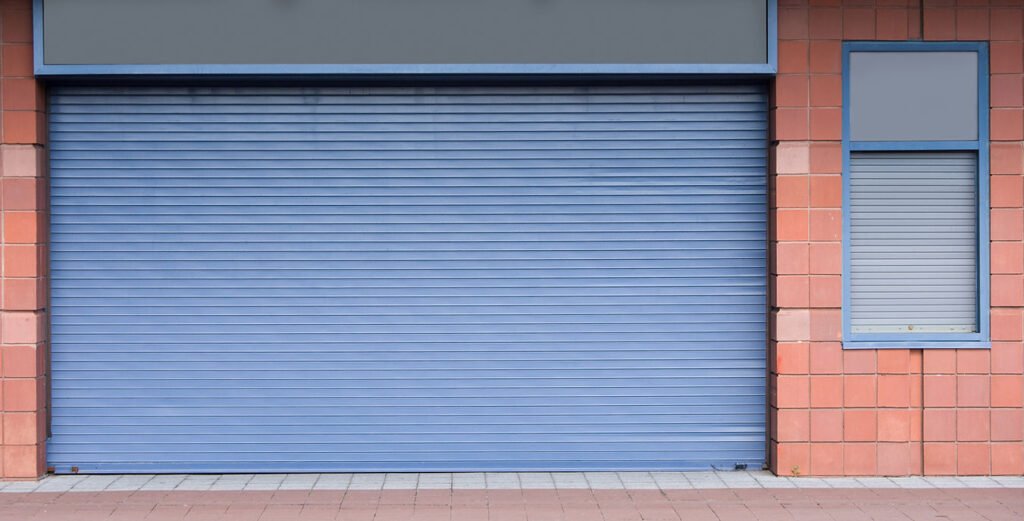
Choosing between steel vs aluminium roller shutters comes down to what the shutter has to do every day. Steel is the usual choice where strength, impact resistance and security come first, such as warehouses, loading bays and high-risk shopfronts. Aluminium is lighter and does not rust, which suits garages, counters, smaller shopfronts and exposed sites where weight, quiet running or corrosion matter more. But the metal is only part of the story: the lath profile, guides, locking and fixings decide how well any shutter performs. This guide explains the real differences, so you can have a better conversation at your survey.
We are Sunrise Shopfronts & Shutters. We survey, manufacture and install roller shutters in our own West Midlands workshop and fit them for shops, warehouses and trade units across Birmingham, the West Midlands and the UK. We are not tied to one material, so this guide sets out where each one genuinely fits.

Key takeaways
- Like for like, steel is stronger and copes better with knocks from vehicles, trolleys and forced entry.
- Aluminium is roughly a third of the weight of steel for the same volume of metal, does not rust and tends to run more quietly.
- The lath type matters as much as the metal. Foam-filled aluminium dents more easily; extruded aluminium is much stronger.
- Security is a whole-system result: lath thickness, guide depth, end locks, bottom-rail locking and fixings. Ask for test certificates, not adjectives.
- Match the material to the opening: steel for large, busy or high-risk openings; aluminium for garages, counters and lighter or exposed openings.
In this guide
- Steel vs aluminium: the short answer
- How the two materials differ
- The three lath types you will be offered
- Security: which is stronger?
- Durability and impact damage
- Corrosion and weather
- Weight, motors and manual operation
- Noise and insulation
- Appearance, colour and planning
- What affects the cost of each
- Which material suits which premises?
- What decides how long a shutter lasts
- Four common misconceptions
- Questions to ask your installer
- How to read a shutter quote
- Looking after each material
- Frequently asked questions
Steel vs aluminium roller shutters: the short answer
| If this matters most… | Usually choose | Why |
|---|---|---|
| Security against forced entry | Steel (or a tested extruded aluminium design) | Stiffer laths resist bending, cutting and prising; a tested rating proves it |
| Regular knocks from vehicles or trolleys | Steel | Dents less and keeps running true in the guides |
| A light curtain on a small opening | Aluminium | Less load on springs, motor and the structure |
| Coastal, wash-bay or damp sites | Aluminium, or steel with a suitable finish | Aluminium does not rust |
| Quiet operation | Aluminium (foam-filled) | Lighter curtains tend to run more quietly |
| Some insulation | Foam-filled laths (aluminium or steel) | Insulation comes from the foam, not the metal |
Do not choose on material alone. A well-designed aluminium shutter with a tested security rating can outperform a cheap, thin steel shutter with shallow guides and poor locking.
How the two materials differ
Steel shutters
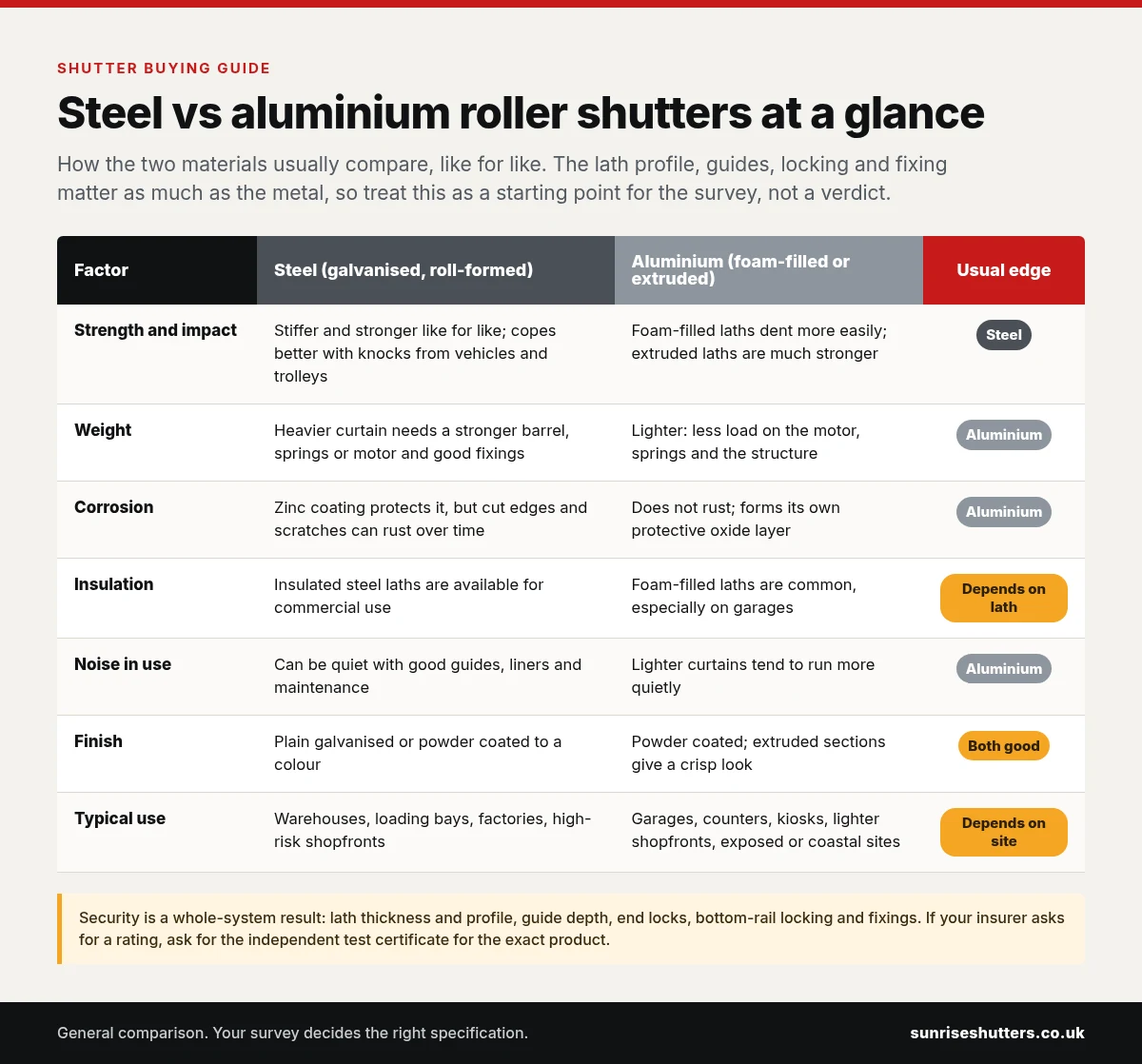
Commercial steel shutters are usually made from roll-formed galvanised steel laths. Galvanising adds a zinc coating that protects the steel from rust, and the laths can be left plain or given a colour finish. Steel’s main advantages are stiffness and strength: a steel curtain resists bending, cutting and prising better than a light aluminium curtain of a similar profile. That is why steel is the default for most warehouse doors, factory openings and solid shopfront shutters.
The trade-off is weight. A steel curtain needs a stronger barrel, springs or motor, and sound fixings into the structure around the opening. On a large industrial door that is normal and easily handled with the right specification. On a small or lightweight structure, it can be a problem.

Aluminium shutters
Aluminium weighs roughly a third as much as steel for the same volume of metal. That lighter curtain puts less load on the motor, springs, barrel and fixings, and tends to run more smoothly and quietly. Aluminium also forms its own thin oxide layer, so it does not rust. That is a genuine advantage on exposed sites, near the coast and in damp environments, although no metal is immune to every chemical environment.
Aluminium shutters come in two very different forms, roll-formed and extruded, and the difference between them is bigger than the difference between aluminium and steel in some cases.
The three lath types you will be offered
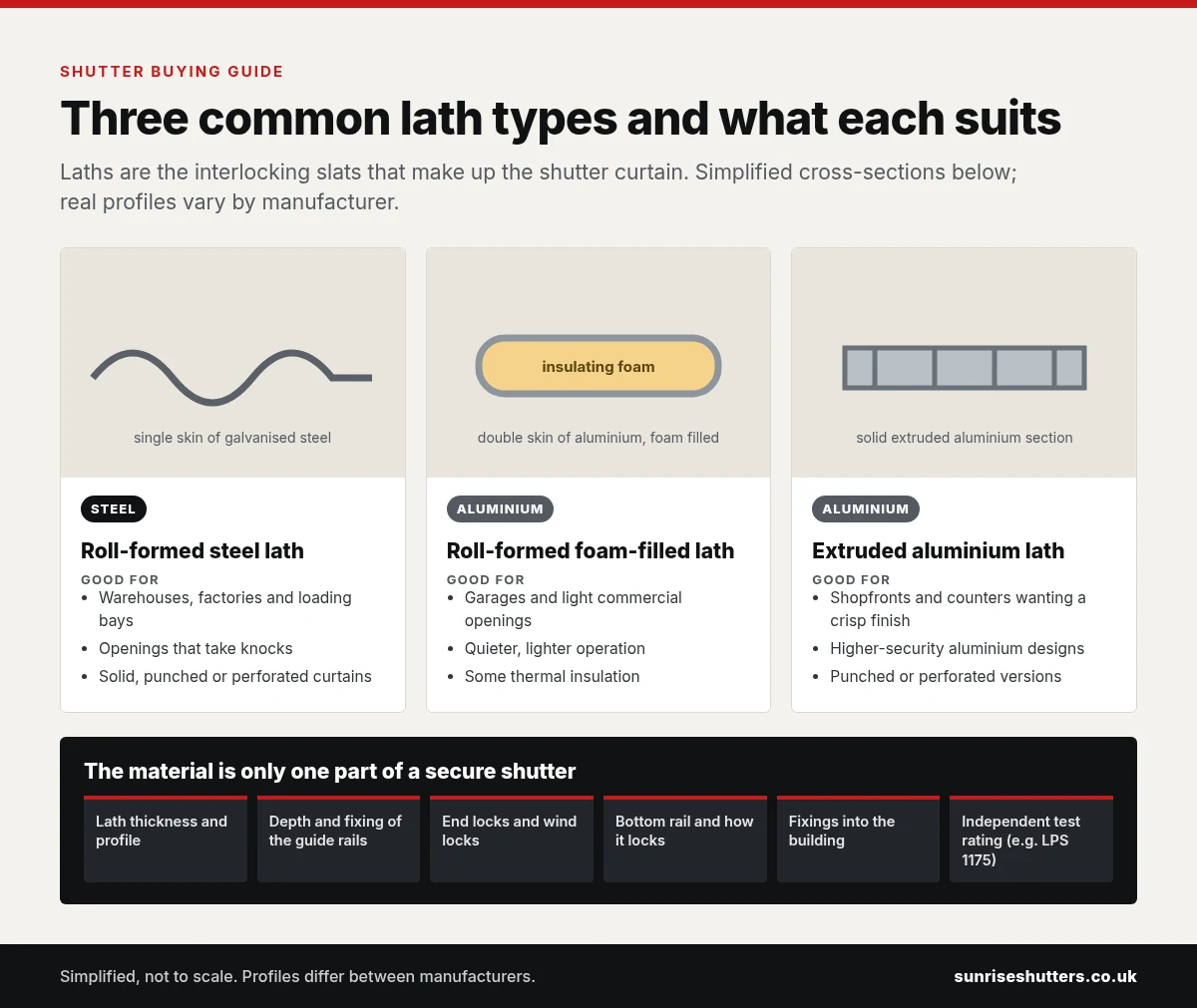
The laths are the interlocking slats that make up the curtain. Most shutter quotes will be based on one of these three.
| Lath type | How it is made | Strengths | Watch out for |
|---|---|---|---|
| Roll-formed steel | Galvanised steel strip shaped through rollers into a curved profile | Strong, impact resistant, widely available, can be solid, punched or perforated | Weight; cut edges and scratches need care on exposed sites |
| Roll-formed foam-filled aluminium | Two thin aluminium skins with insulating foam between them | Light, quiet, some insulation, does not rust | Dents more easily; a dented lath can catch in the guides |
| Extruded aluminium | Solid aluminium pushed through a shaped die | Much stronger than roll-formed aluminium, crisp finish, can be punched or perforated | Often positioned as a premium option; still check tested ratings |

Security: which is stronger?
Like for like, steel is the stronger material. But a shutter’s security depends on the whole system, not just the curtain:
- Lath profile and thickness: a thicker, deeper lath resists attack better than a thin one, whatever the metal.
- Guide rails: deep, well-fixed guides stop the curtain being levered out of the sides.
- End locks and wind locks: these stop laths sliding sideways and help keep the curtain in the guides.
- Bottom rail and locking: how the bottom of the curtain is secured matters a great deal. On electric shutters the motor and its brake also resist the curtain being lifted.
- Fixings: a strong curtain fixed into weak masonry is only as good as those fixings.
If your insurer has asked for a particular level of protection, look for independent testing rather than marketing words like “heavy duty”. In the UK, the best-known standard for shutters is LPS 1175 from the Loss Prevention Certification Board (LPCB). Certificated products are listed on the LPCB’s RedBook Live database. Ratings differ between issues of the standard, so always check the certificate covers the exact product, size and components you are being offered. Our guide to roller shutter security ratings and insurance requirements explains the main schemes.

Durability and impact damage
Day-to-day abuse is one of the main reasons commercial shutters fail. Impact damage from vehicles, trolleys and deliveries is one of the most common faults on commercial sites. Steel copes better with these knocks. A thin foam-filled aluminium lath dents more easily and, once dented, can catch in the guides and wear the curtain.
That does not make aluminium fragile. In a protected location, such as a garage, an internal counter or a shopfront on a pedestrian street, a good aluminium shutter can give many years of service. The real question is how much punishment the opening will take. If you are already dealing with a damaged shutter, our guide to what affects roller shutter repair cost explains how lath, guide and bottom-rail repairs are priced.
| Situation | Steel | Foam-filled aluminium | Extruded aluminium |
|---|---|---|---|
| Forklift or van clips the curtain | Usually dents locally; laths can often be replaced | Dents easily; damaged laths usually replaced | More resistant than foam-filled; laths can be replaced |
| Trolleys and cages knocking the bottom | Copes well | Bottom laths may dent over time | Copes reasonably well |
| Attempted forced entry | Resists better like for like | Least resistant of the three | Can perform well, especially if tested |
| Wind load on a wide opening | Stiffer curtain; wind locks may be used | Lighter curtain; wind locks often needed | Stiffer than foam-filled |
Corrosion and weather
Galvanised steel resists corrosion well, but cut edges, deep scratches and damaged coatings can eventually rust, especially in salty or chemical-laden air. Aluminium does not rust. For coastal premises, vehicle wash bays, food processing areas or exposed rural sites, aluminium, or steel with a suitable protective finish, is worth discussing at survey.
Where aluminium and steel parts meet in wet conditions, such as fixings, the installer should use compatible components to avoid galvanic corrosion between the two metals. It is a small detail that matters on exposed sites.

Weight, motors and manual operation
Weight affects almost everything about how a shutter runs:
- Manual shutters: a lighter aluminium curtain is easier to lift by hand on a small opening. On larger openings, spring balancing or a gearbox is used whichever material you choose.
- Electric shutters: the motor must be sized for the weight and size of the curtain. A heavier steel curtain needs a stronger motor, which is normal on industrial doors.
- The structure: a heavier curtain puts more load on the lintel, walls and fixings. A survey checks what the structure around the opening can carry.
- Wear: an undersized motor or weak springs on a heavy curtain wear faster and fail sooner.
If you are deciding how the shutter will be operated as well as what it is made of, our guide to manual vs electric roller shutters walks through the options.

Not sure which shutter suits your opening?
We survey the opening, agree the specification with you and make the shutter in our own West Midlands workshop. Call our installation and service line or send us the details.
Noise and insulation
Lighter, foam-filled curtains tend to run more quietly. Steel shutters can be quiet too, but that depends on good guides with suitable liners, a well-matched motor and regular maintenance.
★★★★★
“Looks amazing and works well, very quiet”
strikefx uk, Google review
For insulation, it is the foam inside the lath that does the work, not the metal. Foam-filled aluminium laths are common on garage doors and some workshop openings, and insulated steel laths are available for commercial and industrial use. Neither performs like an insulated wall, but both can reduce draughts and heat loss through the opening. For a deeper look, read insulated roller shutters: are they worth it?.
Appearance, colour and planning
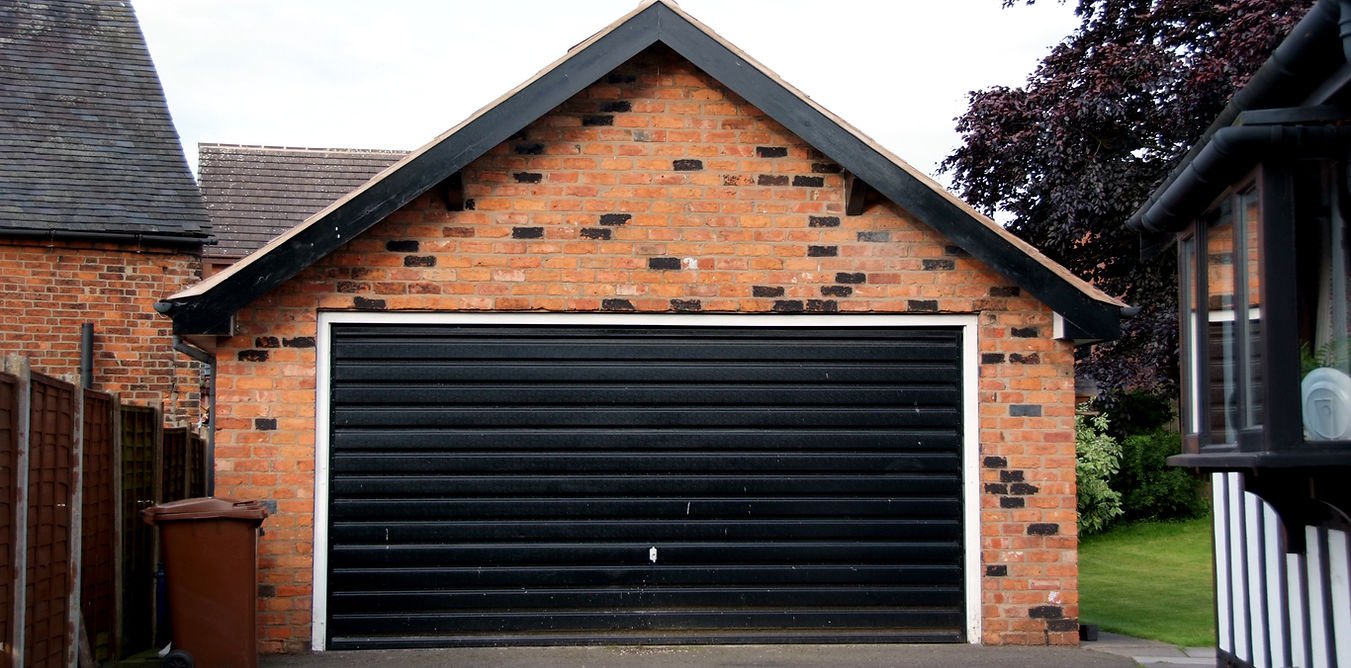
Both materials can be supplied in a wide range of colours. Aluminium is often chosen for shopfronts where the shutter needs to sit alongside aluminium frames and doors, and extruded aluminium gives a crisp, high-quality look. Steel shutters can also be powder coated to match a brand or a building. A coloured shutter is often better received than plain galvanised steel in a sensitive street, and if you are planning a new frontage it pays to design the shutter box and guides with the frame from the start, as described on our shopfronts page.
If you want people to see into the shop after closing, the curtain type matters more than the metal. Our guide to perforated roller shutters vs punched and solid laths compares the options.
What affects the cost of each
We do not publish prices because every shutter is made for its opening. What we can tell you is which choices push the price up or down, whichever material you choose:
- Lath type: roll-formed laths are the everyday option; extruded aluminium and insulated laths add cost.
- Size and weight: bigger, heavier curtains need heavier barrels, springs or motors and stronger fixings.
- Operation: electric operation adds a motor, controls and safety devices; manual is simpler on small openings.
- Finish: powder coating to a colour costs more than plain galvanised steel.
- Tested security: independently rated products cost more than unrated ones, and may be what your insurer requires.
- Installation: access, the condition of the structure and any making good around the opening.
The cheapest shutter is not the best value if it is wrong for the opening. A light curtain on a loading bay that gets hit every week will cost more in repairs than it saved. Our guide to roller shutter installation cost explains the full set of price factors.
Which material suits which premises?
Warehouses, factories and loading bays
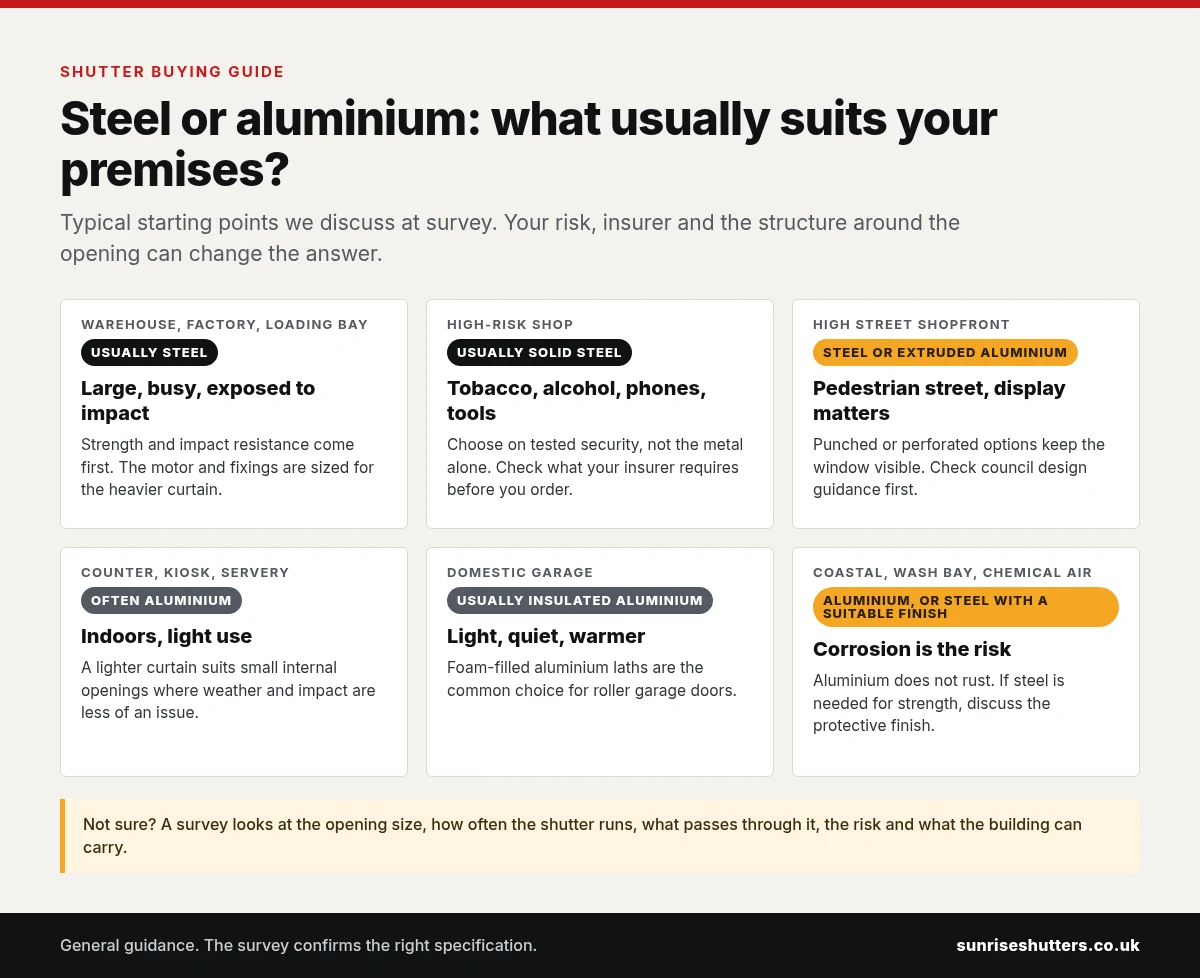
Steel is the usual choice. These openings are large, heavily used and exposed to impact. See our industrial roller shutters page for how we specify heavy-use doors, and our upcoming guide to specifying warehouse roller shutter doors.

High-street shops, takeaways and convenience stores
Solid or punched steel shutters are common where security is the priority. Perforated steel or extruded aluminium can work well where you want some visibility into the shop after hours. Our roller shutters in Birmingham page covers shopfront and commercial work across the city.
Counters, hatches and kiosks
Lighter aluminium shutters are often a good fit, especially indoors where impact and weather are less of an issue.
Domestic garages
Insulated aluminium is the common choice for roller garage doors because it is light, quiet and helps keep the garage warmer.
Self-storage and trade units
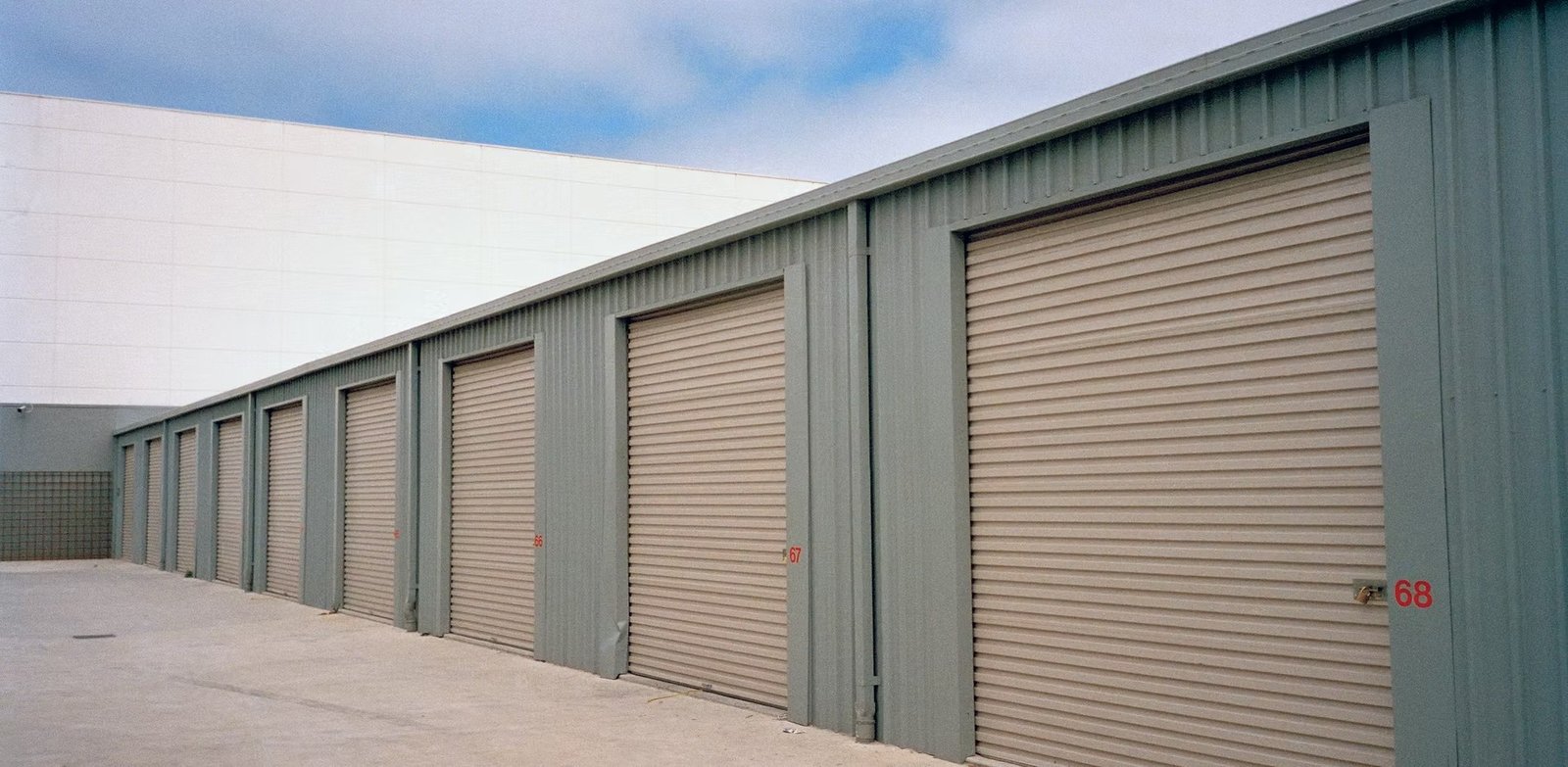
Rows of smaller doors that are opened by many different people suit robust, simple shutters. The choice depends on the size of each door, the exposure of the site and how much abuse the doors take.

What decides how long a shutter lasts
People often ask which material “lasts longer”. In practice, the life of a roller shutter depends far more on how it is specified, used and looked after than on steel versus aluminium. These are the factors that make the difference:
- How often it runs. A shopfront shutter opened and closed twice a day has a very different life from a loading-bay door that cycles dozens of times per shift. Motors, springs, bearings and guides should be specified for the real workload.
- How well it is matched. An undersized motor or springs working at their limit will wear out early on any curtain.
- The environment. Salt air, chemicals, dust and standing water all shorten the life of coatings, fixings and moving parts.
- Impact. Repeated knocks distort laths and guides, which makes every part of the shutter work harder.
- Maintenance. Planned servicing catches wear early, while small faults are still small.
- How it is treated. Forcing a struggling shutter is the quickest way to turn a minor fault into a major repair.
So the honest answer is: choose the material that suits the opening, have it sized properly for its workload, and look after it. A steel shutter on a garage that is rarely used and an aluminium shutter on a busy loading bay are both the wrong way round, and both will disappoint.
Four common misconceptions
“Aluminium shutters are only for homes”
Foam-filled aluminium is common on garages, but extruded aluminium shutters are widely used on shopfronts, counters and commercial interiors. The profile matters more than the label.
“Any steel shutter is secure”
Thin, single-skin steel laths in shallow guides can be bent or levered out with surprisingly little effort. If security is the reason you are buying a shutter, ask how it has been tested and how it locks, not just what it is made of.
“A heavier shutter is always a better shutter”
Weight adds strength, but it also adds load on the motor, springs, barrel and fixings. A heavy curtain on an undersized motor, or fixed to a weak lintel, will wear faster. The best specification balances strength against how the shutter is used and what the structure can carry.
“Aluminium never corrodes, so it never needs looking after”
Aluminium does not rust, but guides, fixings, motors and seals still need maintenance, and dirt in the guides affects any shutter. Material choice reduces some problems; it does not remove the need for servicing.
Questions to ask your installer
- What material and lath profile are you proposing, and why for this opening?
- What thickness are the laths, and what are the guides and bottom rail made from?
- Is the shutter tested to a security standard, and can I see the certificate for this exact product?
- How will it be fixed to my building, and is the structure suitable for the curtain’s weight?
- Manual or electric, and how is the motor or spring matched to the curtain?
- What finish will it have, and how should I look after it?
- What maintenance does it need, and what happens if a lath is damaged?
A good installer should be happy to explain the reasoning rather than simply naming a product. Because every shutter we fit is built for the opening it will fit, we start with how the opening is used, not with what is in stock.
★★★★★
“Great company! The chap who came out to do the quote was really knowledgeable and helped guide us towards the right solution for our premises. Once we’d decided to go ahead, three lads turned up literally a week later and got everything fitted. Really happy with the whole service from start to finish. Would definitely recommend!”
Natalie Clayton, Google review
How to read a shutter quote
Two quotes for “a roller shutter” can describe very different products. Before you compare prices, check each quote states:
- The curtain: material, lath type (roll-formed, foam-filled or extruded) and whether it is solid, punched or perforated.
- The guides and bottom rail: what they are made from and how deep the guides are.
- Operation: manual, spring-assisted or electric, and the type of controls.
- Safety devices on electric shutters, such as a safety edge and photocells where appropriate.
- Finish: plain galvanised, powder coated, and the colour.
- Security evidence: any independent test rating, with the certificate.
- Installation: how it will be fixed, any making good, and what is excluded.
- Aftercare: what guarantee applies and what maintenance is recommended.
If one quote is much cheaper, the difference is usually in one of these lines. It is worth asking, because the cheapest curtain is rarely the cheapest shutter over its working life.
Mixing materials and features
You do not always have to choose one extreme. A mostly solid steel curtain can include a band of perforated or vision laths at eye level. Insulated steel laths combine strength with some thermal benefit. Extruded aluminium can be punched for visibility while keeping a stiffer curtain than foam-filled laths. Talk through what you need the shutter to do, and the specification can be built around it.
Before the survey, it helps to have these to hand:
- ☐ Approximate width and height of the opening, and the space above it for the shutter box
- ☐ What passes through it: people, goods, vehicles or all three
- ☐ How often it will open and close each day
- ☐ Your priorities: security, visibility, insulation, quiet running or appearance
- ☐ Any insurer requirement for a security rating
- ☐ Planning or landlord constraints on the frontage
★★★★★
“Contacted this company on Saturday, owner answered and advised he was on holiday in Spain but gave me a verbal quote , agreed to measure up on Monday, arrived as agreed. I placed the order , and they came and fitted on Friday. I don’t think you can get better than that for service,Fitting , and price etc all round super efficient company. Keep up the good work Regards Springfield Pet Cremation”
Martin Thompson, Google review
Looking after each material
| Material | Simple care between services | Report it when |
|---|---|---|
| Galvanised steel | Keep guides clear; wash off road salt and grime on exposed sites | Coatings are scratched through, cut edges show rust, or laths are dented |
| Foam-filled aluminium | Keep the drop zone clear to avoid denting the bottom laths | A dented lath catches in the guides or the curtain runs unevenly |
| Extruded aluminium | Clean the finish and keep the guides free of debris | Laths are scored or the curtain becomes noisy |
| All shutters | Do not force a struggling shutter; book planned servicing | New noises, slower running or uneven travel |
Our commercial roller shutters page explains how we survey, specify and install, and we work across the West Midlands, including Wolverhampton and Walsall, and across the UK. For a plain-English guide to every component, see our upcoming article on roller shutter parts explained.

Frequently asked questions
Are steel roller shutters more secure than aluminium?
Generally, steel is stronger like for like, but security depends on the whole system: lath profile and thickness, guides, locking and fixings. A tested aluminium design can outperform an untested thin steel shutter, so ask for independent test evidence if security is your priority.
Are aluminium roller shutters cheaper than steel?
Not necessarily. Foam-filled aluminium and roll-formed steel are both everyday options, while extruded aluminium is often a premium choice. The size, operation, finish and any security rating usually affect the price more than the metal alone.
Do aluminium shutters rust?
No. Aluminium forms a protective oxide layer and does not rust, which is why it suits exposed and coastal sites. Fixings, motors and guides still need maintenance.
Which is quieter, steel or aluminium?
Lighter, foam-filled aluminium curtains tend to run more quietly. A steel shutter with good guides, liners and a matched motor can also be quiet.
Can I insulate a steel roller shutter?
Yes. Insulated steel laths are available for commercial and industrial openings. The insulation comes from the foam fill, so ask what lath is being proposed.
Can I swap a steel curtain for an aluminium one, or the other way round?
Sometimes. The barrel, springs or motor, guides and box all have to suit the new curtain’s weight and profile, so a survey is needed before changing material.
How long do steel and aluminium shutters last?
There is no single figure. Life depends mostly on how often the shutter runs, whether the motor and springs are matched to the curtain, the environment, impact damage and maintenance. A well-specified, well-maintained shutter of either material will outlast a poorly matched one.
Do I need planning permission for a new shop shutter?
External shutters on a shopfront often need planning permission, whatever the material, and councils have their own design preferences. Internal shutters and grilles are less likely to need it. Our guide to planning permission for roller shutters explains what councils and landlords usually look for.
Which material is best for a garage door?
Insulated foam-filled aluminium is the most common choice for domestic roller garage doors because it is light, quiet and helps keep the garage warmer.
Talk to us about your shutter
Tell us about the opening, how it is used and what matters most: security, visibility, weight or insulation. We will survey it and explain the options before anything is made.
- Installation and service line: 07931 104162
- Emergency repair line (24/7): 07931 104160
