
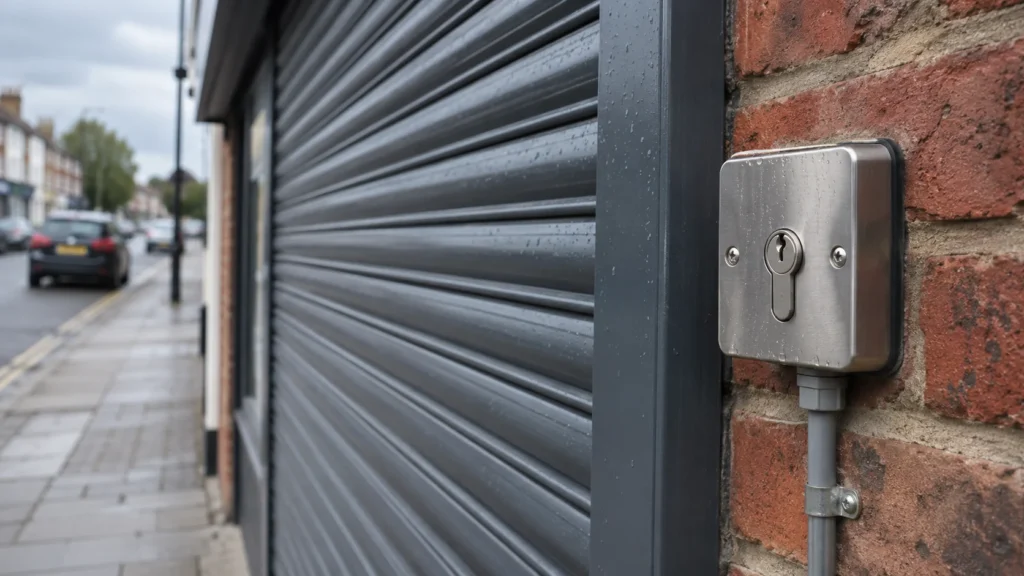
Roller shutter safety regulations in the UK come from a small number of sources, and they all point the same way. Workplace law says a powered door must not trap people, an upward-opening door must not fall back, and both must be kept in good repair. Building Regulations guidance sets out the safety features new doors should have. A family of British and European standards explains how designers and installers normally achieve all of this. If you own, manage or rent commercial premises with a roller shutter, these rules affect you directly, whether the shutter guards a shopfront, a loading bay or a takeaway servery.
This guide explains the rules in plain English, shows the safety devices that matter, walks you through a shutter risk assessment step by step and gives you a checklist you can use today. We are Sunrise Shopfronts & Shutters, a roller shutter manufacturer and installer based in West Bromwich, and we inspect, repair and maintain shutters for businesses across the West Midlands and the wider UK. We are not lawyers, so take advice from your health and safety adviser on your own site.
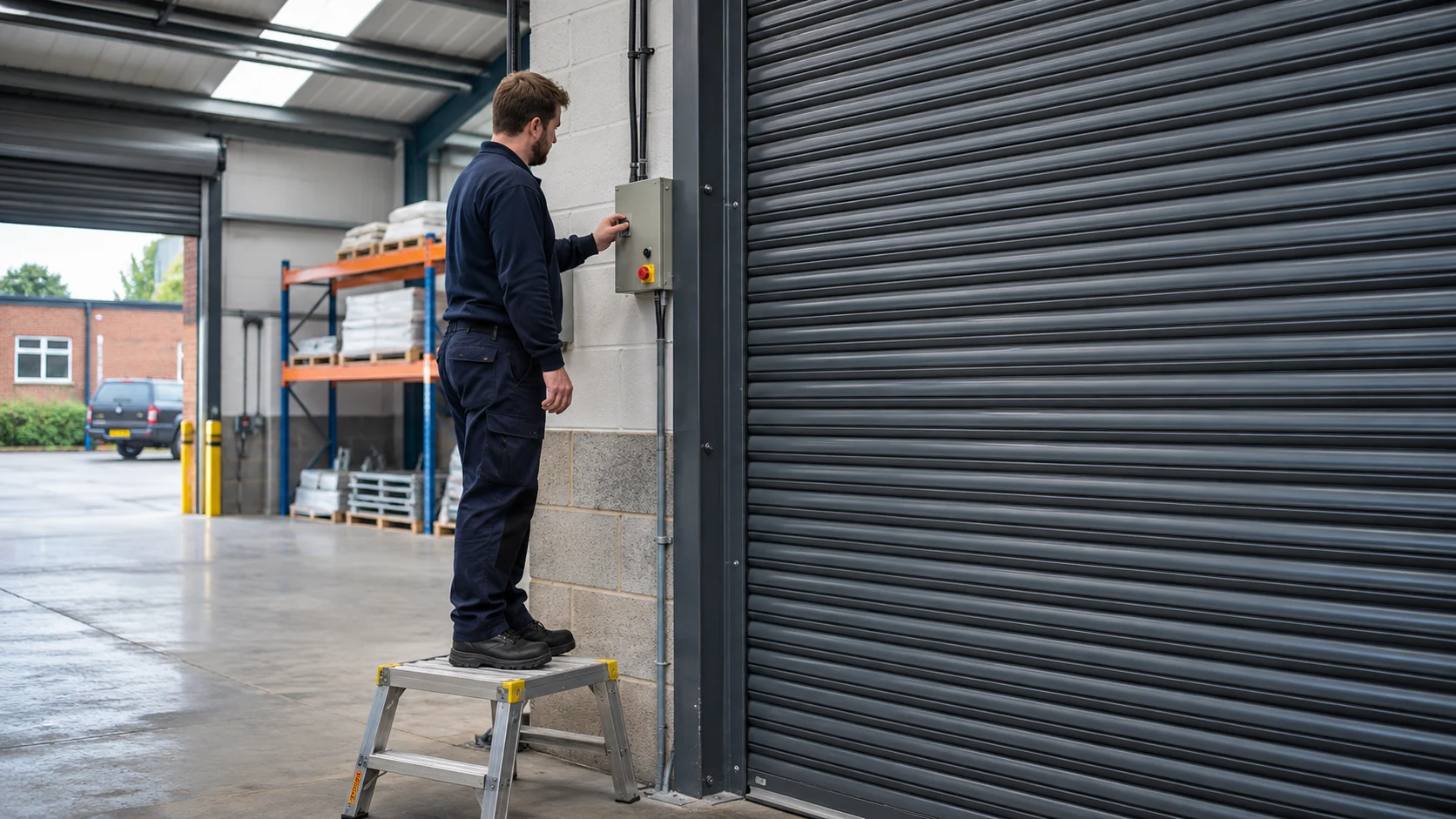
Key takeaways
- Three duties sit at the heart of the law: stop a powered shutter trapping people, stop an upward-opening shutter falling back, and keep it maintained in good repair.
- The law does not name devices. Safety edges, photocells, hold-to-run controls and fall-back brakes are the usual ways of meeting it, chosen to suit how the shutter is used.
- Manual shutters are covered too. In a workplace, a manual roller shutter is still an upward-opening door that must not fall back.
- Changing the controls changes the risk. Adding a remote, a timer or automatic closing can mean extra safety devices are needed.
- Most safety problems are maintenance problems: damaged or disconnected safety edges, dirty photocells, missing override handles and worn brakes.
- Keep records. Service reports, faults and repairs show you are managing the risk and help your engineer spot patterns.
In this guide
- Roller shutter safety regulations: the quick answer
- Where the rules come from
- The Workplace Regulations in detail
- Building Regulations and Approved Document K
- Machinery law and motorising a manual shutter
- The British Standards explained
- Who is responsible for what
- The safety devices on a powered shutter
- How the controls change the risk
- Fall-back protection
- Manual operation in a power cut
- How to risk assess a roller shutter
- Shutter safety self-check
- What a safety-focused service should cover
- The records to keep
- Common safety failures we find
- Fire shutters, garage doors and shared buildings
- If your shutter is unsafe right now
- Frequently asked questions
Roller shutter safety regulations: the quick answer
If your roller shutter is part of a workplace in Great Britain, regulation 18 of the Workplace (Health, Safety and Welfare) Regulations 1992 requires that:
- “any upward opening door or gate has a device to prevent it falling back”;
- “any powered door or gate has suitable and effective features to prevent it causing injury by trapping any person”;
- “where necessary for reasons of health or safety, any powered door or gate can be operated manually unless it opens automatically if the power fails”.
Regulation 5 of the same regulations then requires equipment and devices like these to be “maintained (including cleaned as appropriate) in an efficient state, in efficient working order and in good repair”, with “a suitable system of maintenance” where appropriate. In practice, that means four things for a shutter owner:
- The right safety devices for how the shutter is used and controlled.
- Protection against the curtain falling if a component fails.
- A way to operate it safely in a power cut where that matters for safety.
- Regular maintenance and testing, with records, so all of the above keeps working.
The rest of this guide explains each of those in detail, and how to check your own shutter.
Where the rules come from
It helps to see the whole picture before looking at the detail. There are three layers: the law, which says what must be achieved; the standards, which show how it is usually achieved; and your own day-to-day duties as owner or occupier, which keep it that way.
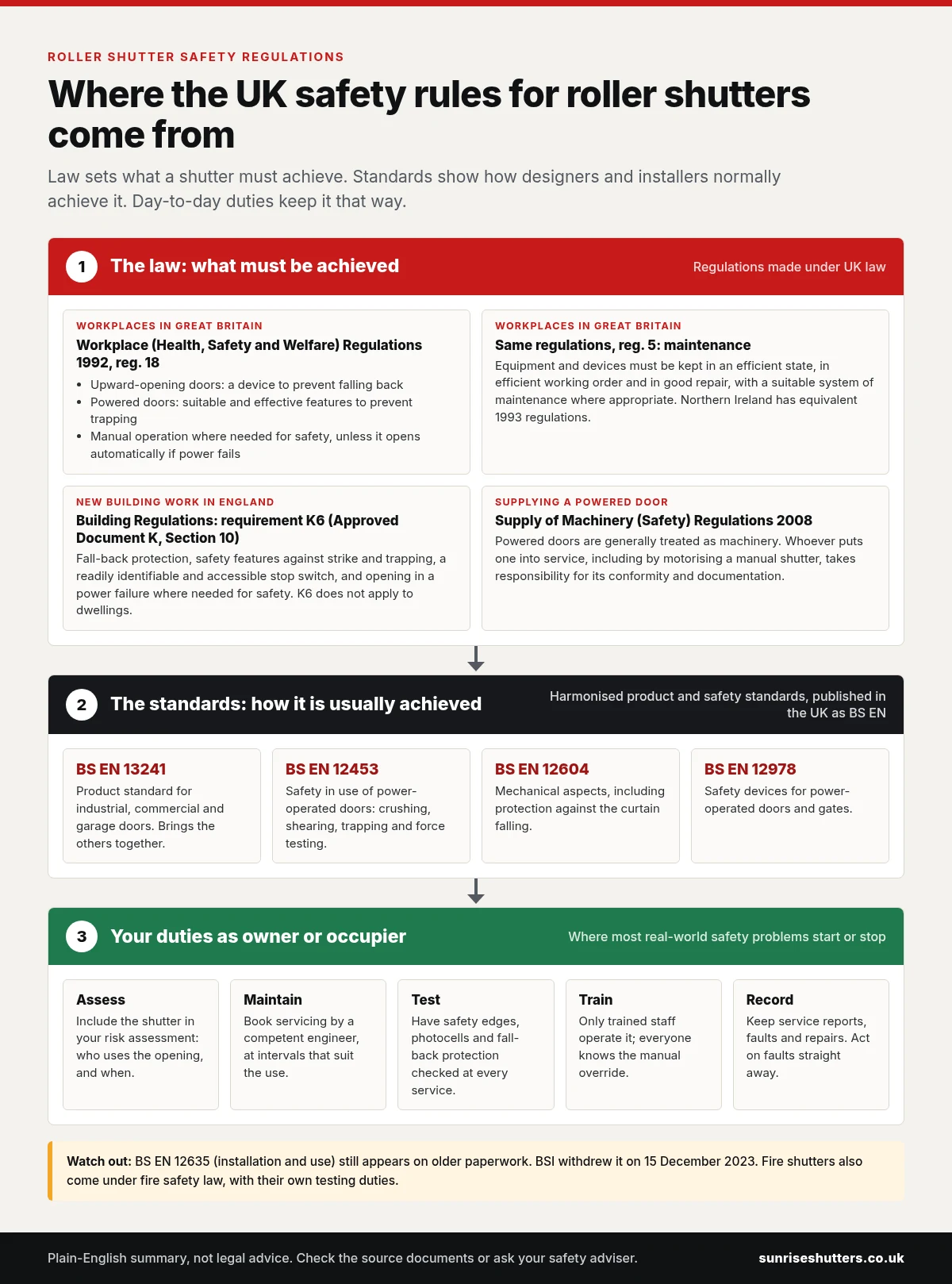
The Workplace Regulations in detail
The Workplace (Health, Safety and Welfare) Regulations 1992 apply to workplaces in England, Wales and Scotland. Northern Ireland has its own equivalent, the Workplace (Health, Safety and Welfare) Regulations (Northern Ireland) 1993. A shop, warehouse, factory, takeaway, office or trade unit with a roller shutter is a workplace, so the regulations apply to the shutter as part of the building.
Regulation 18: doors and gates
Regulation 18 opens with a general duty: doors and gates “shall be suitably constructed (including being fitted with any necessary safety devices)”. It then lists specific requirements. The three quoted above are the ones that matter most for roller shutters. Two points are often missed:
- The fall-back requirement applies to manual shutters too. A roller shutter opens upwards, so whether it is pushed up by hand, wound up with a handle or driven by a motor, it needs a device to prevent it falling back.
- “Suitable and effective” is judged against the actual use. A shutter operated with hold-to-run controls by a trained member of staff who can see the opening is a different risk from one closing automatically over a busy pedestrian route.
Regulation 5: maintenance
Regulation 5 applies to equipment and devices “a fault in which is liable to result in a failure to comply with any of these Regulations”, and to “equipment and devices intended to prevent or reduce hazards”. A shutter’s safety edge, photocells and fall-back device fall squarely into that description. They must be kept in efficient working order and good repair, and where appropriate there should be a suitable system of maintenance: regular inspection and testing, faults put right promptly and records kept.
The HSE’s Approved Code of Practice and guidance, L24 Workplace health, safety and welfare, explains both regulations in more detail and is free to download.
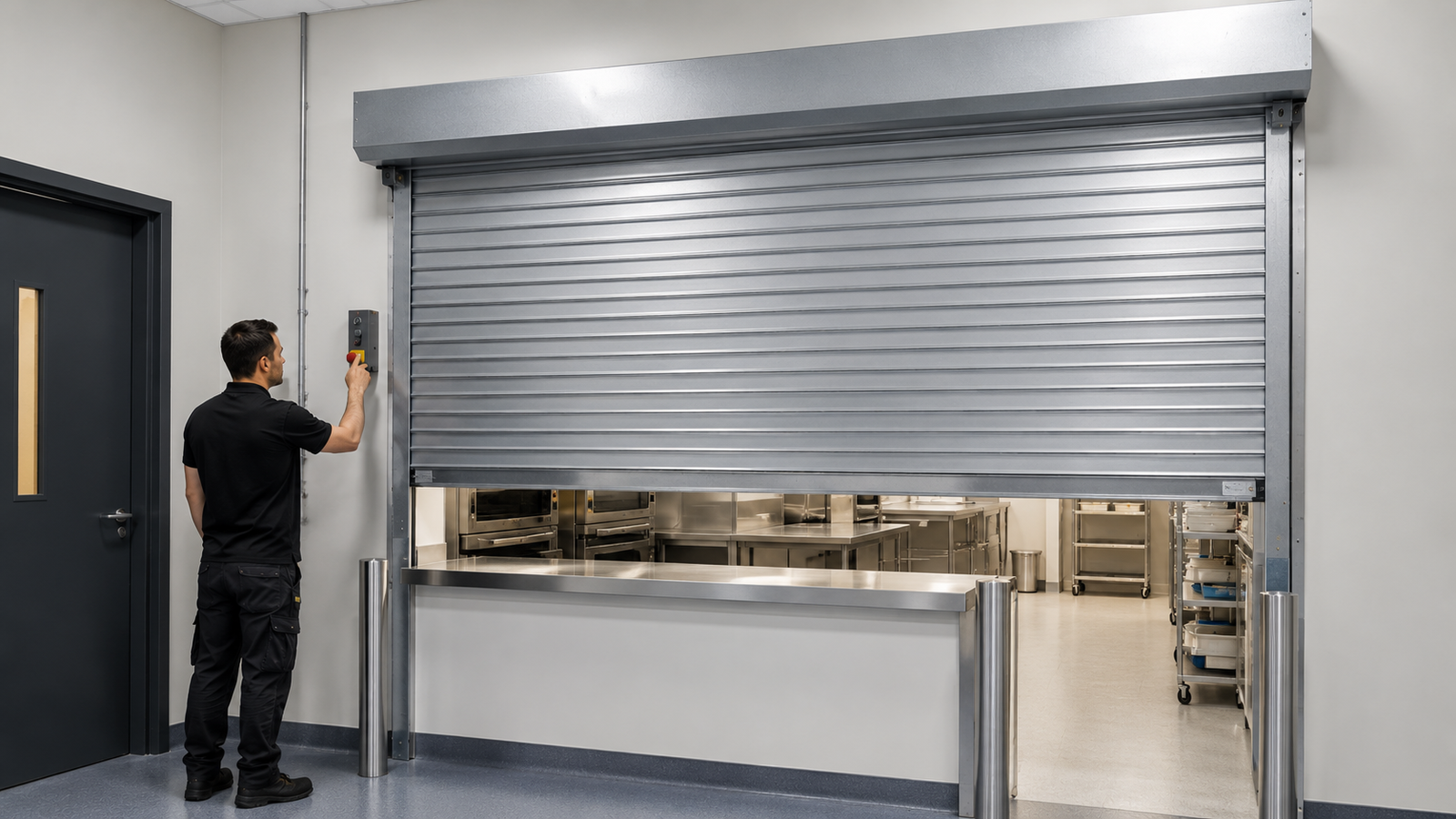
Building Regulations and Approved Document K
When a new powered door is installed as part of building work in England, the Building Regulations also apply. Requirement K6 says provision shall be made to prevent any door or gate “which slides or opens upwards, from falling onto any person” and “which is powered, from trapping any person”, and that provision shall be made “for powered doors and gates to be opened in the event of a power failure”. Requirement K6 does not apply to dwellings.
The government’s guidance on meeting K6 is in Section 10 of Approved Document K (2013 edition). Paragraph 10.1 says that on upward-opening doors you should “fit a device to stop them falling in a way that may cause injury”, and that power-operated doors and gates should have all of the following:
- “safety features (such as a pressure-sensitive door edge which operates the power switch) to prevent injury to people who are struck or trapped”;
- “a readily identifiable and accessible stop switch”;
- “the ability for manual or automatic opening if there is a power failure, when necessary for health or safety”.
Approved Document K itself points readers to regulation 18 of the Workplace Regulations for the equivalent workplace requirement, so the two sets of rules line up. For a new installation, your installer should be designing to both.
Machinery law and motorising a manual shutter
Powered doors are generally treated as machinery under the Supply of Machinery (Safety) Regulations 2008. Whoever places a powered door on the market or puts it into service takes on responsibility for making sure the finished door meets the essential health and safety requirements, with the right technical documentation, declaration and conformity marking.
This matters most when a manual shutter is motorised. Fitting a motor to a manual shutter creates a powered door, and whoever does it takes on that responsibility for the door as a whole, not just the motor. It is one reason motorising an old shutter is a job for a door specialist rather than a general electrician. If you are thinking about it, our guide to manual vs electric roller shutters explains the practical pros and cons, and our article on the signs it is time to upgrade your shutter motor covers replacing an existing motor.
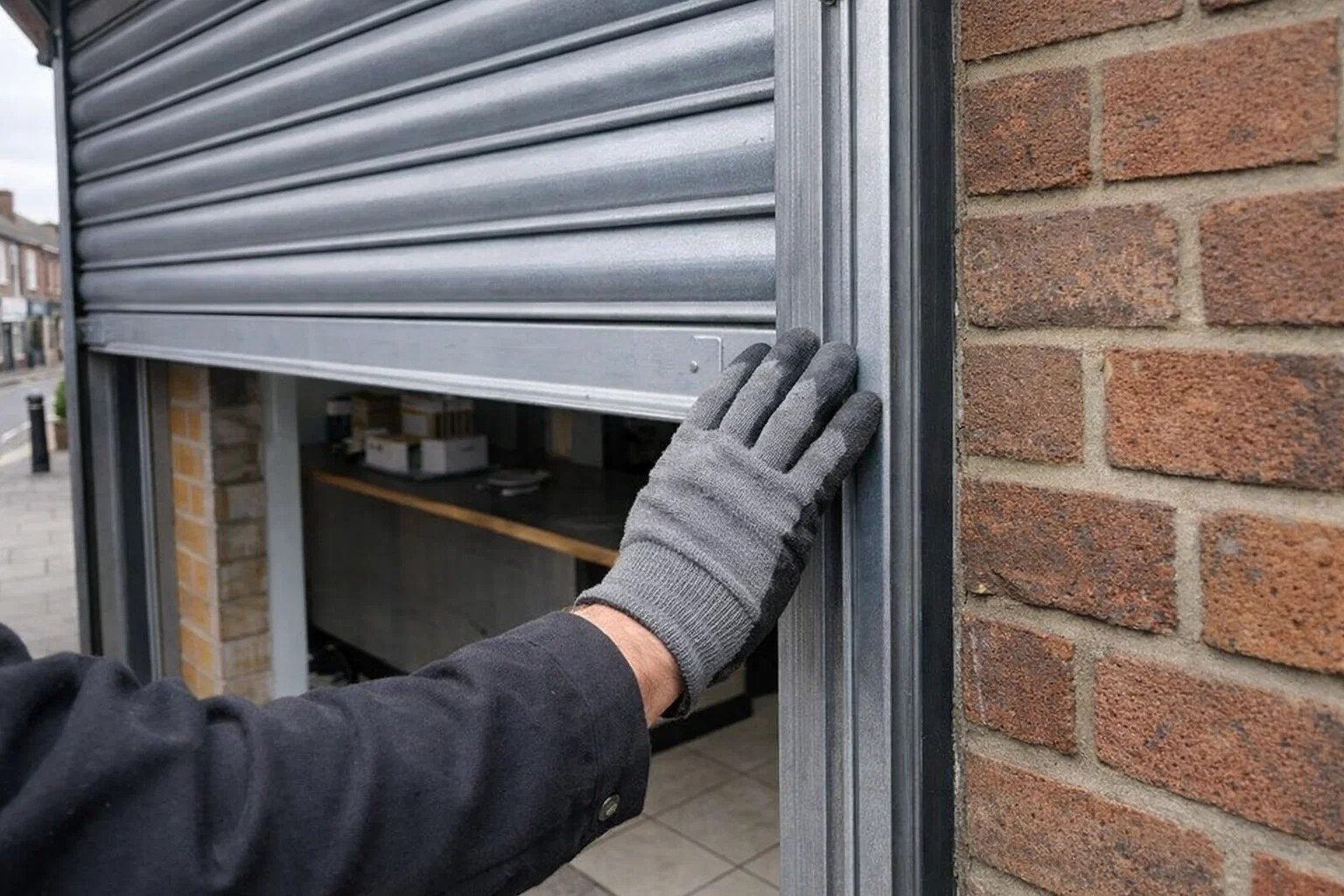
The British Standards explained
Several harmonised European standards, published in the UK with a BS EN prefix, describe how powered industrial, commercial and garage doors should be designed, made, installed and tested. You do not need to read them, but you will see their numbers on declarations, service reports and quotes.
| Standard | What it covers | What it means for you |
|---|---|---|
| BS EN 13241 | The product standard for industrial, commercial, garage doors and gates. It brings the other standards together and is the basis for a door’s declaration of performance and conformity marking. | A new powered shutter should come with documentation referring to it. Ask for it if you were not given it. |
| BS EN 12453 | Safety in use of power-operated doors: protection against crushing, shearing and trapping, and how closing forces are measured and tested. | This is the standard behind the choice of safety edges, photocells and control types for your shutter. |
| BS EN 12604 | Mechanical aspects, including protection against the curtain falling. | Underpins the fall-back protection on your shutter. |
| BS EN 12978 | Safety devices for power-operated doors and gates. | Covers the protective devices themselves, such as safety edges and photocells. |
| BS EN 12635 | Installation and use (older standard). | BSI withdrew it on 15 December 2023 and lists BS EN 12453 and BS EN 12604 as the current standards in its place. You may still see it on older paperwork. |
A properly installed powered shutter should come with user instructions, maintenance requirements and the relevant declaration for the door. Keep them with your building records. If you were not given these when the shutter was installed, ask the installer.
Who is responsible for what
Responsibility for a shutter is often shared, and confusion about who does what is one of the most common reasons safety checks get missed. This is the usual split, but your lease and contracts decide the detail.
| Who | Usually responsible for |
|---|---|
| Employer or person in control of the premises | Making sure the shutter is safe to use, included in the risk assessment, maintained and used only by trained staff. Acting on faults. |
| Landlord | Often responsible for repair and maintenance of building elements, including shutters, under the lease. Many leases pass this to the tenant. Check yours. |
| Tenant | Day-to-day use, reporting faults, and any repair and maintenance the lease gives them. |
| Installer or whoever puts it into service | Designing and installing a door that meets the essential safety requirements, with documentation, for the way it will be used. |
| Service engineer | Inspecting, testing and repairing competently, and telling you plainly about defects and risks. |
| Staff who operate it | Following training, keeping the opening clear, never bypassing safety devices and reporting faults straight away. |
The safety devices on a powered shutter
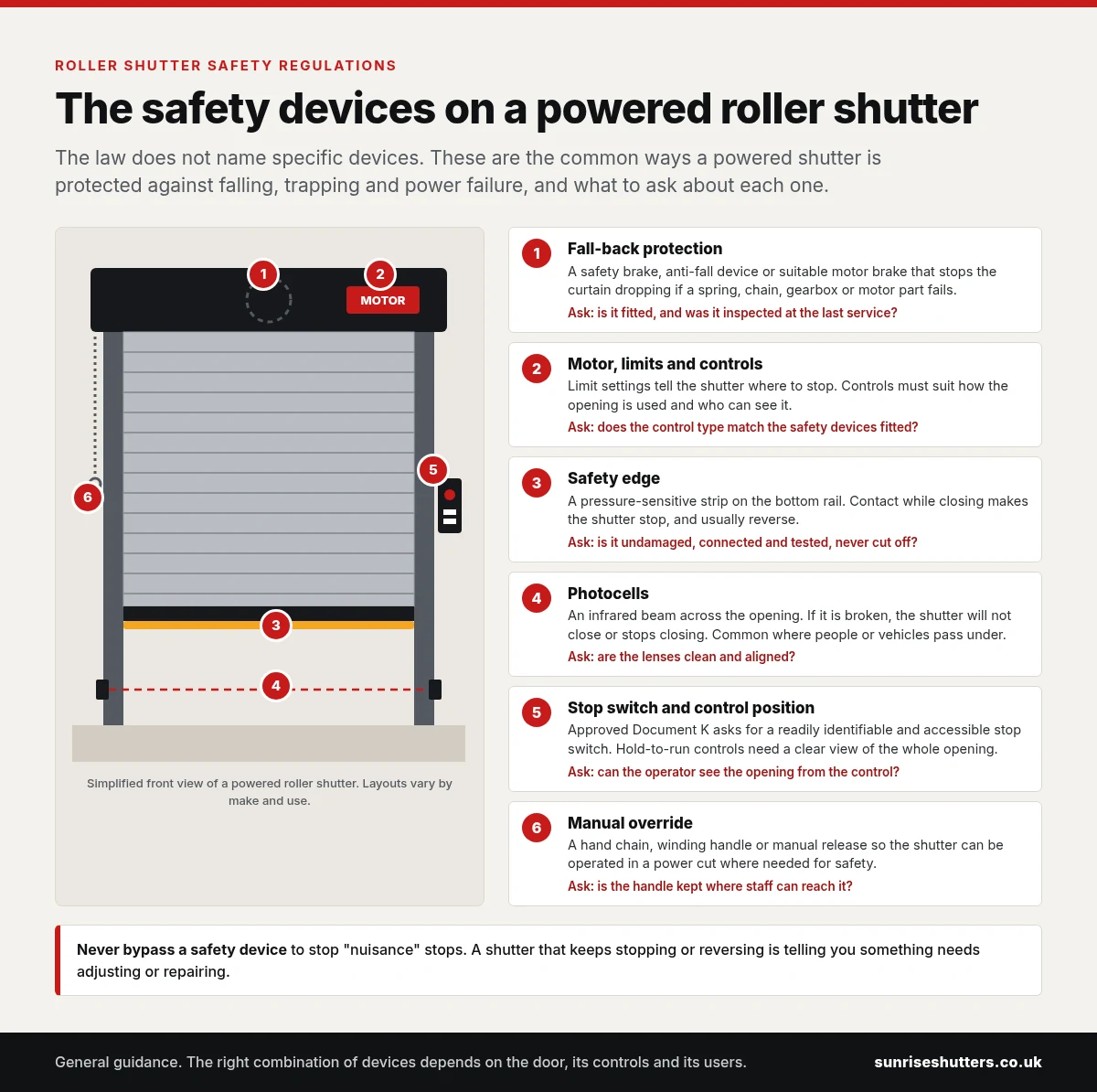
The law asks for “suitable and effective features” against trapping, not for a particular device. These are the common ways a powered roller shutter is protected, and what to ask about each one.
Safety edges
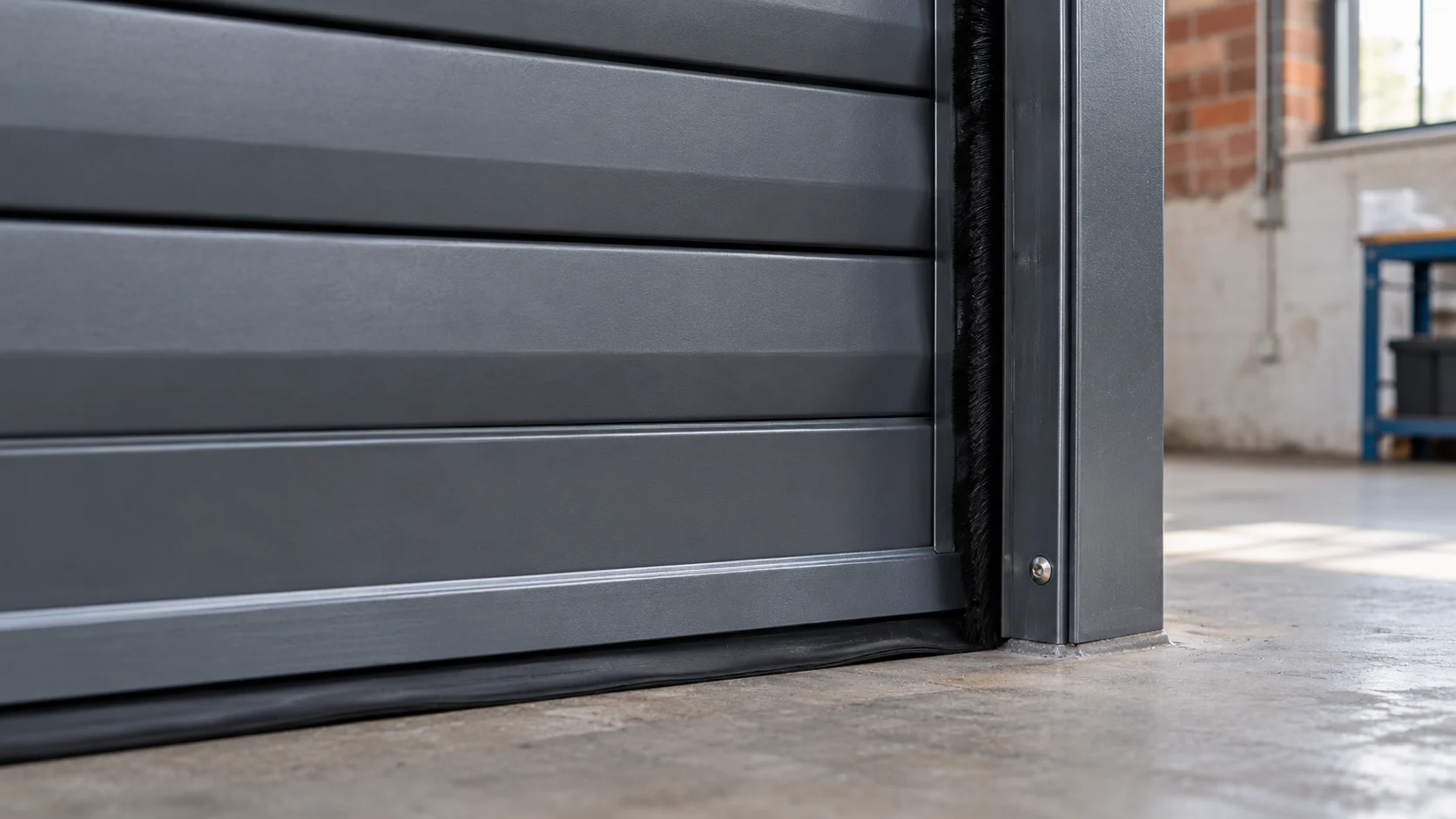
A pressure-sensitive strip along the bottom rail. If it touches a person, vehicle or object while the shutter is closing, the shutter stops and usually reverses. Safety edges are among the most common devices on commercial shutters, and Approved Document K uses a “pressure-sensitive door edge” as its example of a safety feature. Because they sit at the point of impact, they are also among the most frequently damaged parts.
Photocells
An infrared beam across the opening. If the beam is broken, the shutter will not close or stops closing. Photocells are useful where people or vehicles regularly pass under the door, because they can stop the shutter before contact. They need clean lenses and correct alignment, and they can be knocked out of line by vehicles or stock.
Hold-to-run controls
With hold-to-run (sometimes called “dead man”) controls, the shutter only moves while the button is held. If the operator lets go, it stops. This relies on the operator being able to see the whole opening while the door moves, so the control must be positioned with a clear view.
Stop switch
Approved Document K asks for “a readily identifiable and accessible stop switch” on power-operated doors. Staff should know where it is and what it does.
How the controls change the risk
The single biggest factor in what protection a powered shutter needs is how it is controlled. As a rule of thumb, the less the person operating it can see and control, the more automatic protection is needed. The exact combination is set by the installer’s risk assessment against BS EN 12453.
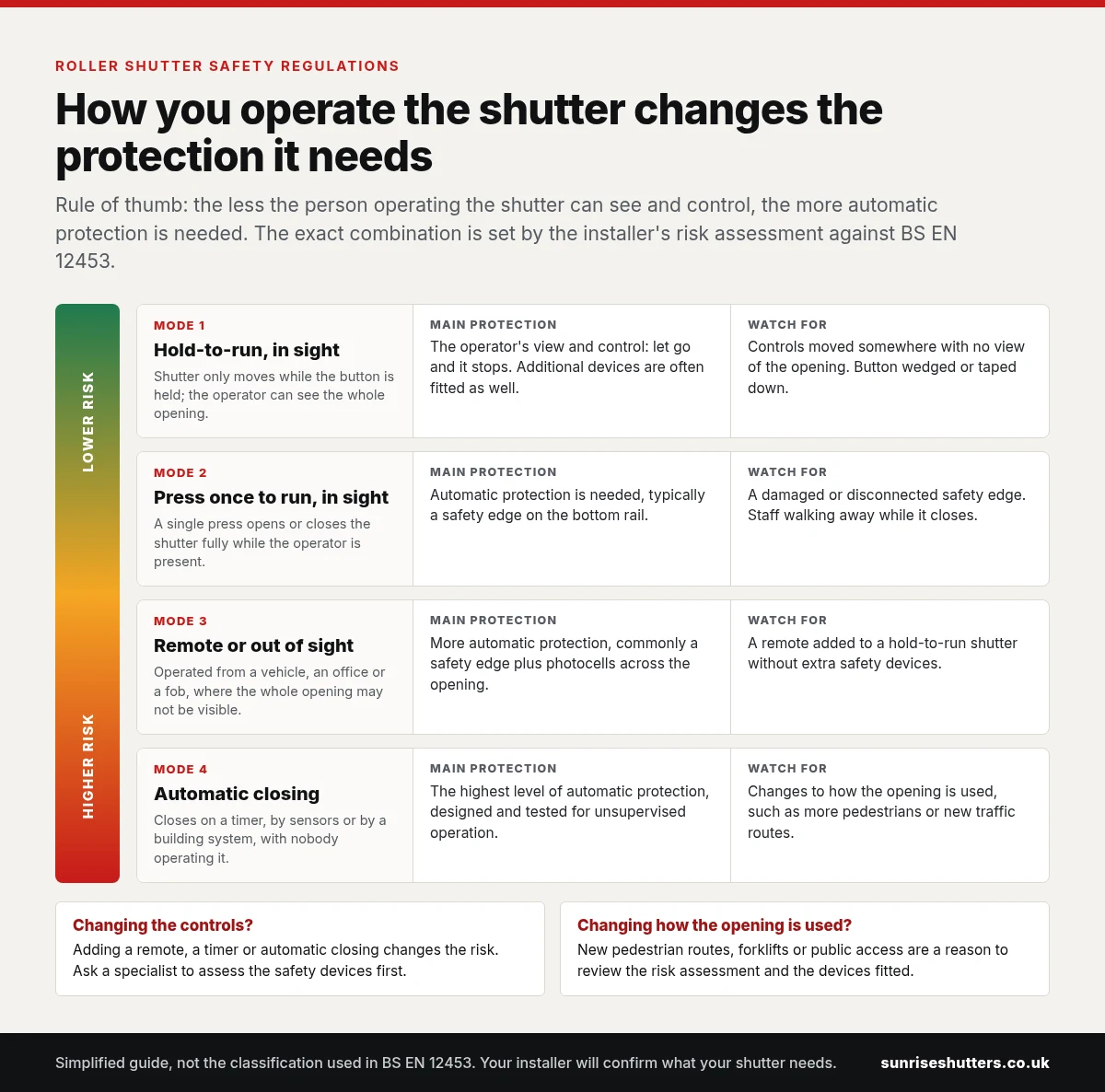
The most common problem we see is a remote control added to a shutter that was designed for hold-to-run use in sight of the opening, without any extra safety devices. It is convenient, but it changes the risk completely. If your remote is not working and you are thinking about replacing or adding handsets, read our guide to what to do when a roller shutter remote is not working and ask whether your safety devices suit remote operation.

Fall-back protection
If a spring, chain, gearbox or motor component fails, a heavy curtain can drop. Regulation 18 requires upward-opening doors to have a device that prevents this. Depending on the shutter, it can be:
- A safety brake or anti-fall device fitted to the barrel, which locks if the curtain starts to run away;
- A motor with an integral brake designed for the purpose;
- A spring and balance arrangement on manual shutters, with suitable safeguards against sudden drop.
Fall-back devices are hidden in the shutter box, so they should be inspected at every service. The warning signs that something in the drive or balance system is wearing include a curtain that drifts down on its own, a jerky or uneven descent, new knocking from the box, or a manual shutter that has become noticeably heavier or lighter to lift. For a closer look at the parts inside the box, see our upcoming guide to roller shutter parts explained.

Never walk or work under a shutter that is stuck part way, drifting down or hanging unevenly. Keep people clear, stop using it and call an engineer. Do not try to release or adjust springs yourself: they store a great deal of energy.
Manual operation in a power cut
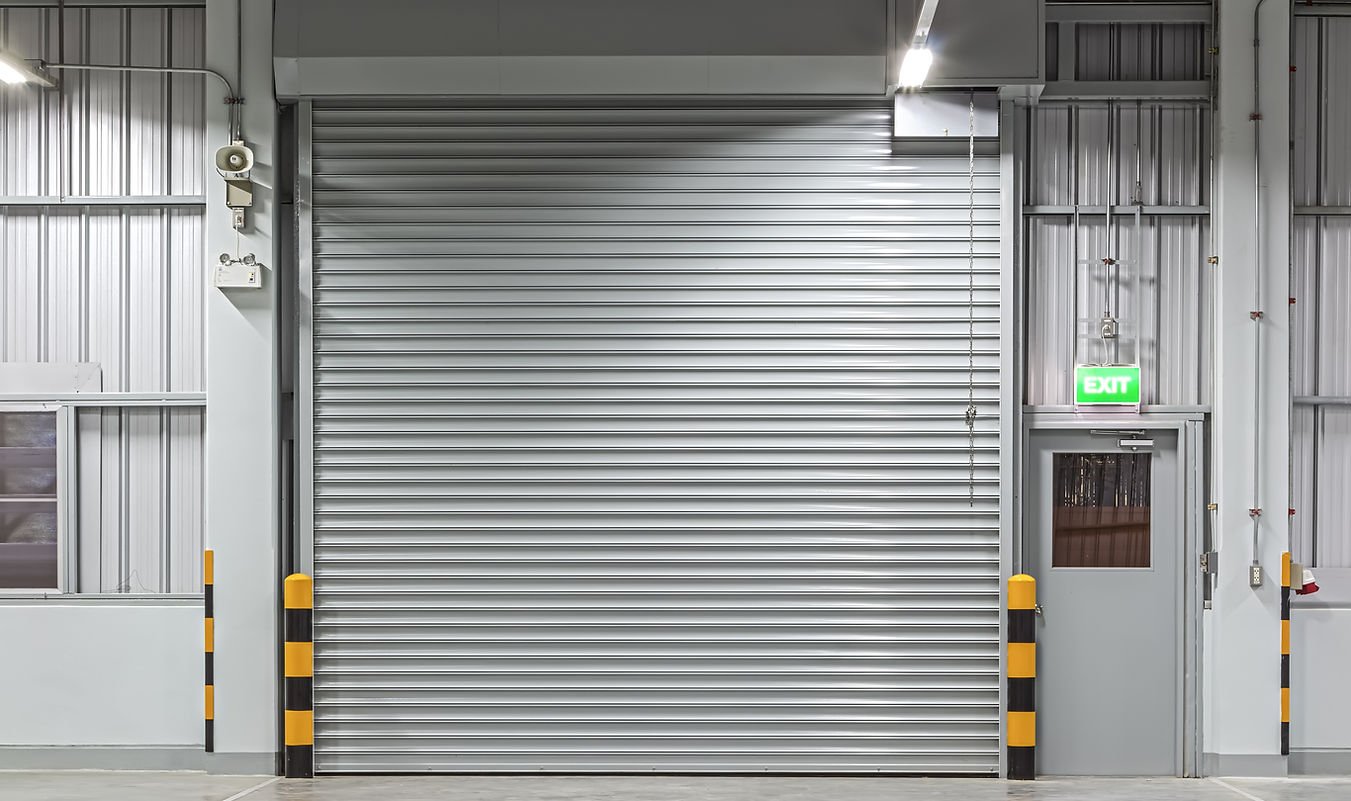
Where it is necessary for health or safety, a powered door must be capable of manual operation unless it opens automatically when the power fails. On roller shutters, this is usually done with a hand chain, a winding handle or a manual release. Think about:
- Who needs to get out or in if the power fails: staff in a unit with no other exit, vehicles that must leave, or emergency access.
- Where the handle or chain is kept. Keep it next to the shutter or somewhere staff can reach quickly, not locked in an office.
- Who knows how to use it. Show key staff, and include it in induction for new starters.
- Whether it still works. Ask for the manual override to be checked at every service.
★★★★★
“I had an emergency with my shutter garage door on a Sunday and was dreading the wait, but Sunrise Shopfronts and Shutters came out remarkably quickly. The engineer was professional, friendly, and got straight to work diagnosing the problem. Nothing was too much trouble for him, and he had everything fixed and working perfectly in no time.”
Kam Kang, Google review
How to risk assess a roller shutter, step by step
Employers must assess the risks in their workplace, and a powered door is an obvious item to include. You do not need special software. Work through these steps for each shutter and write down what you find.
- Identify the shutter. Location, size, manual or powered, how it is controlled, and when it was installed and last serviced.
- Identify who uses the opening. Staff opening up early or closing late, delivery drivers, forklift traffic, customers, contractors, and members of the public walking past a shopfront.
- Identify the hazards. Trapping or crushing under the closing curtain, the curtain falling, being struck by a moving door, vehicles hitting the guides, operating it in the dark, and power failure.
- Check the controls you rely on. Which safety devices are fitted? Do they work? Can the operator see the whole opening? Is there a stop switch? Is the manual override available?
- Look at behaviour. Do people duck under a closing shutter? Is stock stored in the drop zone? Has anyone wedged a button or disconnected a safety edge to avoid “nuisance” stops?
- Decide what else is needed. Training, signage, floor markings, a separate pedestrian door, guide protectors, extra safety devices or a change of controls.
- Record and review. Write down the findings and actions, and review them after any incident, any change of controls, or any change in how the opening is used.
This table shows typical hazards and the controls that usually address them:
| Hazard | Who is at risk | Typical controls |
|---|---|---|
| Trapped or crushed by a closing curtain | Anyone in the opening | Safety edge, photocells, hold-to-run with a clear view, training, keeping the drop zone clear |
| Curtain falling if a component fails | Anyone under the shutter | Fall-back device, regular inspection of springs, brakes and drive, stopping use when faults appear |
| Struck by a moving shutter on a busy route | Pedestrians, customers, passers-by | Control position with a view of the opening, warning lights where appropriate, floor markings |
| Vehicle impact damaging guides and curtain | Drivers, staff nearby | Guide protectors, bollards, clear traffic routes, prompt repair after any impact |
| Unable to open or close in a power cut | Staff, emergency access | Manual override kept accessible, staff trained in its use |

If you manage a warehouse or yard, our upcoming guide to warehouse roller shutter doors covers specifying doors for busy loading areas, and our industrial roller shutters page explains what we make for those sites.
Shutter safety self-check
These checks can be done by a responsible member of staff without tools. They do not replace a service by a competent engineer, but they catch many problems early. Stop and call an engineer if anything looks wrong.
- ☐ The shutter runs smoothly and evenly, without new noises, jerks or hesitation.
- ☐ It stops where it should at the top and bottom, and does not drift down on its own.
- ☐ The safety edge on the bottom rail is present, undamaged and not taped, cut or hanging loose.
- ☐ Photocell lenses are clean and the units are not knocked out of line.
- ☐ The control is positioned so the operator can see the whole opening, and the stop switch is easy to find.
- ☐ The manual override handle or chain is present and kept where staff can reach it.
- ☐ The guides are straight, securely fixed and free of debris, and any guide protectors are intact.
- ☐ The drop zone is clear: no stock, bins or pallets stored under the shutter.
- ☐ Staff know the rules: never walk under a moving shutter, never bypass a safety device, report faults straight away.
- ☐ The last service was within the interval your engineer recommended, and the report is on file.
For a fuller list of routine checks your team can do each month, see our simple monthly roller shutter maintenance checklist.
Want your shutter safety checked?
If you are not sure your safety devices are working, or a device has been removed, damaged or disconnected, call our installation and service line. We will inspect the shutter, test its safety features and tell you plainly what needs doing.
What a safety-focused service should cover
There is no single legal interval for servicing a roller shutter. Follow the manufacturer’s instructions and base the frequency on how heavily the shutter is used and the conditions it works in. Busy commercial and industrial doors need more frequent attention than lightly used ones. Whatever the interval, a service should include more than a squirt of lubricant. This is what to expect:
| Check | Why it matters |
|---|---|
| Safety edge tested by obstructing the closing shutter | Confirms the shutter stops and reverses as it should |
| Photocells tested and lenses cleaned and aligned | Confirms the shutter will not close on someone in the opening |
| Fall-back device, brake and drive inspected | The protection against falling back is hidden in the box and wears with use |
| Springs and balance checked on manual and spring-assisted shutters | Weak or broken springs make a curtain heavy or let it drop |
| Limits checked and adjusted | The shutter should stop at the right points, not run into the floor or over-travel |
| Controls, stop switch and wiring checked | Damaged switches and cables cause faults and electrical risk |
| Curtain, end locks, guides and bottom rail inspected | Damage here makes the curtain run off line and strain the motor |
| Manual override tested | Confirms the shutter can be operated in a power cut |
| Written report with defects and recommendations | Your record that the shutter is being maintained, and a plan for any work needed |
Our roller shutter maintenance and repairs service covers condition checks, operation checks and safety device testing for new and existing shutter systems. Our upcoming roller shutter servicing guide explains in more detail what a service includes and how often you need one.
The records to keep
Good records show that you have a “suitable system of maintenance” and make every future repair quicker. Keep, for each shutter:
- The installation documentation, user instructions and declaration you were given.
- Every service report, with the date, what was tested and what was found.
- Faults, breakdowns and near misses, with dates and what happened.
- Repairs carried out and parts replaced.
- Any changes to controls, safety devices or the way the opening is used.
- Training given to staff who operate the shutter.
Records also help you decide whether a shutter is worth repairing again. Our guide to roller shutter repair cost explains how history and condition affect that decision.
★★★★★
“We’re really happy with the service from Sunrise Shopfronts! They always do a fantastic job and fixed our shutter very quickly. Their service is reliable, efficient, and professional. We really appreciate their quick response and excellent workmanship. Highly recommend Sunrise Shopfronts to anyone looking for a reliable and trustworthy service!”
Paramjot Dhaliwal, Google review
Common safety failures we find
A shutter that was safe on installation day can become dangerous over time. These are the problems that come up again and again on inspection:
- Safety edges damaged by impact, or cut off after repeated “nuisance” stops instead of being repaired.
- Photocells knocked out of alignment, covered in dirt or obstructed by stock.
- Controls moved to a position with no view of the opening, often during a refit.
- Remote handsets added to hold-to-run shutters without extra safety devices.
- Buttons wedged or taped down so the shutter runs without being held.
- Manual override handles missing, or locked away where nobody can reach them.
- Worn springs, brakes and bearings that have not been inspected for years.
If any of these sound familiar, the fix is usually straightforward, and far cheaper than dealing with an injury or a fallen curtain. Our page on roller shutter repairs explains how we diagnose and fix faults, and our shutter repairs in Birmingham page covers local response.

Fire shutters, garage doors and shared buildings
Fire shutters
Fire shutters are part of a building’s fire safety arrangements, so they come under fire safety law as well as the rules above. In England and Wales, the Regulatory Reform (Fire Safety) Order 2005 requires fire safety facilities and equipment to be maintained in efficient working order and good repair. Our guide to fire shutter servicing explains the testing and records involved, and our fire shutters page covers the shutters we supply.
Domestic roller garage doors
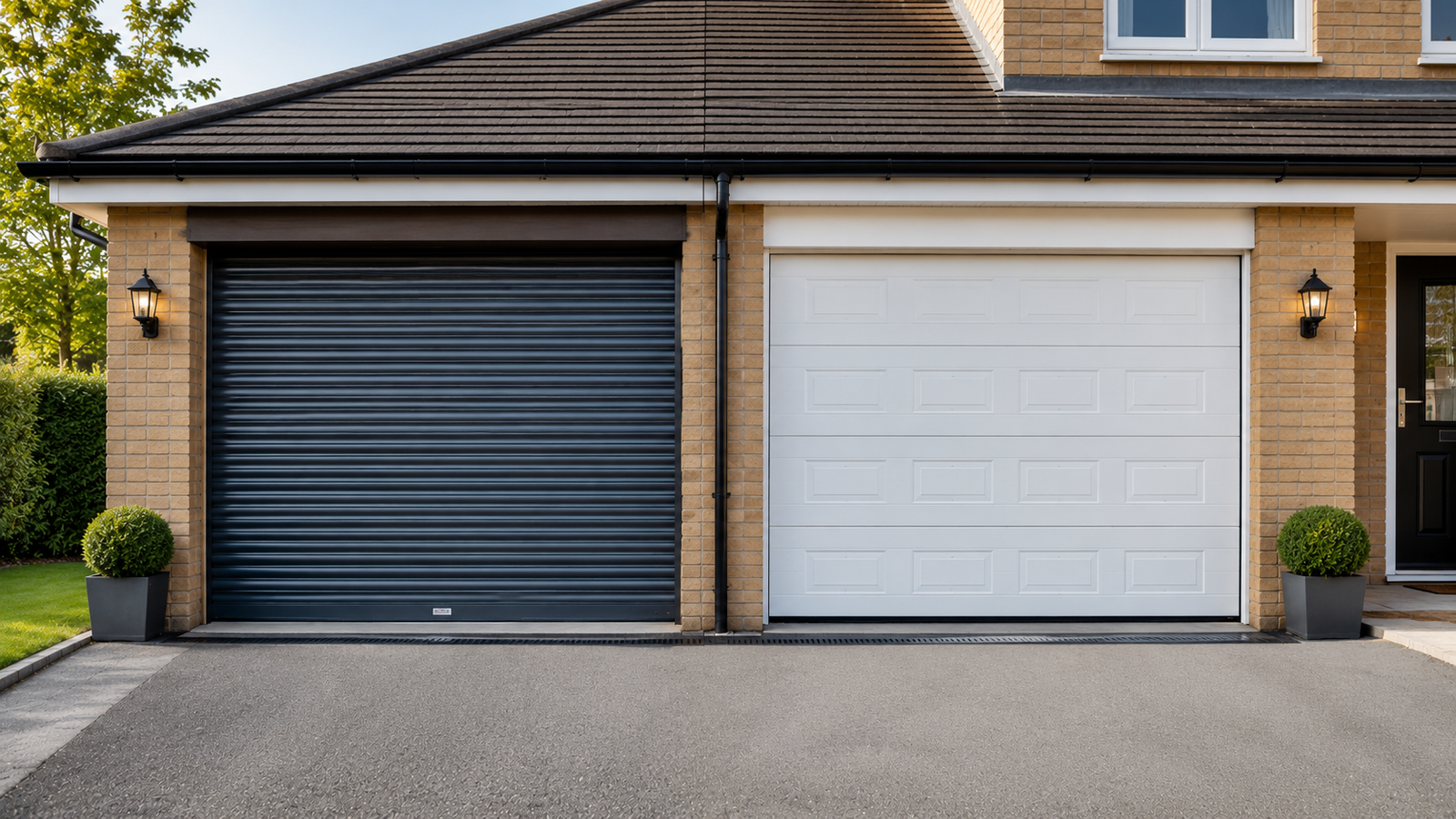
The Workplace Regulations apply to workplaces, not private homes, and Approved Document K says requirement K6 does not apply to dwellings. But the physics is the same, and the product standards above cover garage doors too. A powered roller garage door should still have suitable safety features. Keep children away while it moves, keep remotes out of their reach and have it checked periodically.
Shopfront shutters over public pavements
Shopfront shutters often close across a public footway. Passers-by do not expect it to move, so the person operating it should be able to see the whole opening and the pavement in front, and should never leave a closing shutter unattended. Our commercial roller shutters are made in our own West Midlands workshop and installed with controls and safety devices to suit how each opening is used.
If your shutter is unsafe right now
- Stop using it. Do not keep pressing the button or forcing the curtain.
- Keep people clear of the opening and the area under the shutter.
- Isolate it at its isolator if it is safe to do so and you know where it is. Do not open the control panel.
- Secure the premises another way if the shutter is stuck open, or call for help if it is stuck closed and you cannot trade.
- Call a shutter engineer. Describe what it is doing, any impact or noise, and send a photo if you can.
If your shutter will not close, our guide to why a roller shutter won’t close and when to call an emergency repair goes through the likely causes.
Shutter unsafe, stuck or damaged?
Our emergency line is answered 24 hours a day, 365 days a year, and we usually have an engineer with you within 2 hours to make the opening safe and plan the right repair.
Frequently asked questions
Do electric roller shutters legally need safety edges?
The law requires powered doors to have suitable and effective features to prevent trapping, but it does not name a specific device. Safety edges, photocells and hold-to-run controls are common ways of meeting the requirement. The right combination depends on the door, how it is controlled and who uses the opening.
Is a manual roller shutter covered by the regulations?
Yes. In a workplace, a manual roller shutter is an upward-opening door, so it needs a device to prevent it falling back, and it must be maintained in good repair.
How often should a powered shutter be serviced?
There is no single legal interval. Follow the manufacturer’s instructions and base the frequency on how heavily the shutter is used and its environment. Busy commercial and industrial doors need more frequent attention than lightly used ones. Fire shutters have their own testing requirements.
Who is responsible for shutter safety in a rented unit?
Usually the employer or person in control of the workplace has the day-to-day duty, but leases often split repair and maintenance between landlord and tenant. Check your lease and agree in writing who arranges servicing and keeps the records.
Can I add a remote control to my shutter?
Often, yes, but if the shutter currently relies on hold-to-run controls in sight of the opening, adding a remote may mean extra safety devices are needed. Ask a specialist to assess it before you change the controls.
Our safety edge keeps stopping the shutter. Can we disconnect it?
No. A safety edge that keeps triggering is telling you something: it may be damaged, out of adjustment or hitting an obstruction. Disconnecting it removes a key protection against trapping. Have it repaired instead.
Do I need a certificate for my roller shutter?
A new powered shutter should come with documentation, including user instructions, maintenance requirements and the relevant declaration for the door. After that, what you need is evidence of maintenance: service reports, records of faults and repairs, and any changes made.
Get your shutter checked
Tell us about the shutter, how it is controlled and anything that worries you. We will inspect it, test its safety devices and explain clearly what, if anything, needs doing.
- Emergency line (24/7): 07931 104160
- Installation and service line: 07931 104162
