
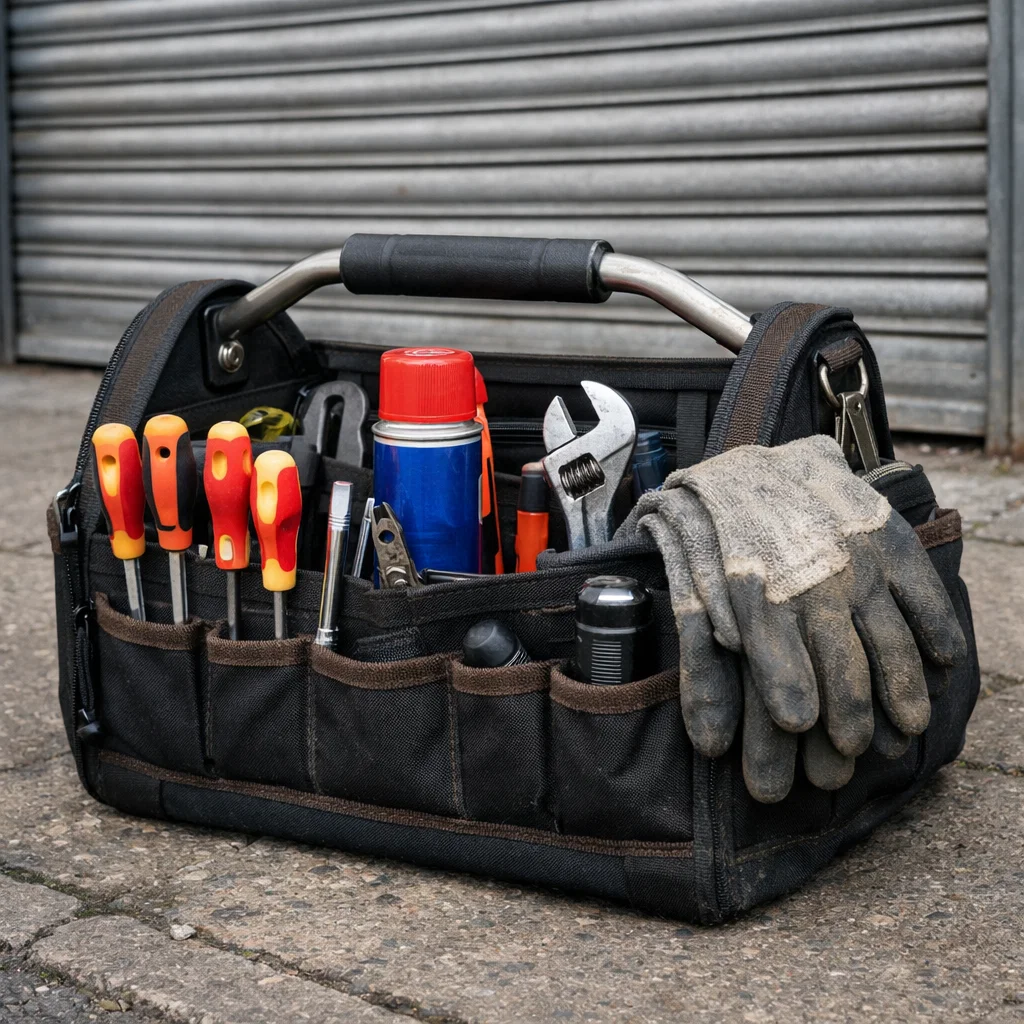
Roller shutter servicing is a planned visit by a trained engineer to inspect, test, adjust and lubricate your shutter, check that its safety devices work and record any wear or defects before they turn into a breakdown. It is different from the simple checks your own staff can do between visits: an engineer can safely look at the springs, brake, motor, limits, controls and fixings, test the safety edge and photocells properly, and tell you plainly what needs attention now and what can be planned. How often a shutter needs servicing depends on how heavily it is used, its age, its environment and the manufacturer’s instructions. A shopfront shutter opened twice a day has very different needs from a loading bay door that runs through every shift.
We are Sunrise Shopfronts & Shutters, based in West Bromwich. We install, maintain and repair commercial and industrial shutters, and this guide explains what a proper service should include, how to decide how often you need one, what the report should tell you and how to manage servicing across several shutters or sites.
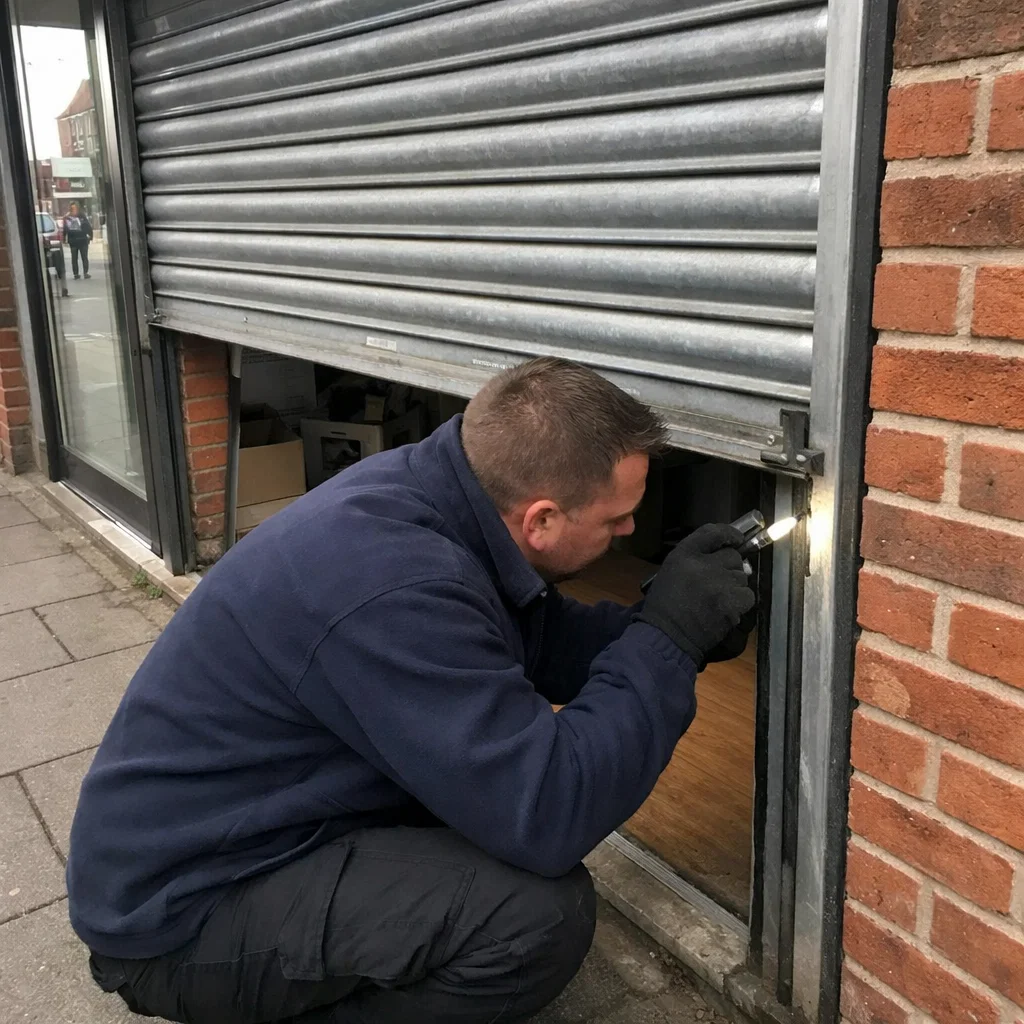
Key takeaways
- A service is more than a spray of lubricant. It should cover the curtain and guides, the mechanical parts, the motor and controls, and functional tests of every safety device.
- There is no single legal interval. Usage, environment, age and the manufacturer’s instructions should set the schedule.
- Busy doors need more frequent visits than lightly used ones; harsh environments speed up wear.
- Your team and your engineer have different jobs. Staff look, listen and keep the opening clear; engineers deal with anything that stores energy or runs on mains power.
- You should get a written report that separates urgent safety issues from planned repairs.
- Fire shutters are a separate case with their own testing and maintenance requirements.
In this guide
- Roller shutter servicing: the quick answer
- Servicing, maintenance checks and repairs
- Why roller shutter servicing matters
- What a professional service includes
- A service visit, step by step
- How often should a roller shutter be serviced?
- Who checks what: your team or an engineer
- Signs your shutter needs attention now
- What the service report should tell you
- What affects the cost of a service
- How to compare service providers
- Managing several shutters or sites
- Fire shutters, garage doors and older shutters
- Your legal duties
- Getting the most from each visit
- Frequently asked questions
Roller shutter servicing: the quick answer
- What it is: a planned inspection, test and adjustment of the whole shutter by a trained engineer, with a written record.
- What it covers: curtain, end locks, bottom rail and guides; box, barrel, end plates and bearings; springs or gearbox; motor, brake and limits; controls and control box; safety edge, photocells, hold-to-run controls, fall-back protection and the manual override.
- How often: agreed for each shutter. Many lightly used shutters are serviced once a year; busy commercial and industrial doors are often serviced more frequently, such as every six months, or quarterly for very heavy use. The manufacturer’s instructions and your risk assessment come first.
- What you get: a shutter that has been run through full cycles and tested, and a report listing what was checked, what was found, what was done and what is recommended.
- What it cannot do: guarantee that a fault will never happen, especially impact damage. It does make wear-related breakdowns much less likely to take you by surprise.
Servicing, maintenance checks and repairs
These three terms get used loosely, which is how people end up paying for one and expecting another. This is how they differ:
| Staff maintenance checks | Planned service | Repair | |
|---|---|---|---|
| Who | Your own team | A trained shutter engineer | A trained shutter engineer |
| When | Regularly, for example monthly, and whenever something changes | At an agreed interval for each shutter | When a fault or damage is found |
| What | Look, listen, keep the opening clear, log anything unusual | Inspect, test, adjust and lubricate the whole shutter, and record findings | Correct a specific fault: replace parts, straighten guides, reset limits and so on |
| Tools and covers | None: no covers off, no work at height | Box, motor and control covers as needed | Whatever the repair needs |
| Outcome | Early warning | A safe, adjusted shutter and a written report | The fault fixed and the shutter tested |
Maintenance checks condition and operation and may identify defects; a repair is the separate work needed to correct them. If you are looking for the checks your own team can do, our simple monthly roller shutter maintenance checklist covers them in detail. This guide covers the professional side.
Why roller shutter servicing matters
Fewer breakdowns at the worst moment
Shutters rarely fail without warning. Springs lose tension, guide liners wear, end locks crack, limits drift and motors start to labour. A service catches these signs early, so parts can be replaced at a time that suits you rather than during an emergency call-out at closing time or before a delivery.
Safety for staff and the public
Powered shutters rely on safety edges, photocells and fall-back protection. These can be damaged, knocked out of line or disconnected without anyone noticing, because the shutter still opens and closes. Only a proper test shows whether they still work.
A longer life for the shutter
Correct adjustment and lubrication reduce wear on the curtain, guides, bearings and motor. A shutter that is looked after usually lasts longer than one that is only looked at when it breaks. Motors in particular tend to give warning before they fail; our guide to the signs it is time to upgrade your shutter motor explains what to listen for.
Records for insurers, landlords and auditors
Service records show that you are looking after workplace equipment. Insurers, landlords and health and safety auditors may ask for them, particularly after an incident or a claim.

What a professional service includes
Every shutter is different, but a thorough service on a powered commercial shutter should cover five areas. On a manual shutter, the electrical checks fall away but the rest still apply.
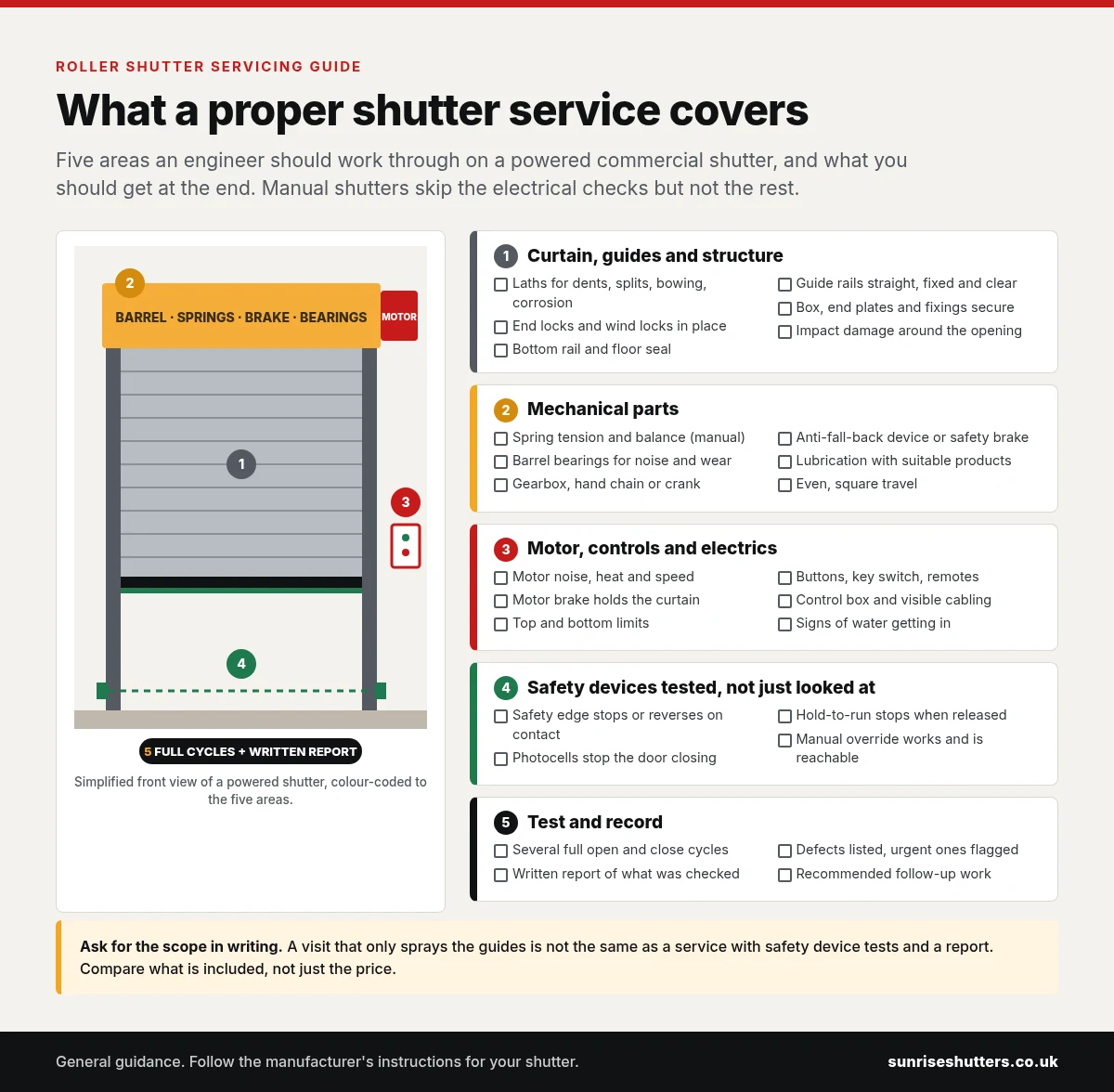
1. Curtain, guides and structure
- The curtain and laths, for dents, splits, bowing and corrosion.
- End locks and wind locks, for missing or broken clips.
- The bottom rail and floor seal, for damage and wear.
- Guide rails and liners, for damage, wear, debris and secure fixing.
- The box, end plates and fixings, for looseness and damage, and any sign of impact around the opening.
2. Mechanical parts
- Spring tension and balance on manual and spring-assisted shutters.
- Barrel bearings, for noise and wear.
- The gearbox, hand chain or winding mechanism, where fitted.
- The anti-fall-back device or safety brake.
- Lubrication of the appropriate moving parts with suitable products. Heavy grease in the guides attracts grit, so more is not better.
3. Motor, controls and electrics
- Motor operation, including unusual noise, heat or slowness.
- The motor brake, which holds the curtain in position.
- Limit settings at the top and bottom of travel.
- Push buttons, key switches and remote handsets.
- The control box and visible cabling, for damage or water getting in.
4. Safety devices, tested rather than just looked at
- The safety edge stops or reverses the shutter on contact.
- Photocells detect an obstruction and prevent closing.
- Hold-to-run controls stop the shutter when released.
- The manual override works and is accessible.
5. Full cycles and a written record
The engineer should run the shutter through several complete opening and closing cycles to confirm smooth, even travel and correct stopping, then give you a written record of what was checked, what was found, what was done on the day and what is recommended next.
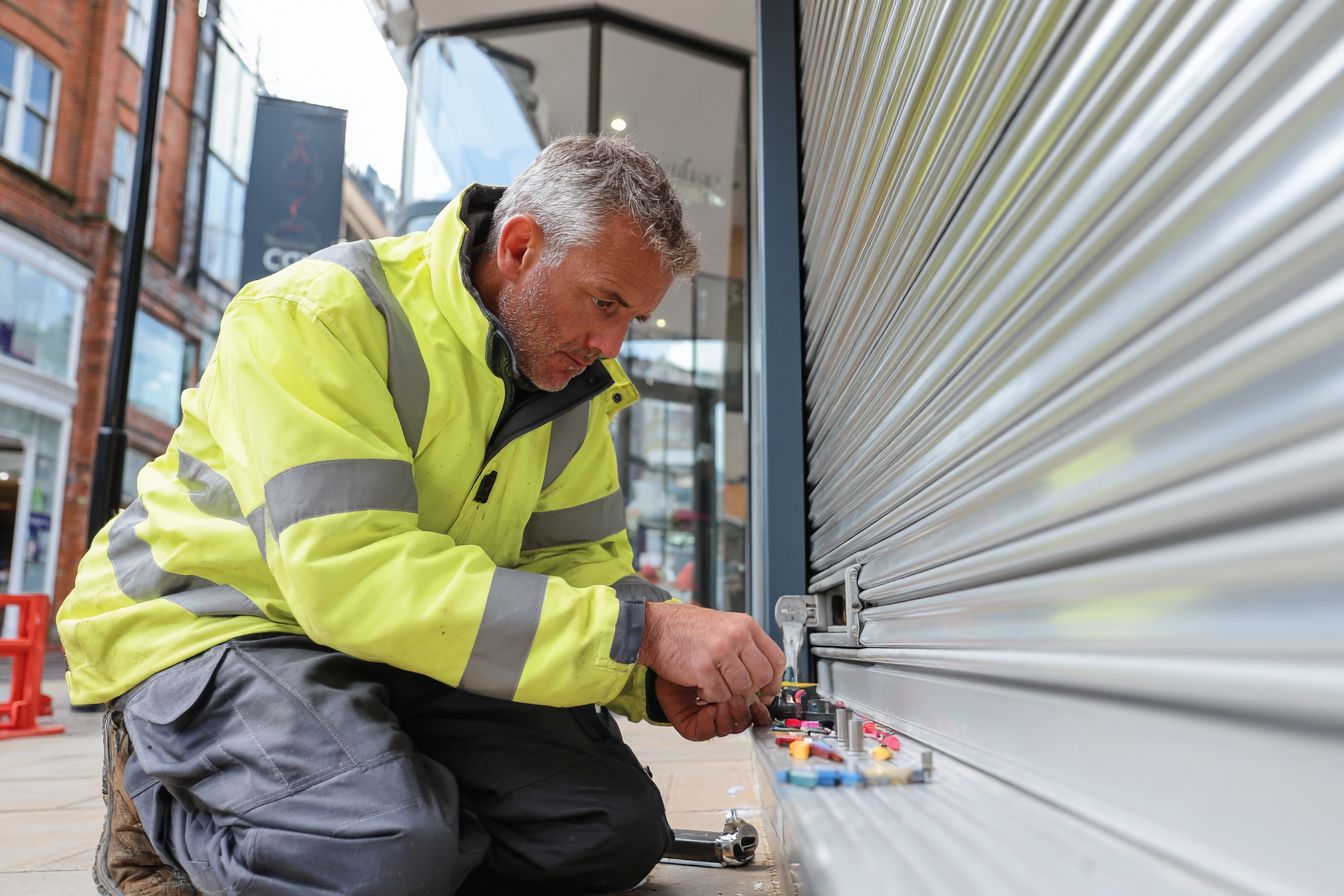
A service visit, step by step
Knowing what to expect makes it easier to tell a thorough service from a quick one. A typical visit runs like this:
- Talk to the site contact. The engineer asks how the shutter has been behaving, whether anything has changed and whether it has been hit or repaired since the last visit.
- Make the area safe. Cones or barriers around the opening, and the shutter isolated before covers come off.
- Watch it run first. Before touching anything, the engineer runs the shutter to see and hear how it behaves.
- Inspect the curtain, guides and bottom rail. Looking for damage, wear, missing end locks and loose fixings.
- Open up and inspect the mechanism. Barrel, bearings, end plates, springs or gearbox, motor, brake and wiring.
- Adjust and lubricate. Limits, spring tension and fixings as needed, with suitable lubricants on the appropriate parts.
- Test every safety device. Safety edge, photocells, hold-to-run, fall-back protection and manual override.
- Run full cycles. Confirming smooth travel, correct stopping and secure locking.
- Explain the findings. What was done, what is wearing and anything that needs a repair, with urgent safety issues separated from planned work.
- Leave a written record for your files.

If a defect is found, the repair is usually quoted separately so you can decide what is done now and what can be planned. That is how our roller shutter maintenance service works: where a defect is found, we explain the repair route and whether further parts or planned work are needed.
How often should a roller shutter be serviced?
There is no single interval that suits every shutter, and you should be wary of anyone who says there is. A sensible schedule considers:
- How often it operates. More cycles mean more wear on every moving part.
- Manual or powered. Powered shutters have more components to check, including safety devices.
- The environment. Dust, damp, coastal air, chemicals, weather exposure and temperature changes all speed up wear.
- Age and history. Older shutters, and those with repeated faults or impact damage, need closer attention.
- The manufacturer’s instructions for the shutter and its motor.
- The shutter’s role. A door that is critical to security, deliveries or fire separation justifies more frequent checks.
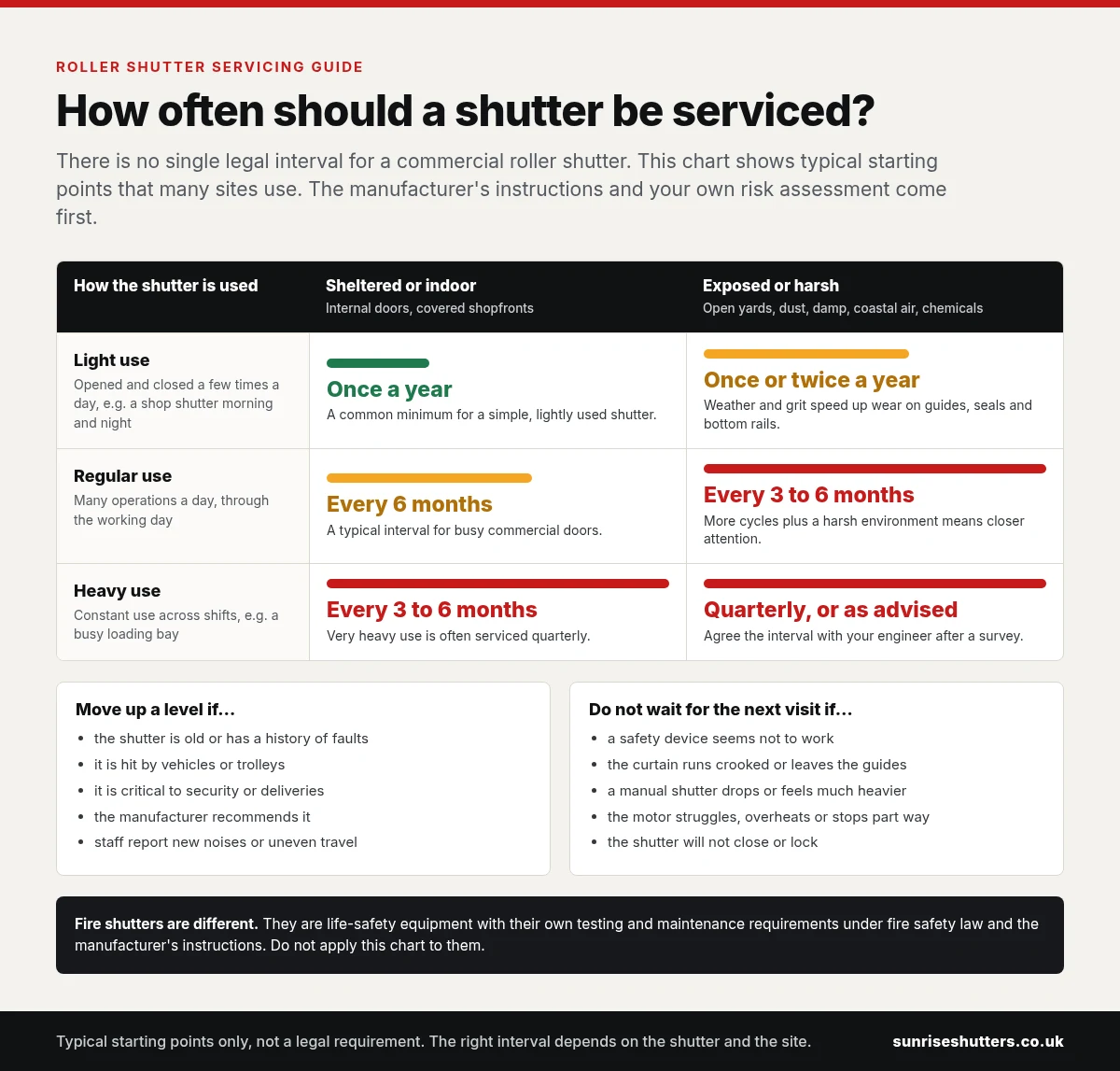
As a rough guide, many lightly used shutters are serviced once a year, while busy commercial and industrial doors are often serviced more frequently, such as every six months, or even quarterly for very heavy use. These are typical starting points, not legal requirements. We shape our service approach around how each shutter is actually used, rather than an arbitrary universal interval.

★★★★★
“We’re really happy with the service from Sunrise Shopfronts! They always do a fantastic job and fixed our shutter very quickly.”
Paramjot Dhaliwal, Google review
Who checks what: your team or an engineer
The best results come from combining simple, regular checks by your own staff with planned engineer visits. Your team are on site every day; they will notice a new noise long before an engineer’s next visit. But some parts are never staff work.
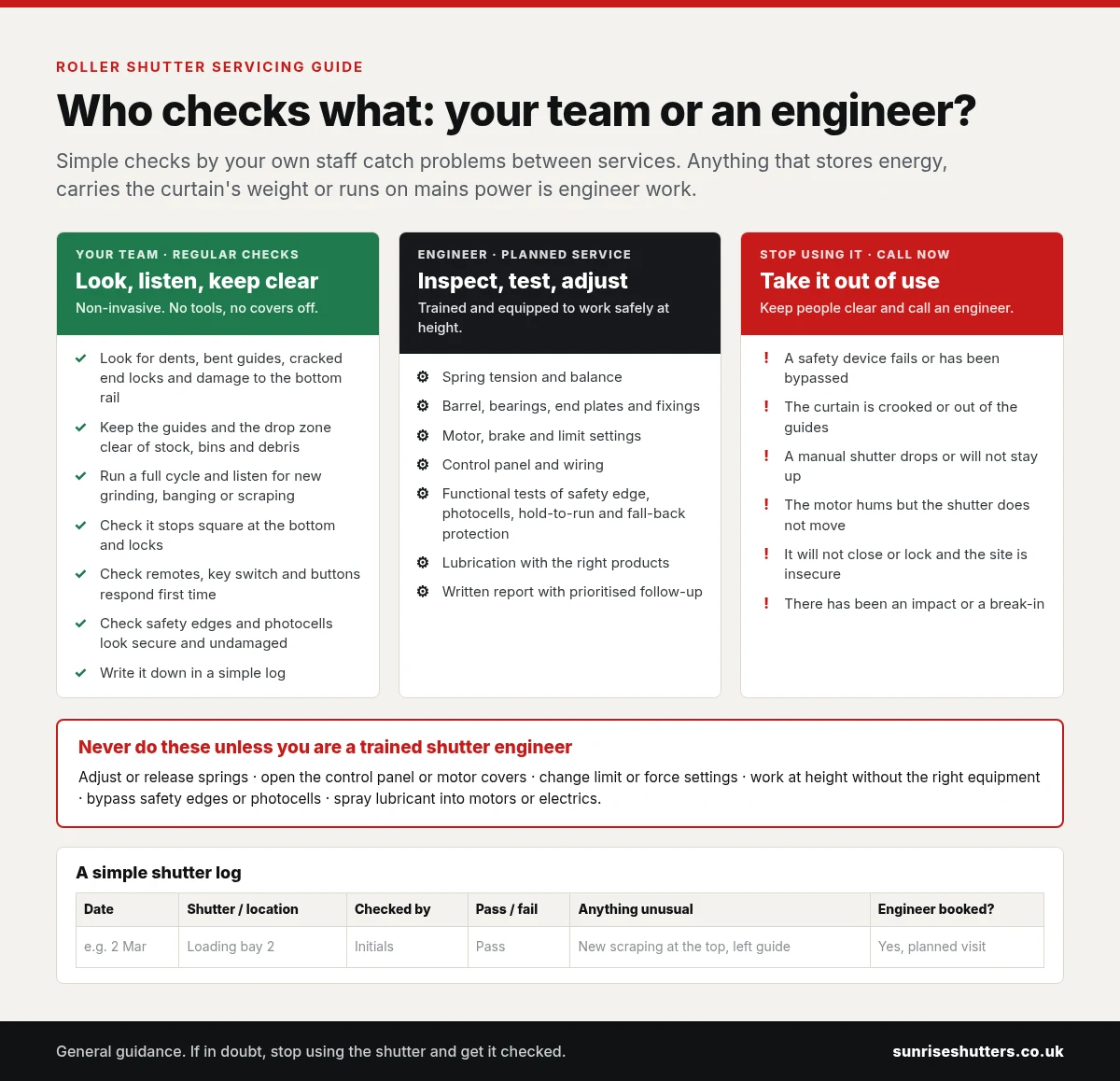
Never let staff: adjust or release springs, open the control panel or motor covers, change limit or force settings, work at height without the right equipment and training, bypass safety edges or photocells, or spray lubricant into motors or electrics. Springs store energy, the barrel carries the curtain’s weight and the controls carry mains voltage.
Signs your shutter needs attention now
Do not wait for the next scheduled visit if you notice any of these. The table shows what each sign usually points to and how urgently to act.
| What you notice | Often points to | What to do |
|---|---|---|
| New scraping, grinding, banging or rattling | Debris or damage in the guides, worn bearings or liners, loose fixings | Book a visit soon, before it becomes a breakdown |
| Uneven travel, one side higher | Missing end locks, bent guide, barrel or bracket problem | Stop using it and call; running a crooked curtain spreads the damage |
| Sticking, hesitating or stopping part way | Safety device triggering, drifted limits, motor struggling, obstruction | Clear the opening; if it continues, call |
| Manual shutter heavier, or will not stay up | Spring tension lost or a spring broken | Keep people clear and call straight away if it drops |
| Controls need repeated presses | Handset battery or programming, key switch, receiver or wiring | Try a new battery and another control; then book a visit |
| Visible damage to the guides, curtain or bottom rail | Impact or attempted forced entry | Book a repair; urgently if it will not close or lock |
| A safety device seems not to work | Damaged, misaligned or disconnected edge or photocells | Take it out of use and call |
If the shutter will not close or the premises are insecure, treat it as an emergency. Our guide to what to do when your roller shutter won’t close explains the safe first steps, and if the problem is a remote, see roller shutter remote not working.

Shutter stuck, damaged or leaving you insecure?
Our emergency line is answered 24 hours a day, 365 days a year, and we usually have an engineer with you within 2 hours to make the opening safe and plan the right repair.
What the service report should tell you
The report is what you are really paying for: it turns the engineer’s visit into decisions you can act on. A useful report includes:
- ☐ The site and the shutter it covers, with its location, type and operating method
- ☐ The date and the engineer’s name
- ☐ What was checked, area by area
- ☐ What was found, including wear that is not yet a fault
- ☐ What was done on the day: adjustments, lubrication, minor parts
- ☐ Safety device test results: safety edge, photocells, hold-to-run, fall-back protection, manual override
- ☐ Recommended follow-up work, with urgent safety issues clearly separated from planned repairs
- ☐ Whether the shutter was left in safe working order, or taken out of use
Keep the reports together, ideally with a simple log your own team fills in between visits. Over time, the pattern tells you a lot: one door that keeps getting hit needs better protection, and a shutter that needs the same repair every visit may be approaching the point where replacement is better value. Our guide to roller shutter repair cost includes a repair-or-replace decision guide.
★★★★★
“Communication was clear, the work was top quality, and I felt looked after from the first phone call to the end of the visit.”
Kam Kang, Google review
What affects the cost of a service
We do not publish a fixed price for servicing, because the time involved varies a great deal from one site to the next. The main factors are:
- The number of shutters on the site. Servicing several doors in one visit is more efficient than separate visits.
- The type and size of each shutter. A large powered industrial door with several safety devices takes longer to service properly than a small manual shopfront shutter.
- Access. Boxes that need a tower or powered access platform, or work outside trading hours, take more time.
- Condition. A shutter that has not been looked at for years usually needs more cleaning and adjustment on the first visit than one serviced regularly.
- Parts. Worn parts found during the service, such as seals, end locks, springs or a safety edge, are usually quoted separately, so you can decide what is done straight away and what can be planned.

How to compare service providers
Ask for the scope of the visit in writing and compare what is included, not just the headline price. A quick visit that only sprays the guides and leaves is not the same as a full inspection with safety device tests and a report.
| Ask | A good answer | A warning sign |
|---|---|---|
| What does the visit cover? | A written list across the curtain, mechanism, motor and controls, and safety devices | “We’ll give it a once-over” |
| Will the safety devices be tested? | Yes, each one, with results recorded | Only a visual check |
| How did you decide the interval? | Based on how the shutter is used, its environment and the manufacturer’s guidance | The same interval for every shutter |
| What happens if you find a defect? | It is explained, prioritised and quoted separately | Repairs carried out and added to the bill without asking |
| Will I get a written report? | Yes, after every visit | A signature on a job sheet only |
| What if it breaks down between visits? | A clear route, including out of hours | No answer |
Want your shutters on a planned service?
Tell us how many shutters you have, where they are, what type they are and how often they run. We will suggest a sensible service approach for each one and explain what each visit covers before anything is booked.
Managing several shutters or sites
If you are responsible for several shutters, perhaps across a warehouse, a parade of shops or a group of sites, a structured approach saves time and money. Work through it in this order:
- List every shutter with its site, location, type, size, operating method and approximate age. A photo of each helps.
- Note how heavily each one is used and how critical it is to security, deliveries or trading.
- Record known issues and history: repeated faults, impacts, recent repairs.
- Agree an interval for each shutter, not one for the whole estate.
- Group visits by site so one engineer visit covers several doors.
- Prioritise follow-up work, separating urgent safety issues from planned repairs, so facilities teams can act clearly.
- Keep the records together so you can see patterns, such as one door that keeps getting hit.
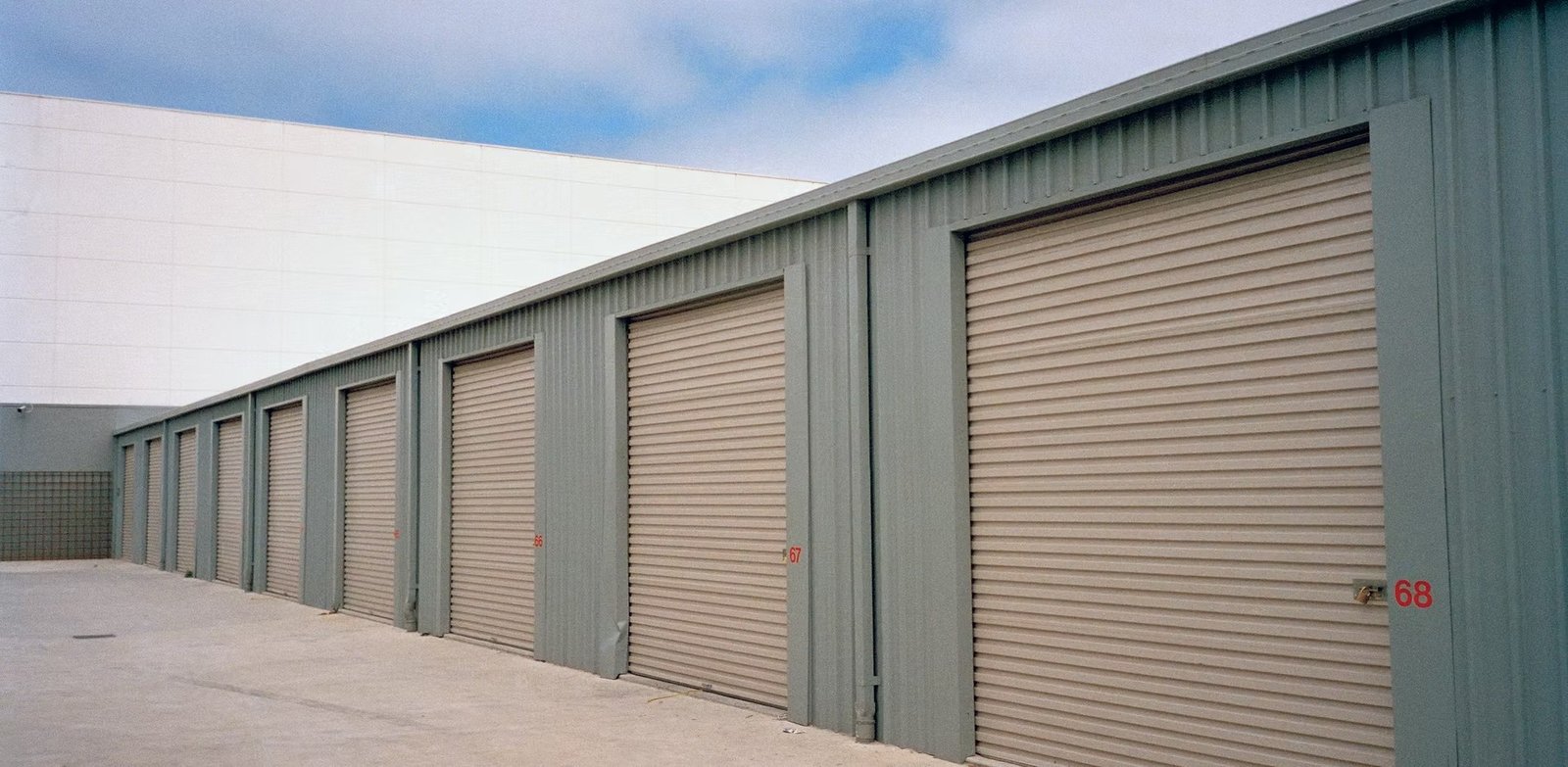
This is how we approach a shutter estate: we establish the shutter types, locations, usage and known issues, plan visits around operational needs, inspect and record, then prioritise the follow-up work. If you would like to discuss a site with several shutters, share the number, types and locations and we can suggest an approach.

Fire shutters, garage doors and older shutters
Fire shutters
Fire shutters are life-safety equipment. They have their own testing and maintenance requirements under fire safety law and the manufacturer’s instructions, and they should not be treated as ordinary security shutters. Our guide to fire shutter servicing covers the legal duties, testing and records in detail.
Domestic roller garage doors
Garage doors benefit from servicing too, particularly powered doors with safety devices, which are used by family members and visitors who may not know the risks. A periodic check keeps them running smoothly and safely. See our roller garage doors page for more.

Shutters after an emergency repair
A shutter that has just been repaired after an impact or break-in may have other wear the emergency visit did not deal with. A follow-up service is a good idea, and our guide to post-repair care for roller shutters explains how to look after it.
Older shutters
Older shutters need closer attention, and their service history matters more. If the same fault keeps returning, or parts are getting hard to find, the service report should say so. Our article on the most common causes of shutter failure explains what tends to go wrong as shutters age, and our upcoming guide to roller shutter parts explained describes each component and how it wears.
Your legal duties
If your shutter is part of a workplace, servicing is not only good practice. In Great Britain, regulation 5 of the Workplace (Health, Safety and Welfare) Regulations 1992 requires the equipment, devices and systems it covers to be maintained (including cleaned as appropriate) in an efficient state, in efficient working order and in good repair, and where appropriate to be subject to a suitable system of maintenance. Regulation 18 requires upward-opening doors to have a device to prevent them falling back, and powered doors to have suitable and effective features to prevent them trapping anyone. The HSE’s Approved Code of Practice and guidance (L24) explains these duties in more detail. Northern Ireland has its own equivalent regulations.
The law does not set a fixed service interval for an ordinary roller shutter. A planned service, with records, is the practical way to show the shutter and its safety devices are being maintained. Our guide to roller shutter safety regulations in the UK explains the rules and the British Standards behind them. If you are unsure what applies to your site, take advice from your health and safety adviser.
Getting the most from each visit
- Tell the engineer about any changes in how the shutter behaves, however small. Your team’s log helps.
- Clear access to the shutter, the guides and the controls before the visit, including stock stacked under the box.
- Have the remote handsets and keys available so they can be tested.
- Make sure someone on site can say how the shutter is used and has authority to approve urgent work.
- Ask questions: what is wearing, what will need attention next, and what your staff can do in between.
- File the report and act on the recommendations, starting with anything marked urgent.

★★★★★
“Really happy with the whole service from start to finish. Would definitely recommend!”
Natalie Clayton, Google review
Shutter servicing across the West Midlands and the UK
We are based in West Bromwich, with priority response across Birmingham and the West Midlands, including shutter repair in Birmingham, West Bromwich and Wolverhampton. For other areas, see the areas we cover or call and we will confirm attendance for your site. If a shutter fails between services, our 24/7 emergency shutter repair line is answered 24 hours a day, 365 days a year, and our roller shutter repairs page explains how we diagnose and fix faults.
Frequently asked questions
What is the difference between roller shutter servicing and maintenance checks?
Maintenance checks are simple visual and operational checks your own staff can do, such as keeping the guides clear and listening for changes. Servicing is a visit by a trained engineer who inspects, tests and adjusts the springs, brake, motor, limits, controls and safety devices, and records the results.
How often should a roller shutter be serviced?
There is no single interval. Many lightly used shutters are serviced once a year; busy commercial and industrial doors are often serviced every six months, or quarterly for very heavy use. The manufacturer’s instructions, the environment and your risk assessment should set the schedule for each shutter.
Is roller shutter servicing a legal requirement?
In workplaces, the Workplace (Health, Safety and Welfare) Regulations 1992 require equipment and devices they cover, including doors and their safety features, to be maintained in efficient working order and good repair, with a suitable system of maintenance where appropriate. They do not set a fixed interval, but planned servicing with records is the practical way to meet the duty. Fire shutters have their own requirements.
How long does a roller shutter service take?
It depends on the size and type of shutter, its condition and what is found. A single straightforward shutter usually takes less time than a large industrial door or a site with several shutters. The engineer will tell you if follow-up work is needed.
Will servicing stop my shutter ever breaking down?
No maintenance programme can guarantee a fault will never happen, especially impact damage. But a service can identify developing wear and changes in operation earlier, so problems are usually caught while they are smaller and easier to plan for.
Do I need to be on site during the service?
Someone should be available at the start to explain how the shutter has been behaving and to give access, and at the end to hear the findings. It also helps if they can approve urgent work.
Can my own staff lubricate the shutter?
Light lubrication of the guide channels is sometimes part of a staff checklist, but only if the manufacturer allows it and with the right product. Never spray lubricant into motors or electrics, and leave everything else to the engineer.
Do domestic roller garage doors need servicing?
They benefit from it, particularly powered doors with safety devices. A periodic check keeps them running smoothly and makes sure the safety features still work.
Book a shutter service
For one shutter or a whole site, tell us what you have and how it is used. We will explain what the visit covers, and if we find a defect we will explain the repair route before any further work goes ahead.
- Installation and service line: 07931 104162
- Emergency repair line (24/7): 07931 104160
