
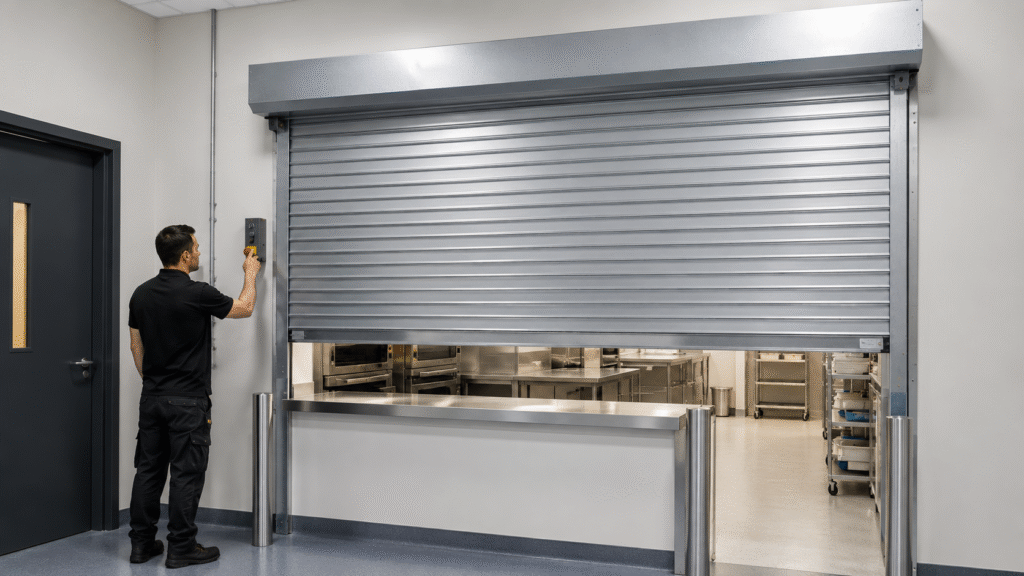
A fire shutter can sit open, untouched, for years, and is then expected to close reliably at the one moment it really matters. That is why fire shutter servicing is not optional paperwork. In England and Wales, the law requires the person responsible for a building’s fire safety to keep fire safety equipment and devices maintained in efficient working order and good repair, and Scotland and Northern Ireland have similar duties. This guide explains who is responsible, how often a fire shutter should be serviced, what a proper service involves, what you can check yourself between visits and what to do if a shutter fails.
We are Sunrise Shopfronts & Shutters, based in West Bromwich with our own West Midlands workshop and over 15 years of work on commercial shutters. We survey, specify, manufacture and install fire shutters for suitable commercial openings, and we can review maintenance and support for an installed fire shutter once we have the product and site details.
Key takeaways
- The responsible person (usually the employer, owner, landlord or whoever controls the premises) must keep fire safety devices, including fire shutters, maintained in efficient working order and good repair.
- Service frequency comes from the manufacturer’s instructions and your fire risk assessment. Many manufacturers recommend at least one service a year, and busy or harsh sites may need more.
- A real service tests that the shutter closes as designed, including any link to the fire alarm, not just that it opens and closes on the switch.
- Between services, keep the closing zone clear, never prop or wedge the shutter, and report damage straight away.
- Keep every record. Service reports, defects and repairs show that the duty is being met.
In this guide
- What a fire shutter does
- What the law requires
- Who is responsible
- How often a fire shutter should be serviced
- What a fire shutter service involves
- How fire shutters close, and why it matters for testing
- Common faults found at a service
- What you can check between services
- Keeping records
- If a fire shutter is damaged or fails
- Choosing who services your fire shutter
- Where fire shutters are found
- Preparing for a service visit
- Frequently asked questions
What a fire shutter does
A fire shutter is a roller shutter designed and tested to resist the passage of fire for a set period when closed. It is used where an opening has to stay open for everyday work, such as a kitchen servery, a counter, a conveyor opening or a doorway in a warehouse compartment wall, but must close to protect the rest of the building in a fire.
Fire shutters are part of a building’s compartmentation: dividing a building into fire-resisting sections so that a fire is held where it starts for long enough for people to escape and for firefighters to work. The shutter’s fire resistance is proven by testing to standards such as BS 476 or BS EN 1634-1, and the shutter has to be installed in a suitable wall and opening for that performance to apply. Building regulations guidance in England, Approved Document B, sets out how openings in compartment walls should be protected.
The critical point is that a fire shutter only protects the building if it closes when it should. Unlike a fire door that is closed every day, a fire shutter is normally open, so a fault can stay hidden until a test or a real fire. Our earlier article, fire shutters in the West Midlands: where they matter most, explains where they are used and why.

What the law requires
England and Wales: the Regulatory Reform (Fire Safety) Order 2005
The Fire Safety Order applies to almost all non-domestic premises in England and Wales, including workplaces, shops, warehouses and the common parts of blocks of flats. Article 17 of the Order requires the responsible person, where necessary to protect relevant persons, to ensure that the premises and the facilities, equipment and devices provided are “subject to a suitable system of maintenance and are maintained in an efficient state, in efficient working order and in good repair”. A fire shutter that forms part of the building’s fire protection falls within that duty.
The responsible person must also carry out and regularly review a fire risk assessment. Government guidance on fire risk assessments says you must keep a written record of your fire risk assessment. If the building relies on a fire shutter, the assessment should identify it and the maintenance it needs.
Scotland and Northern Ireland
In Scotland, duties come from the Fire (Scotland) Act 2005 and related regulations. In Northern Ireland, the Fire Safety Regulations (Northern Ireland) 2010 apply. The wording differs, but both expect fire safety measures to be maintained. If your premises are outside England and Wales, check the guidance that applies there.
| Nation | Main law | Key duty for fire shutters |
|---|---|---|
| England and Wales | Regulatory Reform (Fire Safety) Order 2005 | Responsible person keeps fire safety devices maintained in efficient working order and good repair (Article 17) |
| Scotland | Fire (Scotland) Act 2005 and related regulations | Duty holders maintain fire safety measures |
| Northern Ireland | Fire Safety Regulations (Northern Ireland) 2010 | Appropriate persons maintain fire safety measures |
This article is general guidance, not legal advice. Your fire risk assessor, fire engineer and the shutter manufacturer’s instructions should guide decisions for your building.
Who is responsible
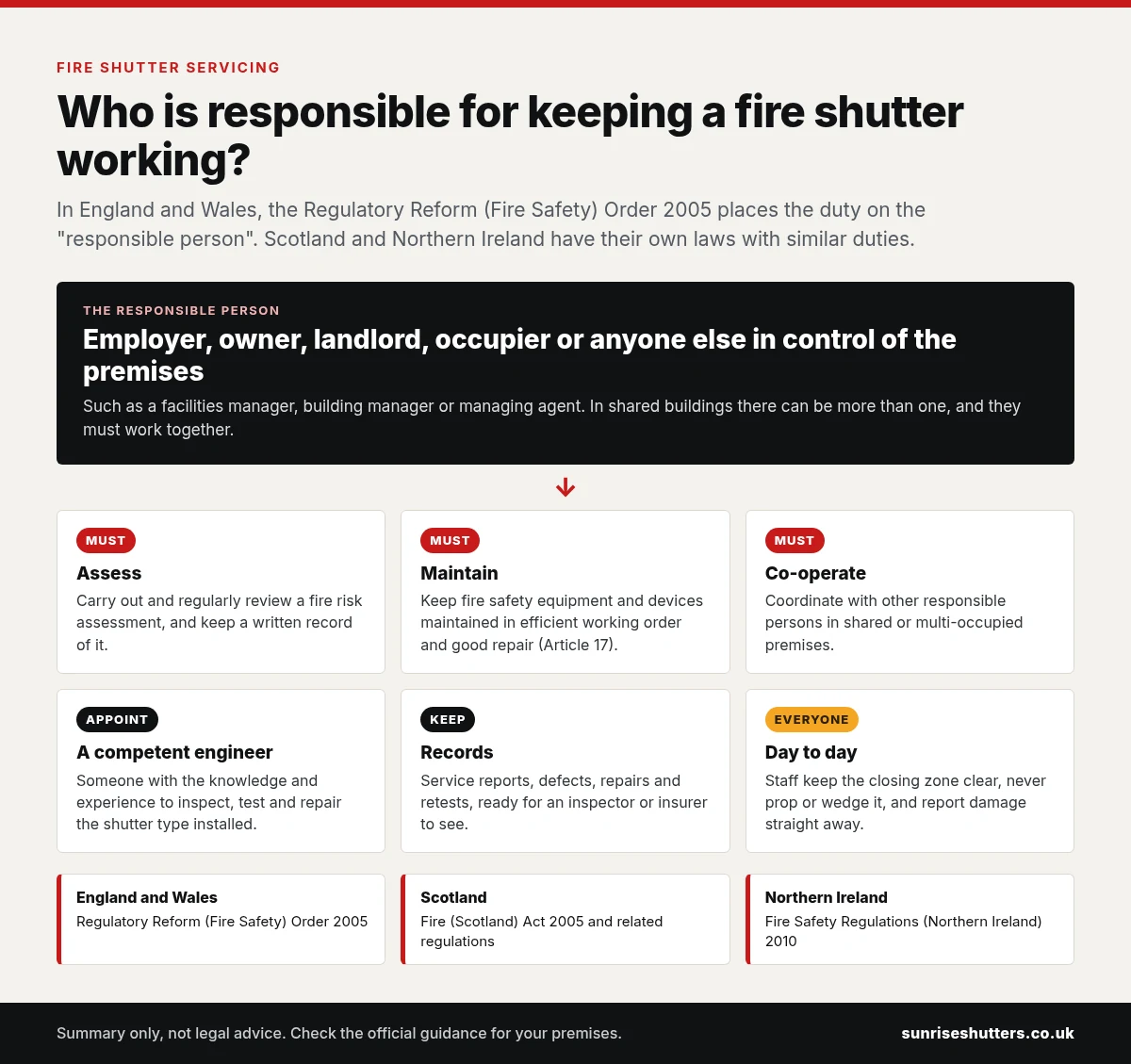
Article 3 of the Fire Safety Order defines the responsible person. In a workplace, it is the employer, if the workplace is under their control. Otherwise it is the person who has control of the premises, or the owner. Government guidance lists the employer, the owner, the landlord, an occupier, or anyone else with control of the premises, such as a facilities manager, building manager or managing agent.
In multi-occupied buildings there can be several responsible persons, and they must co-operate. A typical example is a fire shutter that separates a ground-floor takeaway from the common stair of flats above. The tenant, the landlord and the managing agent all need to be clear about who arranges servicing, who keeps the records and who pays. If nobody owns the task, the shutter tends to be forgotten. It is worth writing down who does what, ideally in the lease or a maintenance agreement.

How often a fire shutter should be serviced
There is no single legal interval written into the Fire Safety Order. Instead, the frequency comes from three sources:
- The manufacturer’s instructions. Many manufacturers recommend that fire shutters are serviced and tested by a competent person at least once a year, and some recommend more frequent checks.
- Your fire risk assessment. The assessor may recommend a specific interval or additional checks based on the risk.
- How the shutter is used and where it is. A shutter on a busy kitchen servery that is opened and closed every day, or one in a dusty, damp or greasy environment, will usually need more attention than one in a clean, quiet corridor.
| Factor | Why it matters | Effect on service frequency |
|---|---|---|
| Manufacturer’s instructions | Set the minimum maintenance for the product and its approvals | Follow as a minimum |
| Fire risk assessment findings | May identify the shutter as critical to escape or compartmentation | Can require more frequent checks |
| Daily use | Shutters used every day wear faster, especially motors, guides and bottom rails | Often more frequent |
| Environment | Grease, dust, damp and heat affect closing mechanisms and controls | Often more frequent |
| Impact risk | Forklifts, trolleys and deliveries can distort guides and curtains | More frequent visual checks |
| Previous faults | Repeat faults suggest underlying wear | Shorter intervals until resolved |
If you do not know when your shutter was last serviced, treat it as overdue. Book an inspection and test, and set a schedule from there.
Fire shutter due a check, damaged or behaving oddly?
Send us the make, model and location of the shutter and any previous service records, and we will review what it needs and the support we can provide.
What a fire shutter service involves
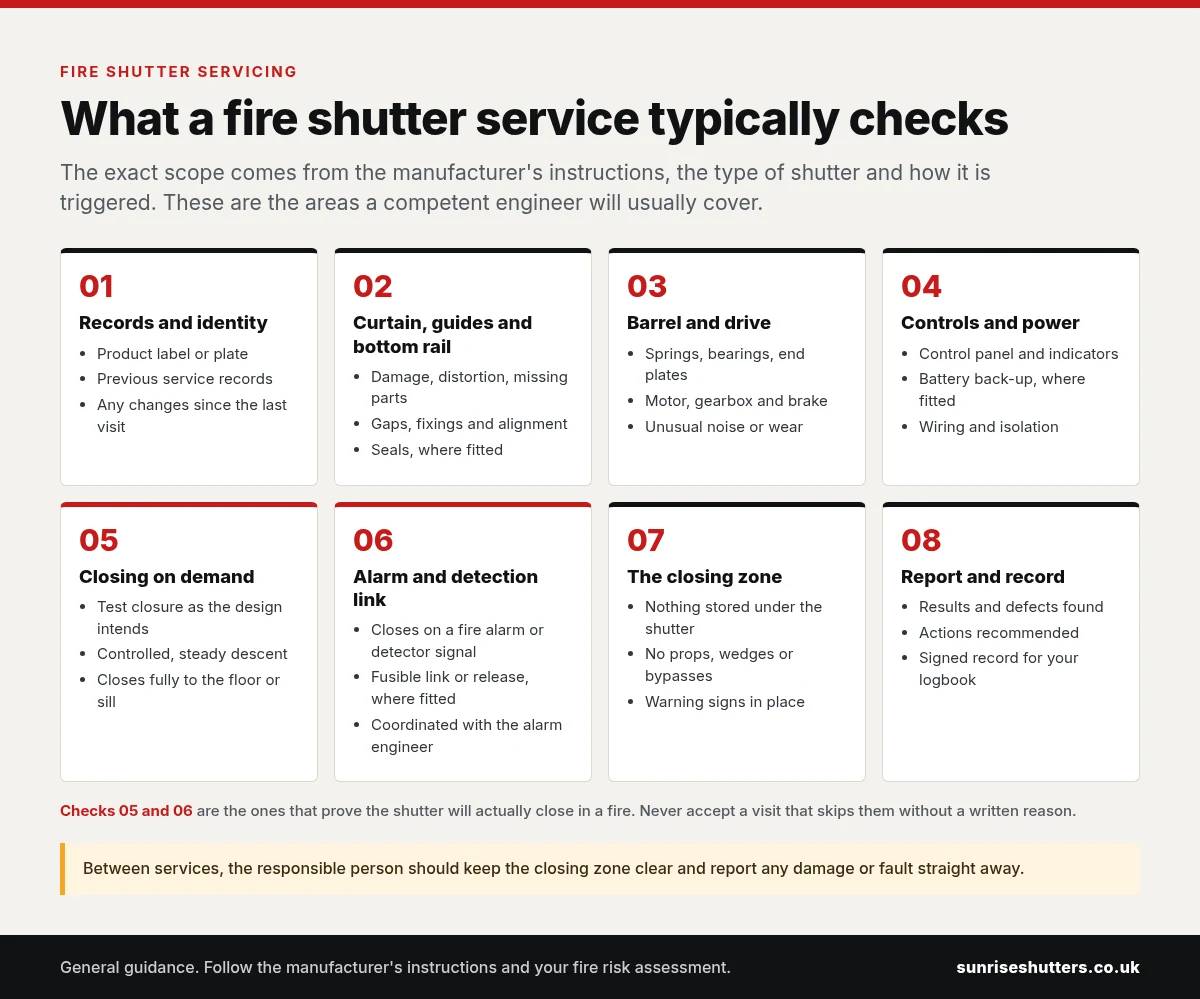
A proper fire shutter service is more than opening and closing the shutter on its switch. It should show that the shutter will close as designed when the fire alarm or detection system tells it to, or when power is lost if that is how it is designed to work. The detail depends on the product and the manufacturer’s instructions, but a service typically includes:
Identification and records
The engineer identifies the shutter, ideally from its label or plate, and reviews previous service reports. Changes since the last visit matter: building work around the opening, new services run through the wall above, a changed alarm system, or new stock racking nearby can all affect the shutter.
Curtain, guides and bottom rail
The curtain is checked for damage, distortion and missing components, and the guides for alignment, secure fixing and impact damage. The bottom rail must be able to come down fully to the floor or sill. Any seals or intumescent materials fitted as part of the product are checked for condition.
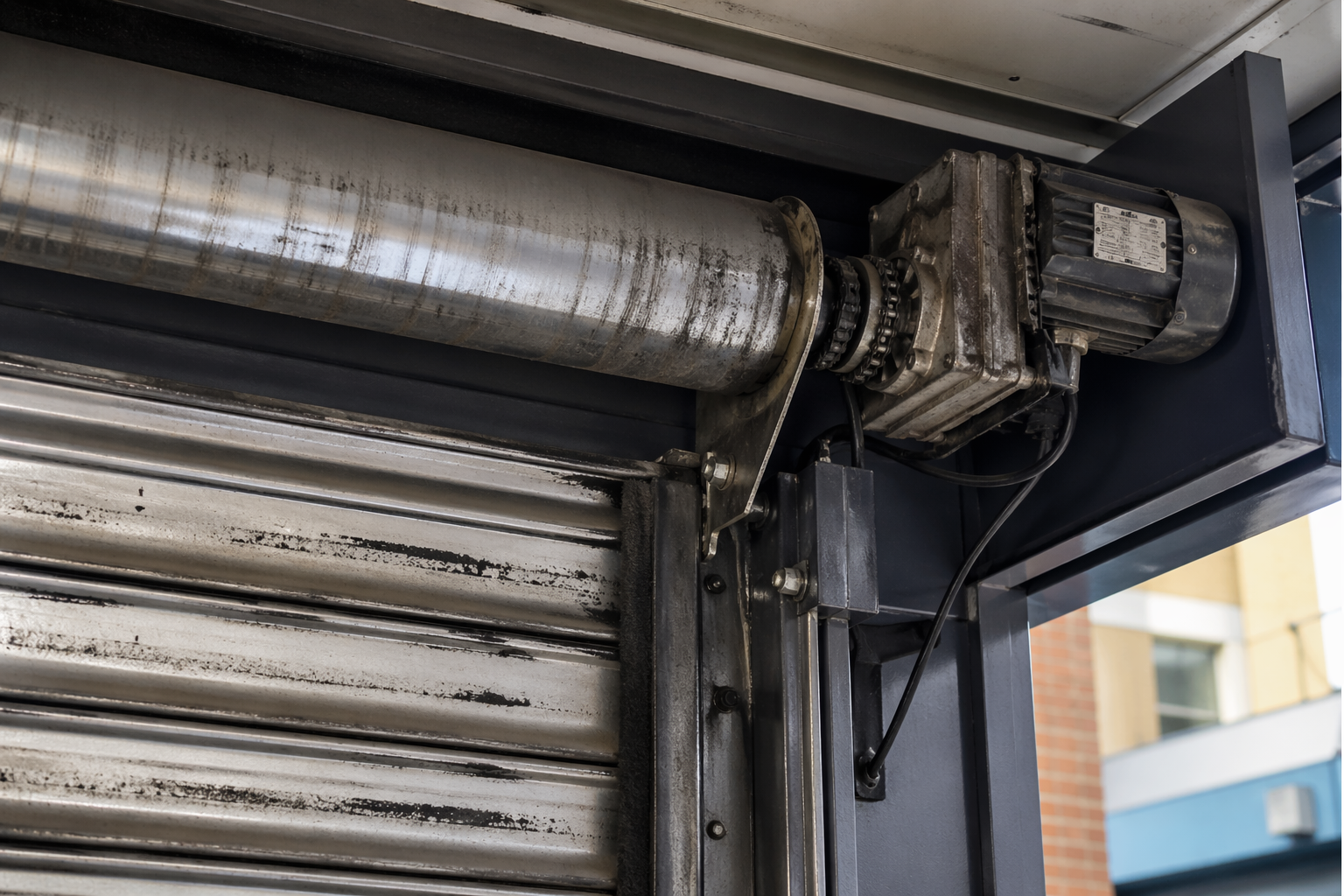
Barrel, springs and drive
The barrel, bearings, end plates, springs, motor, gearbox and brake are inspected for wear, noise and correct adjustment. A worn or poorly adjusted drive can stop a shutter closing fully or make it close too fast.
Controls, power and back-up
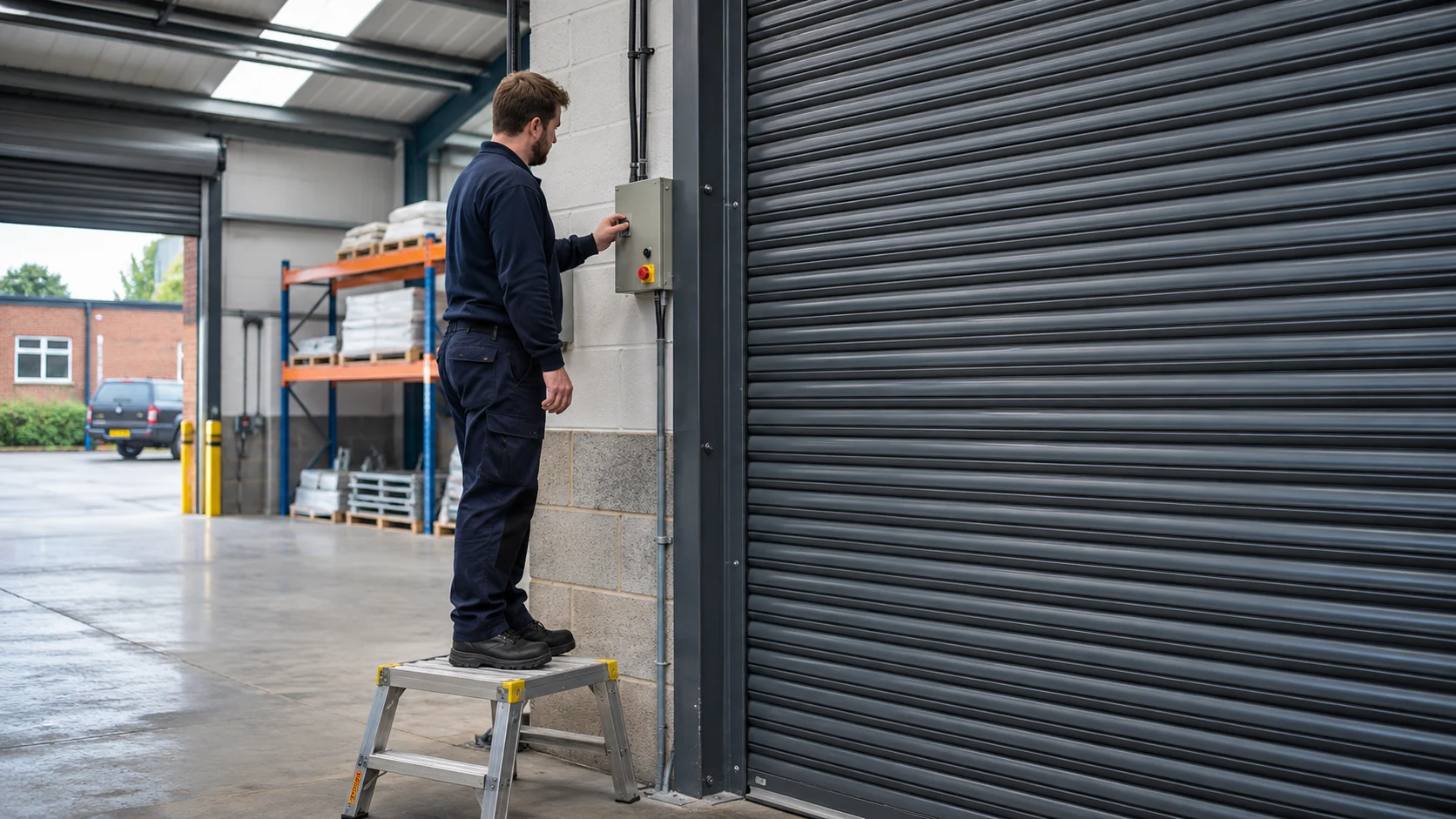
Control panels, indicators, switches, wiring and isolation are checked. Where the shutter relies on battery back-up to close if the mains fails, the batteries and charging are checked, because batteries deteriorate with age.
Closing on demand
This is the heart of the service. The shutter is tested to show it closes as the design intends, at a controlled speed, all the way down. Depending on the design, this may involve simulating a fire alarm signal, a detector, a power failure or the release of a fusible link.
Alarm and detection link
Where the shutter is linked to the fire alarm, the test should show that an alarm signal actually triggers closure. This often needs coordination with whoever maintains the fire alarm, so plan the visit together where you can.
The closing zone and signage
The area beneath and around the shutter must be kept clear so nothing stops it closing. The engineer checks for stock, bins, furniture or equipment in the way, and for any props, wedges or bypassed controls. Signs should warn people not to obstruct the shutter.
Report and record
You should receive a written report listing what was checked and tested, the results, any defects found and the action recommended, with the date and the engineer’s details. Keep it with your fire safety records.
How fire shutters close, and why it matters for testing
Fire shutters close in different ways, and the testing has to match the design. Common arrangements include:
| How it closes | How it typically works | What the test needs to show |
|---|---|---|
| Alarm-linked | Closes when the fire alarm or a local detector sends a signal | An alarm signal really does trigger closure |
| Fail-safe on power loss | Closes when power is removed, using gravity, springs or a governed descent | The shutter closes safely and fully without mains power |
| Battery back-up | A back-up supply powers closing if the mains fails | The batteries hold enough charge to close the shutter |
| Fusible link | A heat-sensitive link releases the shutter at a set temperature | The release mechanism is free and correctly set |
Many shutters combine more than one of these. Check what your shutter is designed to do, and make sure the service tests it. A shutter that has only been opened and closed on its normal switch has not been tested as a fire shutter.
Common faults found at a service
| What you might notice | Possible cause | Why it matters |
|---|---|---|
| Shutter stops short of the floor | Obstruction, damaged bottom rail or guides, worn drive | A gap at the bottom defeats the purpose of the shutter |
| Slams down or closes very fast | Worn or poorly adjusted governor, brake or springs | Risk to people underneath and damage to the shutter |
| Does not close on alarm test | Fault in the alarm interface, controls or release | The shutter would not close in a real fire |
| Panel shows a fault or battery warning | Ageing batteries, wiring or control faults | Back-up closing may not work in a power cut |
| Scraping, grinding or new noises | Impact damage, misalignment, wear | Can lead to the shutter jamming |
| Dented curtain or bent guides | Impact from vehicles, trolleys or stock | May stop it closing or affect fire performance |
| Shutter propped or switched off | People trying to stop it closing during work | The shutter cannot do its job |
Many of these faults are similar to those on ordinary shutters; our guides to why a roller shutter won’t close and signs a shutter motor needs upgrading explain the mechanics. On a fire shutter, though, any repair must keep the product working as designed, so use parts and methods the manufacturer approves. Our upcoming guide to roller shutter parts explains what each component does.
★★★★★
“We’re really happy with the service from Sunrise Shopfronts! They always do a fantastic job and fixed our shutter very quickly. Their service is reliable, efficient, and professional. We really appreciate their quick response and excellent workmanship. Highly recommend Sunrise Shopfronts to anyone looking for a reliable and trustworthy service!”
Paramjot Dhaliwal, Google review
What you can check between services
The responsible person and staff can carry out simple visual checks between professional services. They do not replace a service, but they catch problems early. Typical checks are:
- ☐ The closing zone is clear: no stock, bins, chairs or equipment under or near the shutter
- ☐ Nothing is propped or wedged, and no controls have been switched off or bypassed
- ☐ No visible damage to the curtain, guides or bottom rail
- ☐ The control panel shows no fault or battery warnings
- ☐ Warning signs are in place and readable
- ☐ Any changes near the opening have been reported to the responsible person
Our simple monthly shutter maintenance checklist can be adapted for this. Do not carry out drop tests or adjust springs or brakes yourself; testing a fire shutter’s closing should be done by a competent person following the manufacturer’s procedure. Our upcoming roller shutter servicing guide covers servicing for ordinary shutters.

Keeping records
Good records show that the duty to maintain is being met, help engineers spot repeat faults, and are often the first thing an enforcing authority or insurer will ask for. Keep, for each fire shutter:
- its location, product and any reference on the label;
- installation and handover information, including the manufacturer’s instructions;
- every service report, with the date, results and engineer;
- defects found and when and how they were fixed;
- the results of retesting after any repair;
- notes of any changes to the alarm system or the opening.
Store them with your fire risk assessment and other fire safety records, and make sure the people who need them can find them, including after a change of tenant or managing agent.

Common mistakes that leave fire shutters unmaintained
- Assuming someone else has it covered. In shared buildings, the tenant may think the landlord services the shutter and the landlord may think the tenant does.
- Servicing the shutter but not testing the alarm link. The shutter works on its switch but never closes on a real alarm signal.
- Losing the paperwork. Reports go with a previous manager or tenant, and nobody knows when the shutter was last tested.
- Living with a known fault. A shutter switched off “temporarily” because it kept dropping during service hours can stay off for months.
- Forgetting the shutter after building work. New ceilings, ducts, racking or alarm changes near the opening can stop the shutter working as designed.
If a fire shutter is damaged or fails
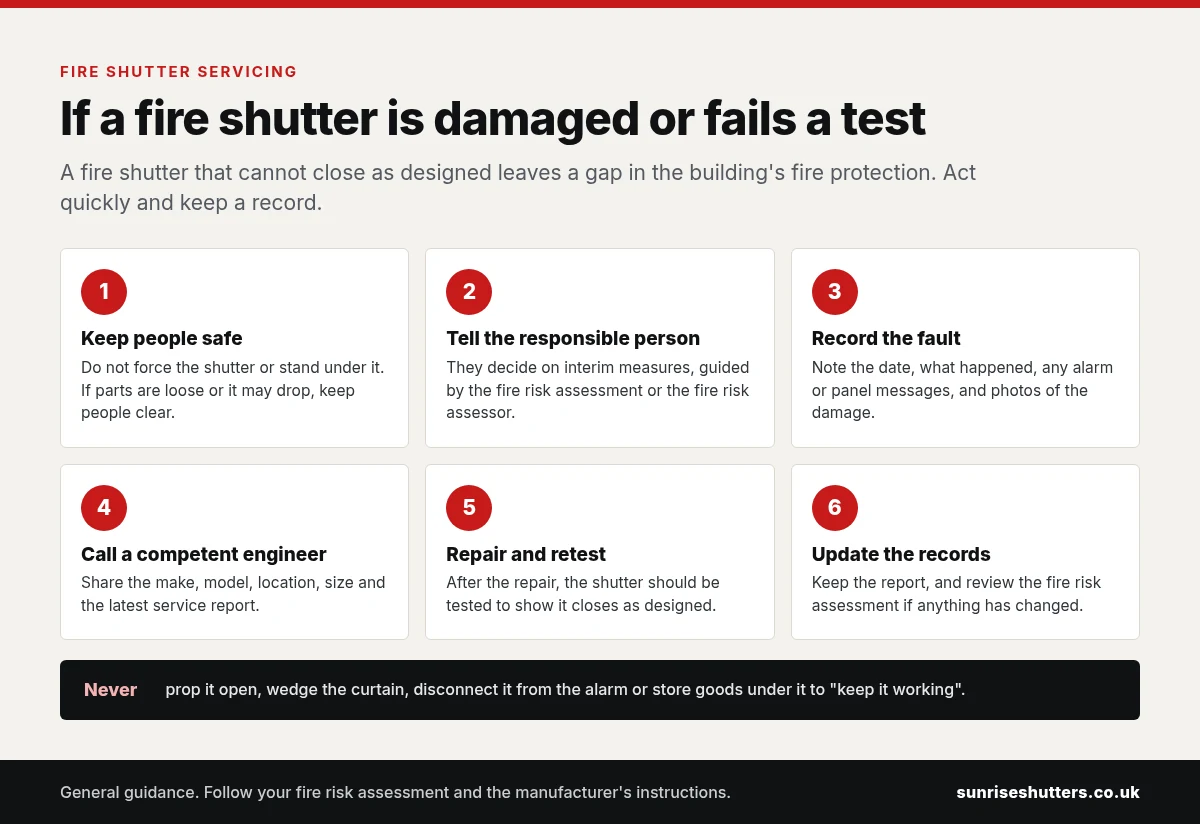
A fire shutter that cannot close as designed leaves a gap in the building’s fire protection. The responsible person should decide on interim measures, guided by the fire risk assessment or the fire risk assessor, while a repair is arranged. Never be tempted to prop the shutter open, wedge the curtain, disconnect it from the alarm or store goods under it to keep the opening usable. That only hides the problem.
If the shutter is stuck, has dropped onto something or someone, or is hanging unevenly, keep people clear and do not try to force it. For urgent shutter problems, our emergency shutter repair line is answered 24/7, 365 days a year. Tell us the shutter is a fire shutter, and give the make, model and location if you can, so we can review what it needs and the support we can provide.
Shutter stuck, damaged or leaving you insecure?
Our emergency line is answered 24 hours a day, 365 days a year, and we usually have an engineer with you within 2 hours to make the opening safe and plan the right repair.
★★★★★
“It’s rare to find a company that offers this level of service, especially at a weekend. Communication was clear, the work was top quality, and I felt looked after from the first phone call to the end of the visit. I wouldn’t hesitate to recommend them to anyone needing shutter repairs, and they’ll be my first call if I ever need help again. Thank you to Joe and the whole team!”
Kam Kang, Google review
Choosing who services your fire shutter
Fire shutters should be serviced by a competent person: someone with the training, knowledge and experience to inspect, test and repair that type of shutter, following the manufacturer’s instructions. When choosing a service provider, ask:
- What experience do you have with this type and make of fire shutter?
- Will you test closing on alarm signal and on power loss, as the design requires?
- Will you coordinate with our fire alarm engineer where needed?
- Will repairs use parts and methods approved for the product?
- What will the written report include?
- Do you hold any third-party certification for fire shutter work?
Our maintenance and repairs service covers planned maintenance for commercial shutters, and our roller shutter repairs team handles faults. For a fire shutter, contact us with the product and site details so the maintenance requirements and the appropriate support can be reviewed before a visit. For wider safety duties on powered shutters, see our guide to roller shutter safety regulations.

Where fire shutters are found
Commercial kitchens and serveries
Fire shutters are used over serveries and hatches between kitchens and dining or public areas. Grease and heat mean these shutters often need more frequent cleaning and checking, and the closing zone is easily obstructed by trays and equipment.
Warehouses and industrial buildings
Larger fire shutters protect openings in compartment walls, conveyor openings and loading areas. Impact from forklifts and pallets is a common cause of damage. See our industrial roller shutters page and our upcoming guide to warehouse roller shutter doors.
Mixed-use buildings
Shops and takeaways with flats above may use fire shutters to separate the commercial unit from shared escape routes. These are often the shutters where responsibility is least clear, so agree it in writing.
Counters and reception areas
Counter shutters in schools, offices and public buildings can be fire-rated where they form part of a fire-resisting wall. They are opened every day, so wear is a factor.

Fire shutters, fire curtains and fire doors
Fire curtains are fabric barriers that drop from a box above an opening, and are designed and tested to their own standards, including BS 8524. Fire doors are hinged or sliding doorsets. Each has its own maintenance requirements, so a service provider for one is not automatically right for the others. Check what the manufacturer specifies for each product.
Preparing for a service visit
A little preparation makes the visit quicker and the test more meaningful:
- ☐ Location and access: where each shutter is and how the engineer reaches the barrel and controls
- ☐ Product details: photos of the label, the make and model if known
- ☐ Previous reports and any outstanding defects
- ☐ Alarm coordination: agree with your alarm engineer how a closure on alarm will be tested
- ☐ Clear the area under and around the shutter
- ☐ Warn staff and occupants that the shutter, and possibly the alarm, will be tested
We work across Birmingham and the West Midlands, with priority response in that area, and across the UK; see the areas we cover. To talk about a fire shutter, send us the details.
Frequently asked questions
Is fire shutter servicing a legal requirement?
In England and Wales, the Fire Safety Order requires the responsible person to keep fire safety equipment and devices maintained in efficient working order and good repair. Regular servicing by a competent person is how most responsible persons meet that duty for fire shutters. Scotland and Northern Ireland have similar duties.
How often should a fire shutter be serviced?
Follow the manufacturer’s instructions and your fire risk assessment. Many manufacturers recommend at least once a year, and shutters in busy or harsh environments may need more frequent checks.
Who pays for fire shutter servicing in a rented building?
It depends on the lease and who has control of the premises. The tenant, landlord and managing agent should agree who arranges and pays for servicing, and write it down.
Can I test a fire shutter myself?
You can carry out visual checks and keep the closing zone clear. Testing the closing mechanism, adjusting springs or brakes, and testing the alarm link should be done by a competent person.
What happens if a fire shutter fails its service?
The engineer should record the defect and recommend action. The responsible person should arrange the repair promptly, decide on interim measures guided by the fire risk assessment, and make sure the shutter is retested afterwards.
Can any shutter engineer service a fire shutter?
The engineer should be competent for that type of fire shutter and follow the manufacturer’s instructions, using approved parts for repairs.
Does a fire shutter need to be linked to the fire alarm?
That depends on the building’s fire strategy and the shutter’s design. Many are, so that they close when the alarm sounds. If yours is linked, the link should be tested at the service.
Can Sunrise service my fire shutter?
Contact us with the product and site details. We will review the maintenance requirements and the support we can provide.
Need a shutter looked at?
Tell us what the shutter is doing and, if you can, send a photo. We will explain the likely next step before any work starts, and we will always tell you plainly whether repair or replacement makes more sense.
- Emergency repair line (24/7): 07931 104160
- Installation and service line: 07931 104162
