
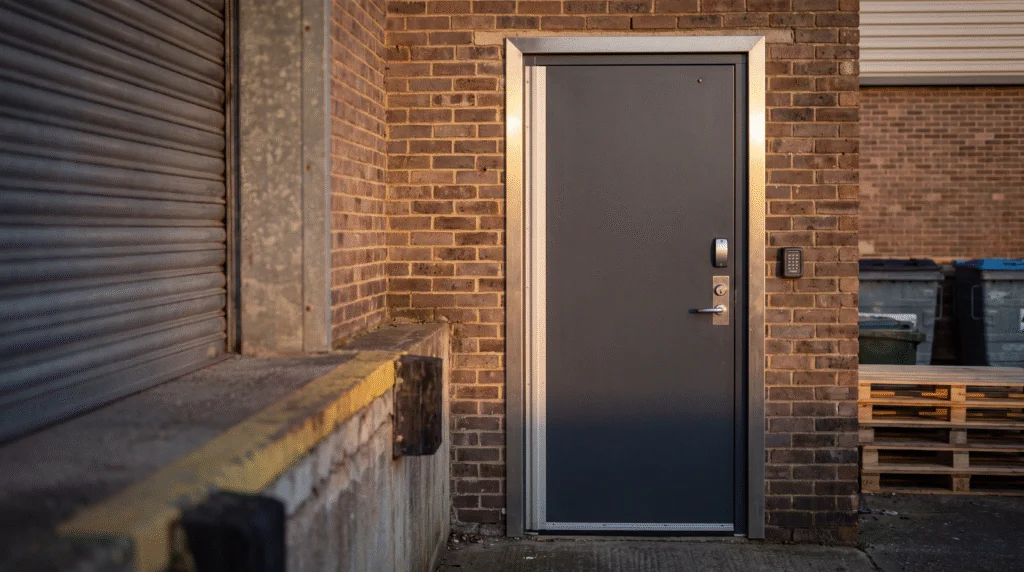
Steel security doors protect the back of house, the loading bay and the side entrance, the places a shutter does not always cover. Choosing the right one takes more than picking a size and a colour. A door that looks solid but lacks the right specification can fail the first time it is tested, by an intruder, an insurer or an inspector.
This guide covers what to specify before you buy steel security doors for commercial premises. Work through it before you request a quote, and you will compare suppliers on the same terms.
Start with what the door needs to protect
Every good specification begins with the risk. A stockroom full of high-value goods needs more than a staff entrance that leads to a corridor. Think about what sits behind the door, how often people use it, and who might try to get through it.
Next, consider how the door will be used day to day. A door that opens fifty times a day needs hardware that copes with that load. A door that opens twice a week needs to resist tampering after long periods of disuse. Write both answers down first, because they shape every decision that follows.
Ask what standard the door is tested to
Security claims mean little without independent testing. Ask every supplier which test standard the door meets and request the certificate. Common benchmarks in the UK include PAS 24 for doorsets and LPS 1175 for security-rated products. Higher ratings mean the door resists attack for longer and against more serious tools.
Your insurer may also set a minimum. Many commercial policies state the level of protection they expect on certain openings. Check this before you buy, not after the door goes in. A door that falls short of the policy wording can cause problems at the worst possible moment, which is when you make a claim.
Look closely at the lock and hardware
A strong steel leaf is only as secure as the locking system holding it shut. Ask how many locking points the door has and where they sit. Multi-point locking spreads the load across the frame, which makes the door much harder to force.
Hinges deserve attention too. Intruders often target the hinge side, so ask whether the hinges are protected against removal. Consider the lock cylinder as well. A weak cylinder can undo the good work of a strong door, so check that it resists common attack methods.
Think about access control at this stage. If you plan to add a keypad, card reader or fob system, tell your supplier now. Fitting this later is harder and sometimes affects the warranty.
Get the size and fit right
Standard sizes rarely match real openings. Brickwork moves, frames settle and older buildings often have openings that are not quite square. A door forced into the wrong space leaves gaps, and gaps are weak points.
This is where made to order manufacture earns its place. We build every door to the measured opening, following a proper site survey. That approach keeps the frame tight and the door true, so it closes cleanly year after year. Ask any supplier you consider whether they survey the opening before they quote, or work from the dimensions you supply.
Check fire safety and escape requirements
Security and fire safety sometimes pull in opposite directions. A door that is hard to break into must still be easy to leave in an emergency. If the door sits on an escape route, it needs the right release hardware, and it may need to meet fire-resistance requirements too.
Speak to your fire risk assessor before you finalise the specification. They can confirm what the opening needs and what it must not do. Telling your supplier early avoids expensive changes later.
Think about finish and appearance
A steel door does not have to look industrial. Ask about the finish options and what each one means for durability. A good coating protects the steel from rust and wear, especially on doors that face the weather or sit in a busy yard.
Appearance matters most on doors that customers or visitors can see. A neat, well-finished door signals that you look after the premises. That impression counts, even on a side entrance.
Plan for installation and aftercare
The best specification can still let you down if the installation is poor. Ask who fits the door, how long the work takes, and what the process looks like on the day. A supplier who manufactures and installs in-house keeps responsibility in one place, which makes problems easier to resolve.
Aftercare matters too. Doors take knocks, locks wear and hinges need attention over time. Ask what maintenance support the supplier offers and what happens if the door fails out of hours. We offer 24/7 emergency repair, because a damaged security door cannot wait until Monday morning.
A short list of questions to ask before you buy
Before you accept a quote, make sure you can answer these questions. What standard is the door tested to, and can I see the certificate? Does the specification meet my insurer’s requirements? How many locking points does it have? Will someone survey the opening before manufacture? Does the door meet fire and escape requirements? What finish does it come with? Who installs it, and who repairs it if it fails?
If a supplier cannot answer these clearly, keep looking. Clear answers show a supplier who understands the product and stands behind it.
FAQ
What should I specify when buying a steel security door? Specify the test standard, the locking system, the size and fit, the fire and escape requirements, the finish, and the installation and aftercare terms. Match each one to the risk the door must manage.
Do I need a certified security door for insurance? It depends on your policy. Some insurers set minimum security ratings for certain openings. Check your policy wording or ask your broker before you buy.
Why does a made to order door matter? Real openings are rarely perfectly standard. A door built to the surveyed opening fits tightly, closes cleanly and avoids the weak points that gaps create.
Can a security door also work as a fire exit? Sometimes, but it needs the right release hardware and must meet any fire requirements for the opening. Speak to your fire risk assessor before you specify it.