
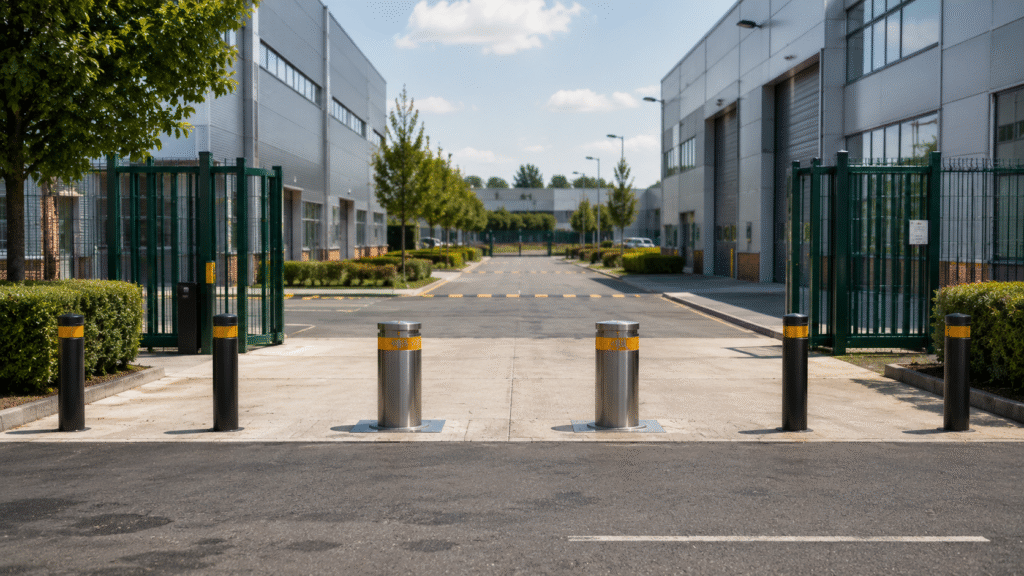
Choosing between retractable bollards and fixed bollards sounds simple until you look at how the site actually works. A car park, service yard, shopfront or private forecourt rarely needs only one thing. It usually needs security, safe access, clear pedestrian routes and a layout that does not slow the whole place down. That is why HSE treats site traffic control as a mix of physical measures, road layout, signs, signals, procedures and training, rather than a single product decision.
That wider view is also how Sunrise Shutters presents its access-control offer. On its bollards and gates pages, the company positions retractable bollards, fixed bollards, gates, barriers, intercoms and automation as connected solutions, not standalone add-ons. In practice, that is the right way to think about bollards. You are not just buying posts in the ground. You are deciding how vehicles should, or should not, move around your property.
The short answer
If your site needs authorised vehicle access at some times but not others, retractable bollards are usually the better fit. Sunrise explicitly describes them as ideal where access is needed periodically, for example a parking area that only opens briefly in the morning and evening.
If your site does not need vehicle access through a particular point, fixed bollards are usually the stronger and simpler choice. Sunrise’s own guidance says fixed bollards suit sites where access is not required, because they stop vehicle entry while still allowing pedestrian movement.
However, there is an important caveat. If your concern involves high-consequence security, such as hostile vehicle threats or a high-risk public-facing location, do not assume that any standard bollard will do. NPSA says hostile vehicle mitigation should be risk-based, and where the aim is countering vehicle-borne threats, rated vehicle security barriers that have undergone impact testing should be considered.
Start with the site, not the bollard
The best bollard choice usually becomes obvious once you answer a few operational questions. Who needs vehicle access, how often, at what times, and for what reason? A site that receives timed deliveries is very different from a shopfront that never wants a vehicle near the glazing, and both are different again from a private driveway that needs flexible resident access.
For businesses, HSE guidance is useful here because it frames access control around route planning, loading areas, entrances, road width, speed control and the separation of people and vehicles. In other words, bollards should support the traffic plan, not replace it. If a yard layout is already confusing or unsafe, installing the wrong bollards can simply make the same weaknesses more permanent.
A good access-control decision normally considers:
- whether vehicles should ever cross that point
- whether access is daily, occasional or emergency-only
- whether pedestrians use the same route
- whether deliveries, visitors or contractors need temporary entry
- whether the site needs a manual or automated solution
- whether appearance matters as much as security
Those questions matter for homeowners as well. A private drive with two authorised vehicles and occasional visitors has very different needs from a shared forecourt or a business unit with courier traffic throughout the day.
When retractable bollards make more sense
Car parks and forecourts with controlled entry
Retractable bollards work best where you want a route to be open sometimes and closed the rest of the time. That is why they suit car parks, private forecourts, service roads and access points that operate on a timetable. Sunrise’s own bollard page makes this point clearly, describing retractable bollards as an effective option where access only needs to be opened periodically.
This makes them especially useful for:
- staff car parks that open at set hours
- private drives with occasional authorised visitors
- retail forecourts that need short delivery windows
- shared courtyards that require controlled access
- service roads that should stay closed outside working hours
In these settings, a permanent barrier would create too much friction. A retractable option gives you control without sacrificing legitimate access.
Sites that need flexibility, not total exclusion
Some sites do not want to ban vehicles completely. They want to decide which vehicles get in and when. That is a crucial difference. A service yard, for example, may need vans at 7am, refuse access later in the day, and emergency access at all times.
This is where retractable bollards often outperform fixed bollards. They preserve operational flexibility while still creating a visible, physical access-control point. If the site also needs intercoms, barriers or automation, Sunrise already offers those wider access-control elements, which makes retractable bollards easier to integrate into a joined-up entrance system.
Homes and private premises
For homeowners, retractable bollards can make sense on driveways where parking protection matters but daily convenience matters just as much. If unauthorised parking is the main problem, or if the property sits on a driveway where the owner still needs routine access, a retractable solution often feels more practical than a fixed one.
That said, simplicity still matters. If the bollard will be raised and lowered several times a day, ease of operation becomes part of the buying decision, not a small detail.
When fixed bollards are the smarter choice
Sites that should never allow vehicle access
If a route should stay closed to vehicles all the time, fixed bollards are usually the more sensible answer. They give constant protection without moving parts, and they remove the temptation to leave the entrance open “just for now”. Sunrise positions fixed bollards exactly this way, as the right option where vehicle access is not required at all.
This often applies to:
- pedestrian-only areas
- shopfronts that front directly onto the pavement
- frontage protection outside glazing
- building corners vulnerable to vehicle strike
- private land where pedestrian access is fine but vehicle entry is not
In these situations, permanence is a strength. The message stays clear every hour of the day.
Shopfront protection and frontage security
Fixed bollards are often the better fit when the real priority is protecting the building line rather than managing vehicle permissions. Sunrise’s bollard page specifically links bollards with protection against unauthorised vehicle access and ram-raid style attacks on retail outlets and other business premises.
For this type of frontage protection, a fixed arrangement often makes more sense because there is no operational benefit in dropping the barrier. The whole point is to keep the vulnerable line protected at all times. Consequently, fixed bollards often suit convenience stores, jewellers, pharmacies, high street retail units and glazed frontages better than retractable ones, unless deliveries must cross that exact point.
Lower-complexity, lower-maintenance sites
Fixed bollards are also attractive because they are simpler. There are fewer operational steps, fewer moving parts and fewer opportunities for user error. Therefore, if the site does not genuinely need flexible vehicle access, a fixed solution often wins on practicality alone.
That matters for both businesses and homeowners. Sometimes the “best” access-control product is simply the one that fits the site without adding unnecessary complexity.
The mistake many sites make
The most common mistake is choosing bollards before the traffic plan is clear. HSE’s guidance on safe workplaces is useful here because it stresses route planning, adequate entrance width, safe loading areas, clear signposting, one-way systems where possible, and suitable speed reduction measures including bollards where needed. In other words, bollards should fit the movement strategy, not substitute for one.
Another frequent mistake is forgetting pedestrian movement. Government bollard-design guidance says a bollard scheme needs to balance operational and security requirements, and it specifically considers route capacity, comfort, convenience and conflict for pedestrians. That is a strong reminder that “more bollards” is not automatically “better access control”. If the spacing, layout or location feels wrong, the site may become awkward for the people who actually use it every day.
Not all bollards deliver the same level of security
This point matters more than most buyers realise. There is a big difference between a bollard installed for routine access control and a barrier selected for serious vehicle attack resistance. NPSA says hostile vehicle mitigation is a risk-based security discipline, and where the purpose is to counter vehicle-borne threats, the relevant barrier should be one that has undergone formal vehicle impact testing.
That does not mean every shopfront or private drive needs a high-security tested barrier. Most do not. However, it does mean buyers should be clear about the job. If the requirement is everyday access control, parking control or low-speed perimeter discipline, standard retractable or fixed bollards may be entirely appropriate. If the requirement is high-consequence perimeter protection, the conversation changes and the specification needs to follow the risk.
Practical examples
Here is the simplest way to think about it in real life.
Choose retractable bollards if:
- you need timed vehicle access to a yard or forecourt
- authorised users need regular entry
- a private drive needs both protection and everyday usability
- the site may later need intercoms, barriers or automation
- flexibility is just as important as security
Choose fixed bollards if:
- the route should never admit vehicles
- the goal is constant frontage protection
- you want a lower-maintenance solution
- the area is pedestrian-first by design
- shopfront or glazing protection matters more than access flexibility
Questions to ask before you buy
Before you specify either option, ask these questions:
- Do vehicles ever need to cross this line?
- If yes, who authorises that access?
- Is access daily, occasional or emergency-only?
- Could fixed bollards interfere with deliveries or servicing?
- Could retractable bollards be left down too often?
- Do pedestrians need a cleaner, easier route through the same area?
- Is the main risk parking abuse, accidental impact, ram-raid style attack, or something higher consequence?
Those questions usually narrow the answer quickly. They also help avoid overspending on flexibility you do not need, or under-specifying a site that needs more protection than a basic bollard can offer.
Final thoughts
So, which is right for your site’s access control? Retractable bollards are usually the better answer where vehicle access must stay possible, but controlled. Fixed bollards are usually the better answer where vehicle access should be prevented altogether and permanent protection is the priority.
The strongest results come from looking at the whole entrance, not just the post itself. That is where Sunrise Shutters fits naturally into the conversation. Its Birmingham and West Midlands offer already connects retractable bollards, fixed bollards, gates, barriers, intercoms and automation, which is exactly the joined-up thinking most sites need when access control has to work in real life, not just on paper.